

Table of content
Your sales no longer match your dashboard? Your cost per acquisition is rising for no obvious reason? Or you simply wonder whether your site complies with the revised FADP? These three symptoms often share one cause: data collection that is no longer reliable. Here is why the reliability of your data has become your most valuable asset, and how a Geneva-based tracking agency can help you rebuild it.
In short
Browser restrictions, consent refusals and ad blockers shrink the share of journeys you actually see.
A first-party server-side setup makes measurement reliable and always respects the visitor's choice.
Our published case studies show the concrete effect on French-speaking Swiss sites (e-commerce, lead gen, a sensitive sector).
Clear packages, from CHF 1,200 excl. VAT for setup.
Why work with a specialised tracking agency in Geneva
Digital marketing has become more complex. Ten years ago, pasting a Google Analytics script into a WordPress site was enough to get decent data. Today, it is a trap.
Local expertise: the FADP and the Swiss market
Geneva is an international hub, but it is subject to Swiss law. The FADP sets rules close to the European GDPR without being identical: in Switzerland, Art. 45c of the Telecommunications Act requires information and a right to refuse cookies (opt-out), whereas the EU requires prior consent. An international agency or a generic SaaS tool does not always know these nuances, nor the role of the Federal Data Protection and Information Commissioner (FDPIC). Based in Geneva, we configure a CMP (Consent Management Platform) suited to your Swiss and European markets, and clear for your visitors.
Proximity for sensitive topics
Tracking touches two nerve centres: legality and profitability. Being able to meet your expert over coffee in Geneva or Lausanne, and discuss your data architecture in confidence, builds a trust that a distant platform cannot offer.
The "data first, ads second" approach
Many Geneva agencies excel at ad creative or bid management, but tracking is not their core job and is often rushed. Our positioning is clear: we do not manage your ads, we manage the data that drives your ads. If the data is wrong ("garbage in"), Google's and Meta's algorithms make bad decisions ("garbage out"). Working with a dedicated tracking agency gives your media agency the right signals.
The technical problem: why some of your conversions vanish
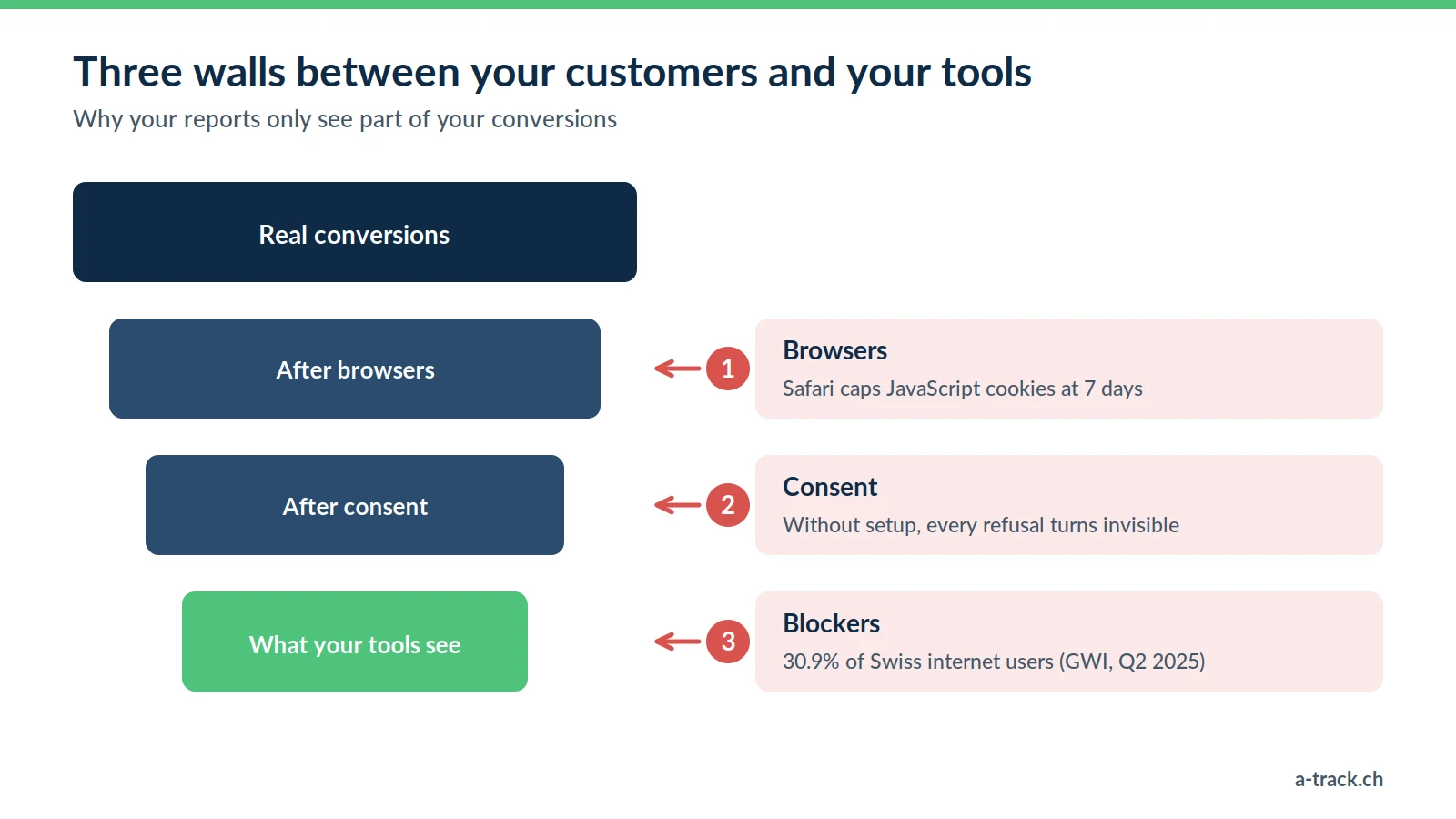
Traditional client-side tracking relies entirely on the visitor's browser. And that browser is an increasingly unreliable collection point.
Safari, ITP and ad blockers
With ITP (Intelligent Tracking Prevention), Safari caps JavaScript-set cookies at 7 days, and at 24 hours in some link-tracking cases. A visitor arrives on Monday via an ad, thinks it over and comes back to buy ten days later: their cookie is gone. The sale shows up as "direct" or "organic", you cut a campaign that worked, and sales drop. Then there are ad blockers: according to GWI (Q2 2025), 30.9% of Swiss internet users use one.
Note: contrary to what was long announced, Google gave up in April 2025 on removing third-party cookies from Chrome. The problem is therefore not Chrome, but Safari, blockers and consent.
Cookie refusals
Consent refusals are legitimate and must be respected. But if your setup is poorly configured, you also lose information you could lawfully measure, or you send data before the visitor has chosen. Consent Mode v2 lets Google model part of the unobserved conversions: according to Google (2021), more than 70% of ad-click-to-conversion journeys lost to cookie refusals are recovered on average.
A-Track's answer: server-side tracking
Instead of sending data straight from the browser to Google or Meta, we route it through an intermediate server that we configure for you, hosted in Switzerland or Europe. This server cleans the data, pseudonymises it where needed, then sends it to the platforms you have authorised.
First-party collection: the flow goes through your own subdomain (e.g.
metrics.your-site.ch), making it more resilient to technical restrictions.Longer-lived first-party cookies: set by your server, they help track long purchase journeys, provided the infrastructure is configured correctly.
Control over data: the IP address can be truncated or removed before anything is sent to Google or Meta.
What does not change: the visitor's choice is respected. A refusal stays a refusal, server or no server.
Our services: audit, server-side and consent
We have made technical excellence accessible: clear packages and annual maintenance built to last.
Audit and data governance
It often starts with an audit of your Google Tag Manager (GTM) and GA4. We regularly find outdated tags slowing down the site, data sent to the United States before any consent, or conversions counted twice. Our data governance advice cleans up this foundation, an essential step for international organisations based in Geneva.
Server-side tracking implementation
This is our core business: we deploy a server-side Google Tag Manager container.
Infrastructure: we manage server hosting, without tying up your IT team.
API connectors: Meta Conversions API (CAPI), Google Ads enhanced conversions, flows to TikTok or LinkedIn. These server-to-server connections are more robust.
Enrichment: we can pass margin or customer status from your CRM to your analytics tools, without exposing it in the site's source code.
Compliance and consent
Performing well does not mean breaking the law. We configure your CMP (Cookiebot, Axeptio, Didomi, etc.) so that it really controls when tags fire. Google has required Consent Mode v2 for European Economic Area data since March 2024, and for Switzerland since 31 July 2024: without it, your remarketing audiences empty out. Details in our Consent Mode v2 guide.
Client cases: measured results in French-speaking Switzerland
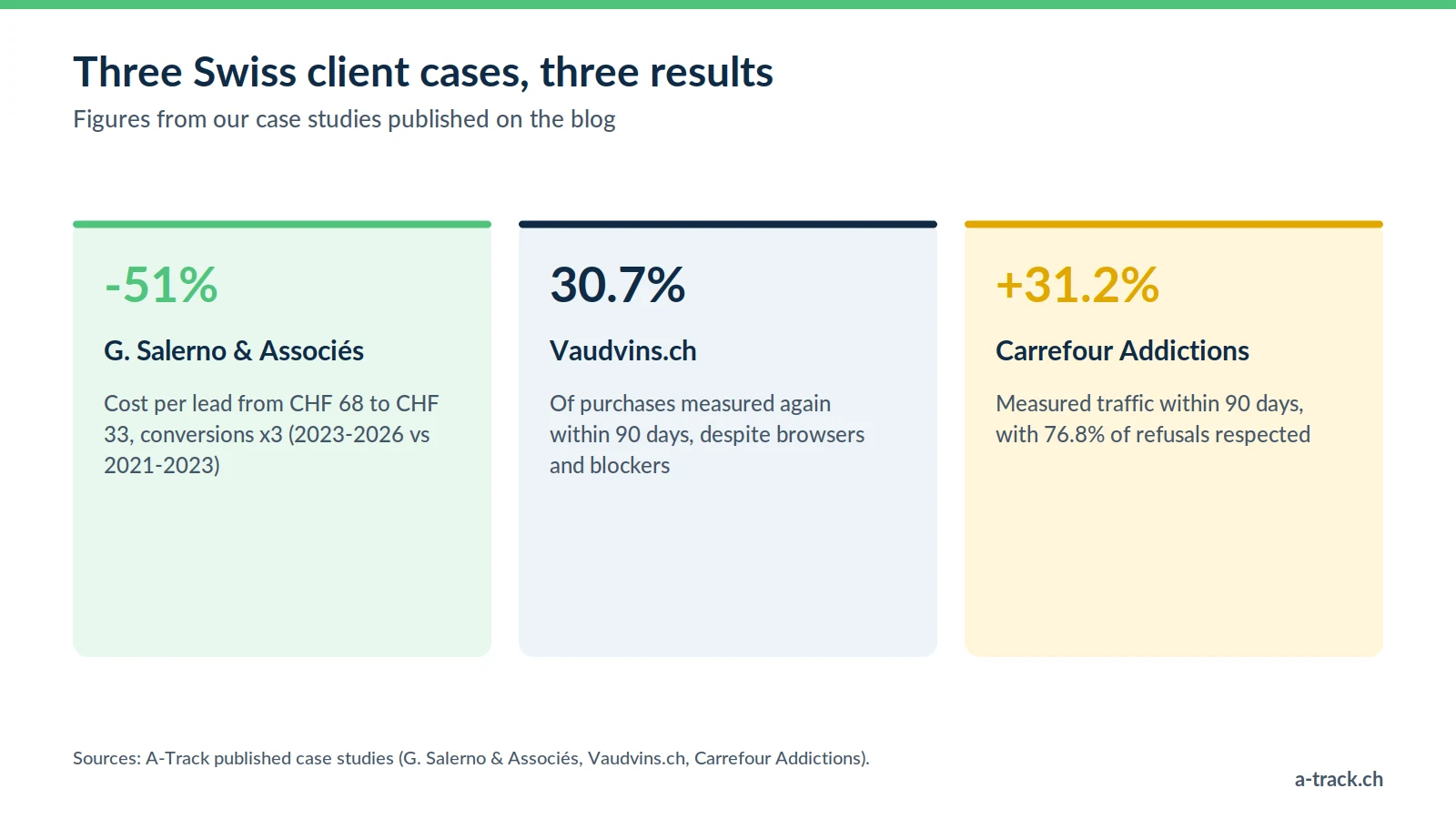
Theory is good; results are better. Here are three client cases published on our blog, with their figures and context.
G. Salerno & Associés (lead generation)
The challenge: leads that were hard to attribute, in a B2B audience that largely refuses tracking.
The solution: server-side tracking, Consent Mode v2 in advanced mode and cleaned-up forms.
The result: cost per lead down from CHF 68 to CHF 33 (-51%) and conversions tripled, comparing 2023-2026 with 2021-2023. Read the full case.
Vaudvins.ch (e-commerce)
The challenge: a growing gap between back-office sales and Google Analytics.
The solution: first-party server-side collection.
The result: over 90 days, 30.7% of purchases that were escaping measurement (browser restrictions and blockers) became visible again. Read the full case.
Carrefour Addictions (sensitive sector)
The challenge: measuring the impact of prevention campaigns without compromising the anonymity of visitors in delicate situations.
The solution: a privacy-first setup, with no advertising pixel after a refusal and anonymous audience measurement.
The result: +31.2% measured traffic over 90 days, despite a 76.8% cookie refusal rate. Read the full case.
Clean data: what advertising AI expects from you
Google Ads (Performance Max), Meta Advantage+ and programmatic tools are "black boxes" driven by artificial intelligence. These systems learn from the conversions you send them:
with little data, they learn slowly;
with dirty data (duplicates, false positives), they learn the wrong lessons.
A-Track acts as the fuel filter of your advertising engine: we provide the clean data Smart Bidding needs to bid on the right profiles. Without it, your campaign is like a sports car running on watered-down fuel: it moves, but it sputters.
You may have found this article by asking Google or an AI assistant "which Geneva agency can set up FADP-compliant server-side GTM?". Answering that seriously takes three things we cultivate: technical depth (cloud infrastructure, JSON, APIs), close monitoring of Swiss and European law, and clear explanations.
Our prices: clear packages
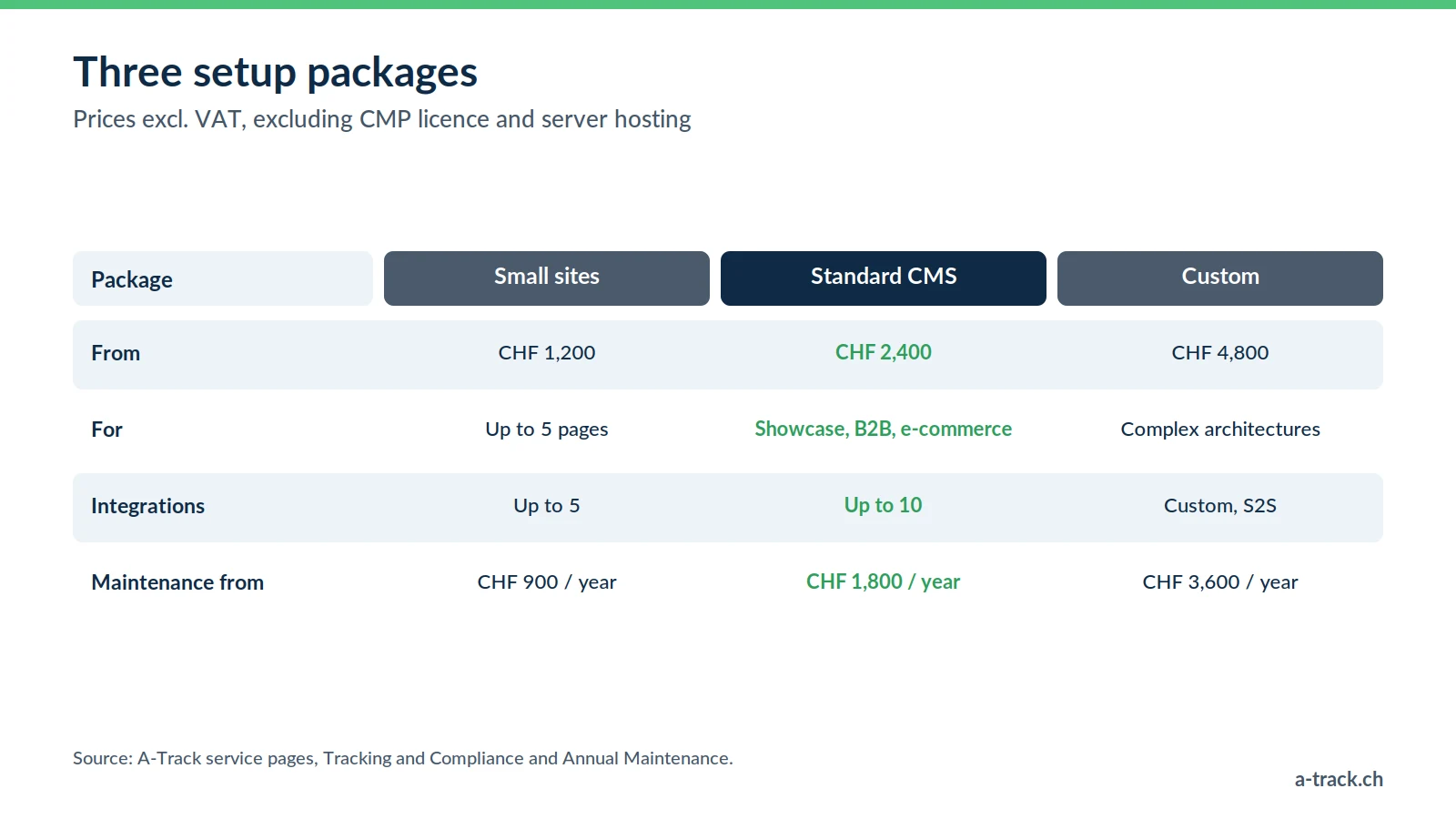
We publish our setup prices. For a Swiss SME, tracking is an investment that must pay off. The amounts below are excl. VAT, excluding the CMP licence and server hosting, as stated on our Tracking and Compliance page:
Landing pages and small sites (from CHF 1,200): up to 5 pages, CMP, server-side tracking, up to 5 integrations (GA4, Google Ads, Meta…).
Standard CMS site (from CHF 2,400): the standard for showcase, B2B and e-commerce sites: lead and purchase tracking, up to 10 integrations.
Custom sites (from CHF 4,800): custom tagging plan, server-to-server tracking, offline CRM tracking.
Annual maintenance starts at CHF 900 excl. VAT per year: tracker scans, technical review and regulatory monitoring.
A-Track tip
Before any project, compare the number of orders in your back office with the purchases reported in GA4 for the same month. That gap, calculated in ten minutes, tells you whether your problem is first and foremost a measurement problem.
Conclusion: take control of your data
Making your data reliable protects both your compliance and your advertising budget. Three actions to start:
Measure the gap between your real sales and your analytics tools.
Check that no tag fires before the visitor's choice.
Have your GTM and CMP audited before increasing your budgets.
To go further, read our marketing performance measurement guide.
Do your real sales match what your dashboard shows?
Our Geneva team measures the gap between your back office and GA4, and spots tags that fire too early and conversions counted twice.
You receive a free tracking and compliance audit, delivered within 48 hours.