

Table of content
Your Google Ads campaigns are spending, but the conversions reported no longer reflect real sales. Smart Bidding then bids on a partial picture, and cost per acquisition becomes hard to steer. Server-side tracking makes that signal reliable by routing conversions through a server you control, while respecting the visitor's choice.
In short
Blockers, Safari's ITP and badly wired consent deprive Google Ads of part of its conversions.
Server-side sends conversions from your own subdomain and lets you add enhanced and offline conversions.
It helps you apply the FADP: you choose what goes to Google.
It bypasses neither consent nor a refusal.
Why your Google Ads campaigns are missing conversions
Google Ads tracking has always relied on tags running in the browser, often through GTM. That model now runs into three obstacles.
Browser restrictions. Safari's ITP caps cookies set by JavaScript at 7 days, and Firefox blocks many third-party trackers by default. A purchase made after that window is no longer tied to the click.
Ad blockers. According to GWI (Q2 2025), 30.9% of Swiss internet users run one; many stop Google tags from loading.
Consent. Since 31 July 2024, Google has applied its EU user consent policy to Swiss traffic: without a properly configured Consent Mode v2, signals drop.
The result: Smart Bidding learns from incomplete data and struggles to recognise the profiles that convert.
Server-side tracking in one sentence
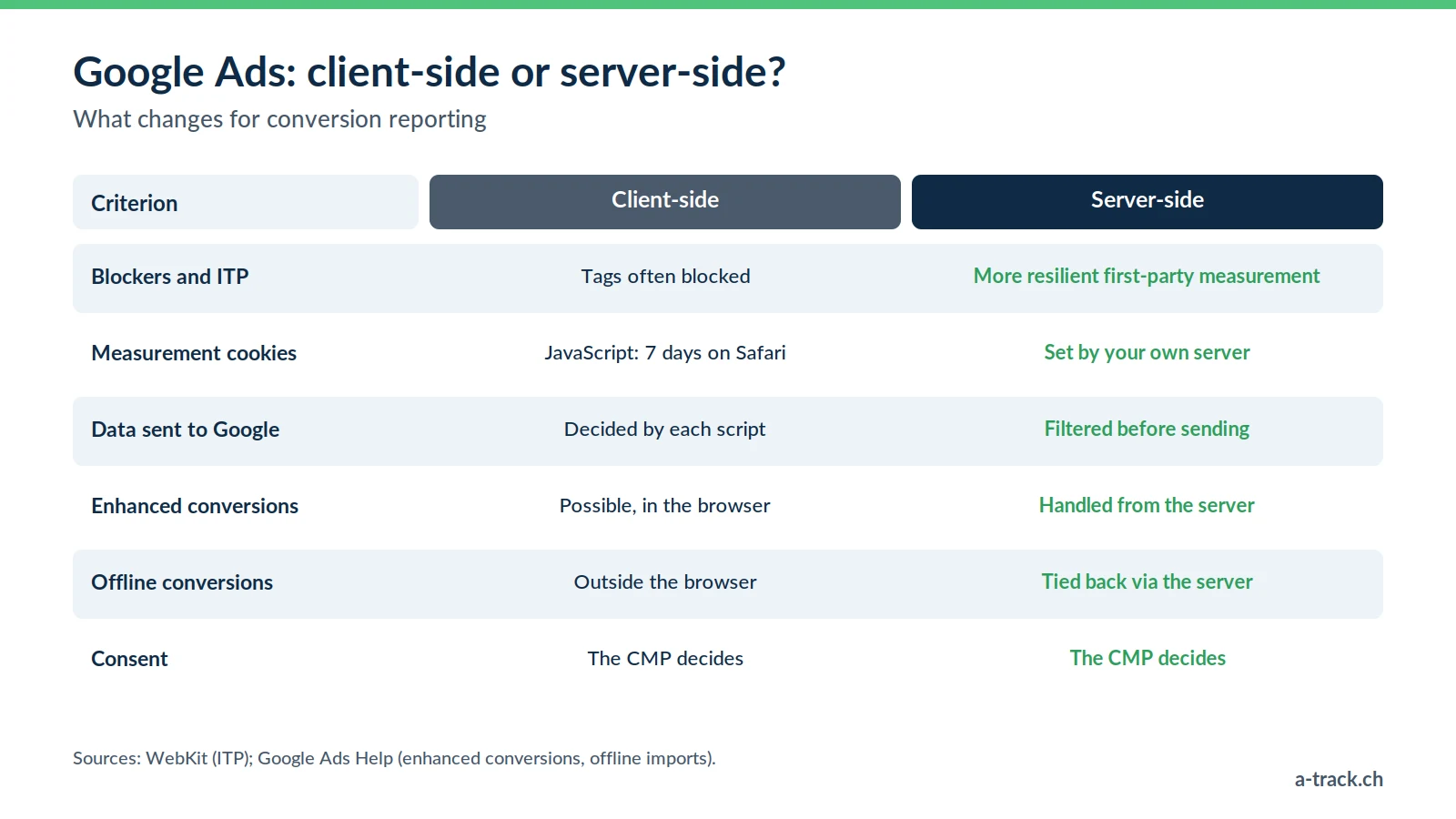
Instead of the browser talking to Google directly, it sends events to your own tagging server, on a subdomain of the site, which cleans them and then forwards them to Google Ads. For the full definition, see our article what is server-side tracking.
What changes for a Google Ads account is detailed below. One thing does not change: the CMP decides, in both architectures.
What server-side changes for Google Ads
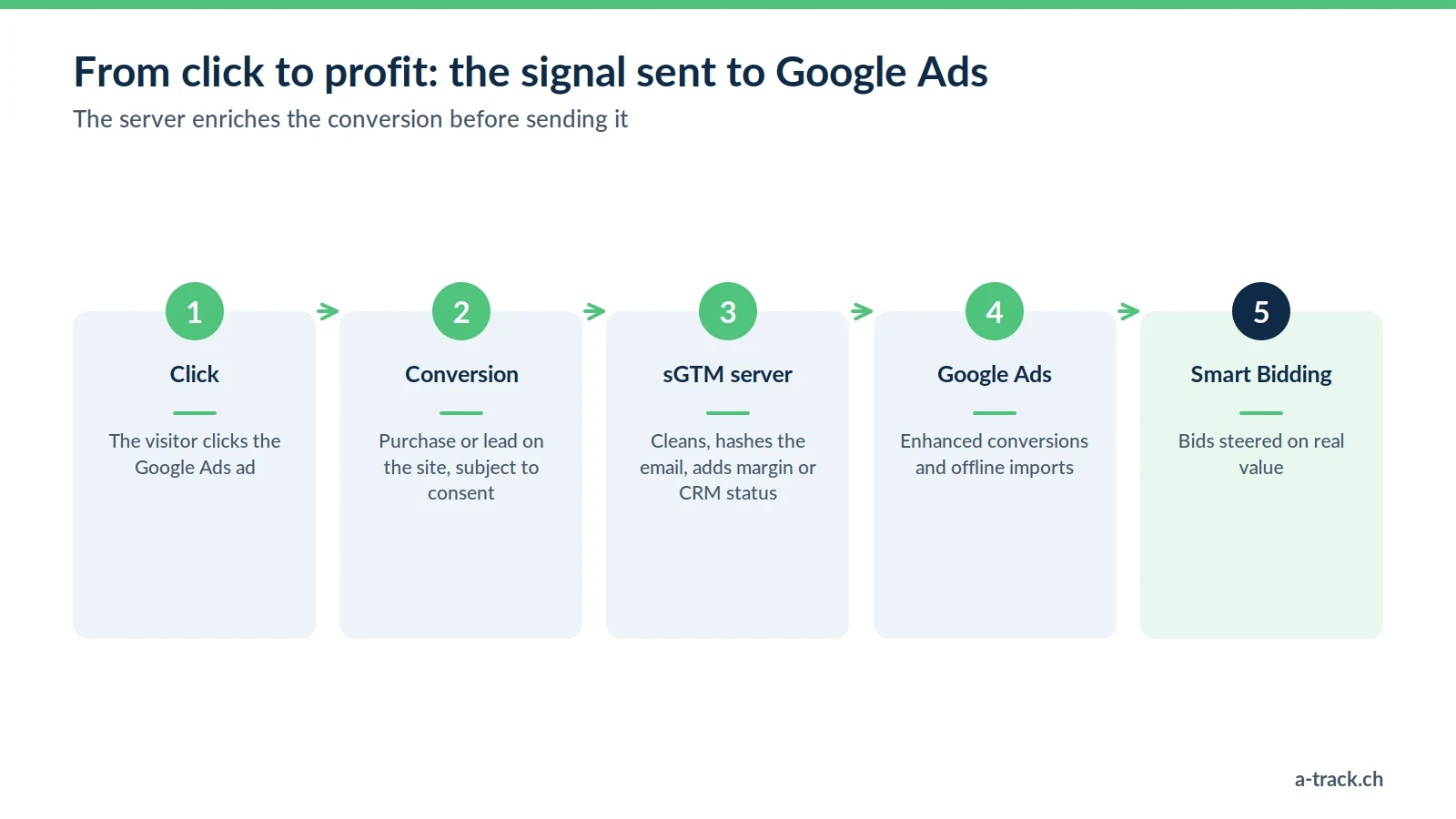
Conversions that actually get through
With first-party measurement, requests go to the site's own domain and cookies are set by your server, so they stand up better to browser restrictions. Based on our measurements across more than 100 installations (Stape Analytics), server-side tracking recovers 30 to 80% more data depending on the site, around 40% on average. More attributed conversions mean Smart Bidding leaves its learning phase sooner. The gain depends on the site and on consent: compare before and after.
Enhanced conversions
The server can send first-party data (email, phone) hashed with SHA256, as Google provides for enhanced conversions. Google states that this feature measures conversions more accurately and supports more effective bidding. It requires a legal basis and clear information for visitors.
Optimise for profit, not clicks
The server can enrich a conversion with what the browser never sees: margin, confirmed payment, product return, a lead qualified in the CRM. Google Ads supports offline conversion imports to tie those sales back to clicks (see our offline conversions guide).
A lighter landing page
Landing page experience is part of Quality Score. Removing third-party scripts from the browser lightens the page, provided you actually remove client-side pixels.
Server-side and the FADP: what it can and cannot do
Since 1 September 2023, the revised FADP has increased Swiss companies' responsibility for personal data, including data protection by design (Art. 7 FADP).
Server-side is a good tool to apply it: before sending to Google Ads, the server can truncate the IP address, strip a sensitive URL parameter or limit the fields sent to what is strictly needed. But it does not make processing lawful on its own: the privacy policy, the CMP and documented transfers to the United States remain essential. See our FADP and GDPR compliance guide.
A-Track tip
Before migrating, export one month of Google Ads conversions and back-office sales, day by day. If the gap widens on mobile and Safari, you have found your priority: that is where server-side will have the most effect.
Our method for moving to server-side
The transition needs three skills working together: technical, marketing and legal.
Audit and tagging plan. We define the conversions and variables that matter for your profitability (value, margin, lead quality), not just one more tag.
Technical collaboration. We work with your developers to set up the server-side GTM container and its hosting.
Business alignment. Google Ads receives reliable signals, aligned with your profitability goals.
FADP validation. Every data flow is documented and respects the choices passed on by the CMP.
Conclusion: three actions for your Google Ads account
Measure the gap between Google Ads conversions and real sales over one month.
Check Consent Mode v2 before any migration.
Start server-side on your main conversion, then add enhanced and offline conversions. For the big picture, read our guide to marketing performance measurement.
How many Google Ads conversions are your bids missing?
A-Track compares your Google Ads conversions with real sales, checks Consent Mode v2 and assesses what a first-party server would change for your account.
First step: a 30-minute call with an expert.