

Tonight you walk into your favourite bar, say a cosy carnotzet in Valais. The bartender sees you, smiles and starts pouring your usual: a Petite Arvine, or a gin and tonic with cucumber, definitely no lemon. You do not cry out that your privacy has been violated. You feel recognised, and you probably leave a good tip.
Now picture a stranger following you down Rue de Bourg in Lausanne, noting every shop window you pause at, then leaping out of a bush shouting: "I SAW YOU LOOKING AT THOSE SHOES! BUY THEM NOW!" You call the police.
In short
The data tracking crisis does not come from data itself, but from how marketing has used it: as a stalker rather than a bartender.
Data reveals what people actually do, not what they say: it is a tool for understanding.
Reliable measurement lowers the cost of mistakes and makes creative boldness affordable, even for a small business.
The line is clear: transparency, respect for the visitor's choice, and never exploiting their weak moments.
The bartender and the stalker: two uses of the same data
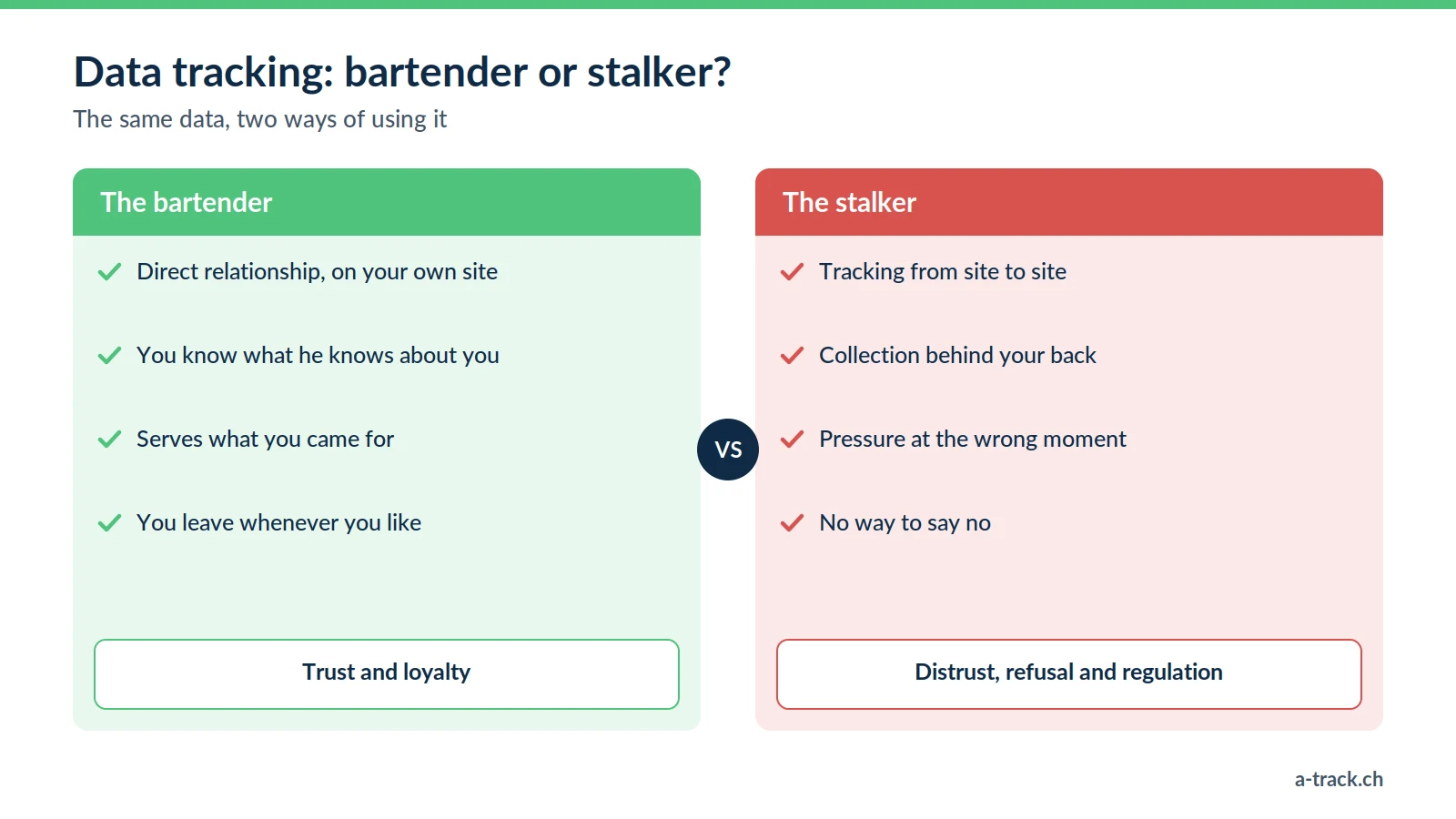
The bartender and the stranger hold the same information: your tastes. But the bartender knows you because you came back to his bar of your own free will, and he uses what he knows to serve you better, in plain sight. The stranger watches you without your knowledge in order to pressure you.
That is the heart of today's data tracking crisis. If the privacy debate is so heated, it is largely because marketing spent years playing the stranger in the bush: tracking people from site to site, ads that follow you around, opaque collection. We treated data as a surveillance tool when it should have been a tool of courtesy.
The good news: the bartender model matches what the law and browsers now expect. A direct relationship (first-party measurement on your own site), transparency about what you collect, and respect for the visitor's choice.
Data is a matter of psychology
We talk about data in industrial terms: we "extract" it, we "mine" it, like coal. I would argue it belongs to psychology instead.
Data is the digital footprint of our choices. Economists call it "revealed preference": what we do says more than what we declare. In a survey, people talk about local quinoa, careful recycling and documentaries on Arte. Their data will show that at 10 pm they ordered a pizza and watched four episodes of a reality show.
That is valuable information: a business that understands what its customers really do can offer them what they actually need. Provided that understanding serves the customer, not the other way round.
Data does not kill creativity, it protects it
To the business leaders reading this, here is a contrarian idea: data does not kill creativity. It protects it.
In the Mad Men era, creativity was a frightening gamble. A brilliant but odd idea had to persuade a client to pay for billboards across French-speaking Switzerland. If it flopped, the agency lost the client. So everyone played it safe, with boring ads.
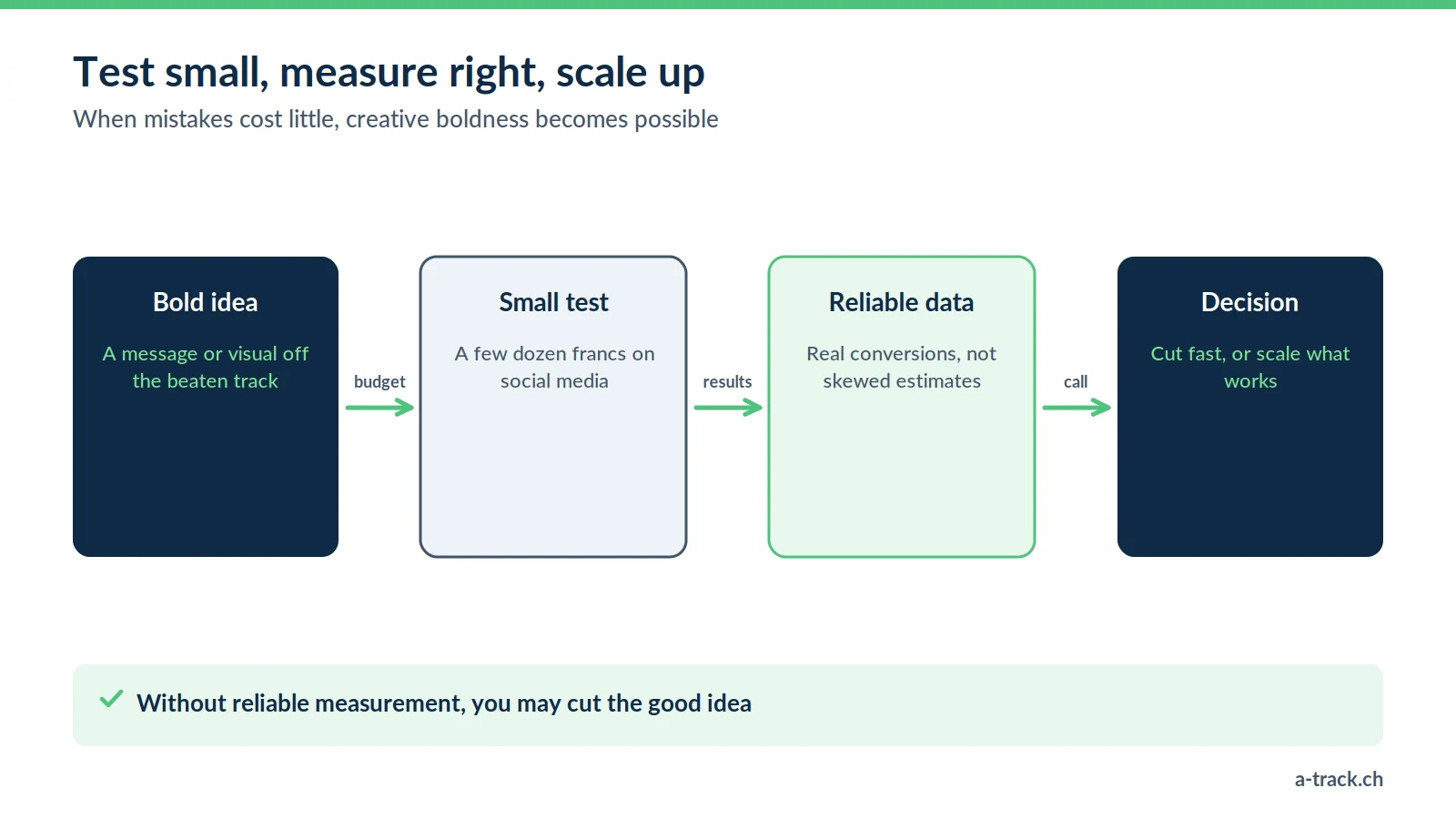
Today, an EPFL start-up or a craftsman in La Chaux-de-Fonds can test a bold idea on social media for a few dozen francs. If it fails, they lose the price of a lunch. If it works, they can scale it up.
Data lowers the cost of mistakes, and when mistakes cost less, boldness grows. It is the safety net that lets the acrobat leap. But the net has to hold: if your conversions are poorly measured, you may cut the good idea and keep the bad one. That is what reliable marketing performance measurement is all about.
From mass to relevance
Data is also a great democratiser of commerce. Without it, marketing is a game of brute force: you buy the biggest spaces and shout louder than everyone else. An expensive game, and an annoying one for the vast majority of people, who have no need for your product.
With data, you move from mass to relevance. A watchmaker selling spare parts for vintage watches can speak directly to the few hundred enthusiasts in the Jura Arc. Without data, he has to shout "WATCHES!" at everyone. With it, he can have a quiet word with the people who need him.
That value does not come from volume, but from relevance. The game stops being zero-sum.
Understanding without manipulating: where is the line?
The promise of data is not to sell more things nobody needs, but to understand the context of human behaviour better: we are emotional, rushed and sometimes contradictory.
But that understanding has a clear limit. Spotting the moment someone is stressed or vulnerable in order to sell them something is not empathy: it is manipulation, and it is exactly what the stranger in the bush does. The bartender serves you what you came for, and lets you leave whenever you like.
In practice, being the bartender means:
Saying what you measure, clearly, in your banner and privacy policy.
Respecting the visitor's choice: in Switzerland, Art. 45c of the Telecommunications Act requires information and a right to refuse; for EU visitors, prior consent applies. A refusal stays a refusal.
Collecting what is useful, and nothing more: data that improves neither your service nor your decisions has no place in your tools.
For the full legal framework, see our FADP and GDPR compliance guide.
A-Track tip
Run the bartender test: for every tag on your site, ask yourself whether you would be comfortable explaining to a customer, face to face, what it collects and why. If not, it is a stranger-in-the-bush tag.
Conclusion: be the bartender
Let's stop treating data like radioactive waste and start treating it like a conversation. If we use it to track people, we deserve every regulation that comes our way. If we use it to anticipate needs, reduce friction and give creativity a chance, we build better businesses, and a web that listens to us.
Three questions to ask yourself this week:
Does your banner clearly say what you measure, and is refusing as easy as accepting?
Is your conversion data reliable enough to test a bold idea without the risk of a wrong decision?
Does every tag on your site pass the bartender test?
Does your website really pass the bartender test?
A-Track reviews every tag: what it collects, whether your banner explains it, and whether a refusal is truly respected.
Let's talk it through in a 30-minute call with an expert, with no commitment.