
Feature (similar to Google's Enhanced Conversions) that allows sending hashed data (email, phone) to Meta/TikTok to identify the user even without cookies.
Glossary
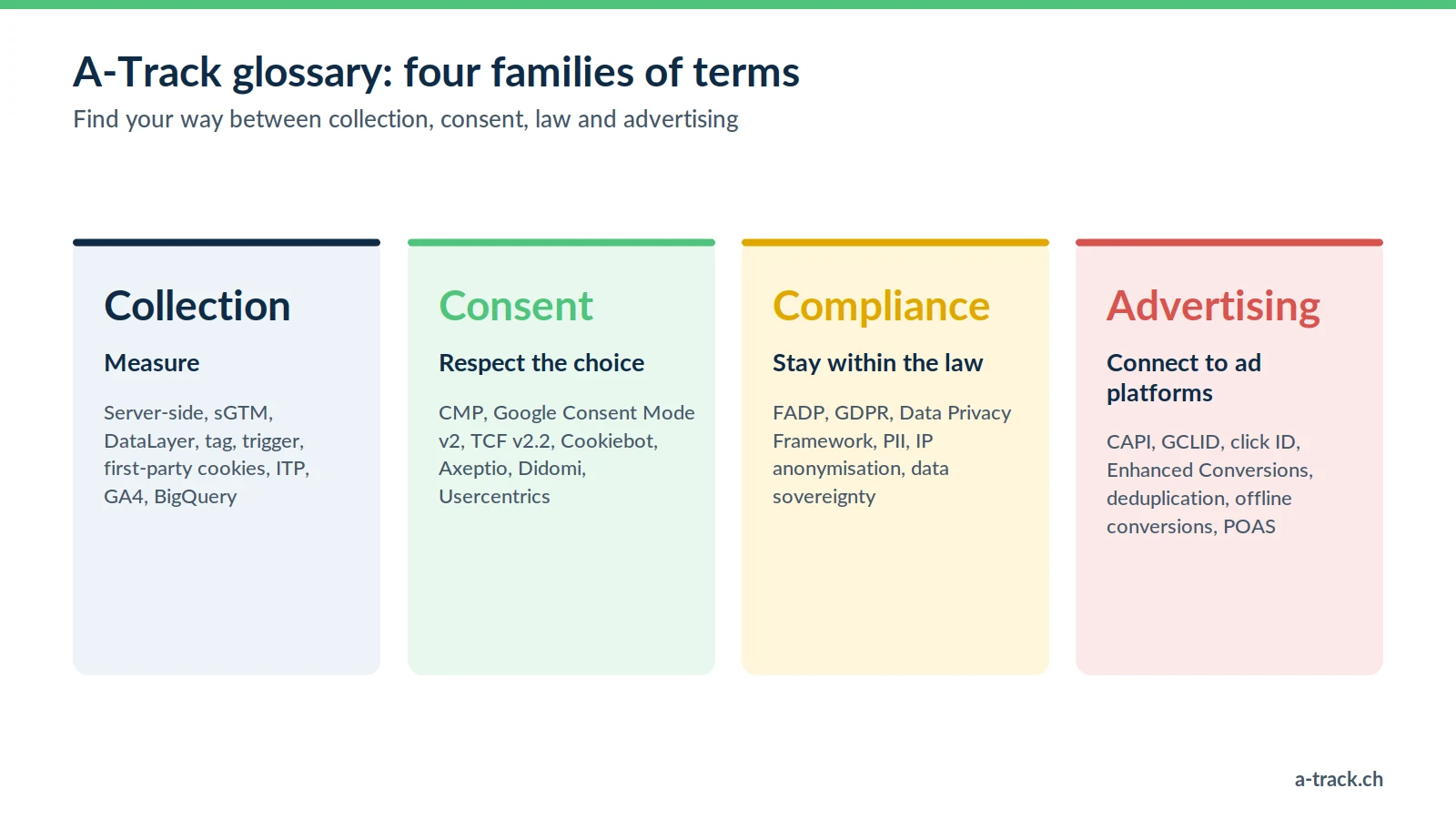
This glossary details the evolution of digital tracking towards a more secure and efficient model, driven by A-Track experts.
Table of content
Architecture & Fundamental Concepts
Advanced Matching
Client-Side Tracking
Definition: Traditional method where the user's browser directly sends data to platforms via pixels or third-party cookies. A-Track's opinion: This method has become obsolete and unreliable due to Apple's restrictions (ITP) and ad blockers.
Cross-Device Tracking
Ability to recognize that a user on mobile is the same person as on a computer (often via a User-ID). Essential for understanding the complete purchasing journey.
Customer Data Platform
Definition: Software that unifies customer data from all sources (Website, Store, App) to create a unique 360° profile.
A-Track's opinion: The ultimate stage of data maturity. Before investing in an expensive CDP (Salesforce, Tealium), ensure that your basic collection (GTM) is flawless.
Data Clean Room
Definition: A secure environment where two parties (e.g., a Brand and Amazon/Google) can cross-reference their customer data without ever revealing the raw email lists.
A-Track's Opinion: The future of marketing collaboration for large accounts that want to share data without violating nFADP.
Data Privacy Framework
Definition: The new agreement (2023) facilitating data transfers between the EU/Switzerland and the United States.
The A-Track Opinion: Although it simplifies matters, it remains legally fragile. We still recommend a 'belt and braces' approach with Server-Side anonymization to avoid relying on policy.
Data Sovereignty
Definition: The principle that data is subject to the laws of the country where it is physically stored.
A-Track's opinion: This is the number one argument for hosting your tracking in Switzerland (Infomaniak). It protects your data from the extraterritoriality of American law (CLOUD Act).
DataLayer
Definition: An invisible object in the website's code that serves as a "translator" between the site and marketing tools. It stores key information (price, product, currency) in a structured way so that Google Tag Manager can read it. The A-Track opinion: Without a clean DataLayer, your tracking is fragile and will break at the slightest design change of the site.
Fingerprinting
Identification method (often considered intrusive and blocked by Apple) based on browser characteristics (screen size, version, fonts) rather than cookies. To be distinguished from ethical tracking.
First-Party Data Strategy
Definition: A strategy that prioritizes the collection of proprietary data (Emails, Numbers) directly from your customers, to no longer depend on third-party cookies.
A-Track's opinion: In 2026, your CRM database is your most valuable asset. Tracking now serves to enrich this database, not just to measure clicks.
ITP
Intelligent Tracking Prevention - Apple's technology (Safari) that drastically limits the lifespan of cookies (sometimes to 24 hours). This is the main reason why Server-Side tracking has become essential to retain visitor history on iPhone/Mac.
Media Mix Modeling
Definition: Statistical analysis that evaluates the impact of different channels (TV, Radio, Web) on sales, without needing to individually track users.
A-Track's opinion: The most resilient measurement method in the face of GDPR for large advertisers investing across multiple channels.
POAS
Profit On Ad Spend - A more precise e-commerce performance indicator than ROAS. It measures the actual profit generated by advertising (Margin / Ad Spend) rather than just revenue, allowing for more profitable management.
Reverse Proxy
Definition: A type of server that retrieves resources on behalf of a client. In tracking, it allows loading GTM from your own domain (e.g.,
data.mysite.ch) instead ofgoogletagmanager.com.A-Track's Opinion: Essential for your tracking to be considered 'First-Party' and to bypass AdBlockers.
Sandbox
Definition: An isolated environment in which the code executes. GTM Server-Side operates in a "Sandbox" that prevents it from accessing sensitive data from your main web server.
The A-Track opinion: This is the security guarantee we provide to banking IT departments: tracking cannot "read" your database, it only receives what is sent to it.
Server-Side Tracking
Definition: a data collection method where information goes from the website to an intermediary server (yours) before being sent to advertising platforms (Google, Meta). A-Track's opinion: It is the opposite of classic tracking (Client-Side). It is the only method that allows bypassing AdBlockers, extending the lifespan of cookies, and securing data before sending.
Signal Loss
Definition: The decrease in the amount of conversion data visible to advertising platforms, caused by browser restrictions (ITP) and consents.
A-Track's Opinion: It is the invisible enemy of your ROI. Our mission is to reduce this loss from 30% to less than 5% through Server-Side.
Tag Governance
Definition: The set of rules and processes that define who has the right to add scripts to the site, how they are validated and audited.
The A-Track Opinion: Essential to prevent the site from becoming a "script dump" that slows down loading and creates security vulnerabilities.
Legal & Compliance (Switzerland & EU)
CMP
Definition: Software that manages the display of the cookie banner and stores users' consent choices. The A-Track opinion: A simple plugin is not enough. We use certified CMPs like Cookie-Script to ensure that tracking tags only trigger after explicit consent.
GDPR
Definition: The legal framework of the European Union. It applies to any Swiss company as soon as it targets European residents. The A-Track opinion: We often recommend aligning with the GDPR standard (the strictest) to ensure overall compliance and reassure partners.
IP Anonymization
Technical process (mandatory under the nFADP/GDPR for Analytics) that involves masking the last digits of the user's IP address before storing the data.
PII
Definition: Any data that can directly identify a person (Email, Name, Phone, IP Address, AVS Number). The A-Track Opinion: This data should never be sent in plain text to Google or Facebook. We use hashing (SHA-256) to secure it.
TCF v2.2
Transparency & Consent Framework - Standard technical framework of IAB Europe used by CMPs (cookie banners) to transmit the user's choice to advertising networks (Google, etc.) in a standardized manner.
nFADP
Definition: The Swiss federal law that came into effect on September 1, 2023. It protects the data of individuals and imposes criminal penalties (up to 250,000 CHF) on executives in case of violations. A-Track's opinion: Although technically a bit more flexible than the GDPR regarding consent, it requires total transparency (Privacy Policy) and impeccable data security.
Google & Analytics
Enhanced Conversions
Definition: A feature that allows sending hashed customer data (email, phone) to Google in addition to the standard conversion tag. The A-Track Opinion: Essential for recovering lost conversions due to cookie refusals, as Google can "re-associate" the sale with a logged-in user.
GA4
Definition: The latest version of Google's analytics tool, based on events rather than sessions. A-Track's opinion: Coupled with Server-Side, it allows for detailed analysis while respecting user privacy (IP anonymization).
GCLID
Definition: A unique identifier added by Google to the URL when someone clicks on an ad. The A-Track opinion: It is the cornerstone for linking an offline sale (in the CRM) to an ad click made weeks earlier.
Google Consent Mode v2
Definition: A mandatory mechanism since March 2024 that allows your cookie banner to tell Google: "The user has accepted the ad" or "The user has refused". The A-Track opinion: Without it, your Google Ads remarketing audiences are disabled and conversion tracking is limited.
Offline Conversions
OCI / Offline Conversions - A method of sending a real conversion (e.g., signed contract, validated sale) back to Google Ads from the CRM, after the initial click. Crucial for B2B Lead Gen to optimize for quality rather than quantity.
Thresholding
GA4 mechanism that masks certain data in reports if the user volume is too low or if Google signals are enabled, to prevent the indirect identification of individuals.
User ID
Unique identifier assigned to a user logged into your site. It allows GA4 to deduplicate users and unify their sessions across different devices.
Infrastructure & Tools A-Track
Custom Domain
Technical configuration (e.g., data.mysite.com) allowing the tracking server to be considered as "First-Party" by browsers. Essential for bypassing ad blockers and extending the duration of cookies.
Custom Loader
Definition: An advanced technique that allows masking the tracking script (GTM) by renaming it to resemble a harmless system file. A-Track's opinion: This allows for the retrieval of data from the 30% of users who use an AdBlocker, in strict compliance with their cookie consent.
JSON
JavaScript Object Notation - Standard format for data exchange. It is the "language" used by the DataLayer and Server-Side APIs to structure information (product, price, ID) between your site and the servers.
Proxy
Definition: A proxy server that acts as a customs. The A-Track opinion: It is thanks to the proxy that we can "clean" the data (remove the IP address) before it is sent to the American giants.
Stape.io
Definition: Our preferred infrastructure partner for hosting Server-Side GTM containers. The A-Track Opinion: We chose it for its servers located in the EU (nFADP/GDPR compliance) and its exclusive AdBlocker bypass features.
CMS (Content Management Systems)
Magento
Definition: The solution for very large e-commerce businesses. Powerful but complex. A-Track's opinion: A gas factory. The DataLayer is often managed by expensive extensions. A technical audit is essential before any GA4 migration.
PrestaShop
Definition: Historic French e-commerce CMS, still very present in Switzerland and Europe. A-Track's opinion: Often technically heavy. Native tracking is limited, we often need to inject a paid DataLayer module to send clean data to GA4.
Shopify
Definition: The world's leading SaaS e-commerce platform. Closed but very robust. A-Track's opinion: The current nightmare for agencies due to the 'Checkout Extensibility' update that blocks traditional scripts. We now use 'Customer Events' (Custom Pixels) to ensure sales tracking.
Webflow
Definition: The preferred 'No-Code' CMS for modern designers and creative agencies. A-Track's opinion: Generates very clean code, but does not have a native DataLayer. We often have to code it manually via JavaScript to track form submissions or complex interactions.
Wix / Squarespace
Definition: All-in-one platforms for small showcase sites. A-Track's opinion: Long closed to advanced tracking, they are slowly opening up. GTM integration is possible, but Server-Side is more complex to implement due to domain restrictions.
WordPress / WooCommerce
Definition: The most widely used open-source CMS in the world. WooCommerce is its e-commerce extension. A-Track's opinion: Offers total flexibility for the DataLayer (especially thanks to the GTM4WP plugin), but requires rigorous maintenance as theme updates often break tracking.
CMPs (Consent Management)
Axeptio
Definition: The French CMP known for its playful design ("Nice Cookies"). The A-Track opinion: Very popular among marketing teams for its UX. However, the technical integration of Google Consent Mode v2 can sometimes be less intuitive than on Cookie-Script.
Didomi / Usercentrics
Definition: "Enterprise" solutions for large groups. A-Track's opinion: Essential for multinationals with complex legal needs, but often oversized (and too expensive) for a typical Swiss SME.
Google Tag Manager (GTM) Vocabulary
Container
Definition: The "box" that contains all your tracking tags. You install a single piece of code (the container) on the site, and manage everything else from the GTM interface. The A-Track opinion: A client should have a Web container (Classic) and a Server container (Stape) for a modern setup.
GTM Server-Side Client
Specific element of the Server container (not to be confused with "Client-Side"). The "Client" listens for incoming requests, "translates" them into understandable event data, and then passes them to the tags.
Lookup Table
Very commonly used variable in GTM to transform one data into another (e.g., If the product ID is "123", return the category "Shoes"). Useful for cleaning data before sending.
Preview Mode
Definition: The GTM debugging tool that allows you to test tags on your own screen before publishing them for everyone. A-Track's opinion: We never publish anything without having run a test order in Preview mode. It's the safety belt of tracking.
Tag
Definition: The code that must be executed (e.g., "Google Ads conversion code", "Facebook Pixel"). The A-Track opinion: We always prefer the official "Templates" from the community gallery over custom HTML tags, for security and performance reasons.
Trigger
Definition: The condition that activates the tag (e.g., "On all pages", "On click of the blue button", "When the form is submitted"). The A-Track opinion: Avoid text-based triggers ("Click on 'Buy'"). Prefer event-based triggers from DataLayer (event: purchase), which are much more stable.
Variable
Definition: A dynamic value that changes according to the context (e.g., "Order Amount", "Product ID", "Page URL"). The A-Track Opinion: The richness of your reports depends on the quality of your variables. This is where A-Track's configuration work adds the most value.
GA4 Vocabulary (Google Analytics 4)
BigQuery
Definition: Google Cloud's data warehouse. GA4 allows you to export all raw data for free. A-Track's opinion: Vital. GA4 only retains data for 14 months. Connecting BigQuery is the only way to maintain ownership of your data history for life. We systematically configure it for our clients.
DebugView
Definition: A real-time view in GA4 dedicated to developers to check that events are arriving correctly. The A-Track opinion: Essential to verify if the Server-Side is functioning properly and if the parameters (such as product data) are being transmitted correctly.
Engagement Rate
Definition: Replaces the "Bounce Rate". It is the percentage of sessions that lasted more than 10 seconds, had a conversion, or viewed 2 pages. A-Track's Opinion: A much more positive and useful metric for measuring the actual quality of traffic.
Key Event
Definition: In GA4, everything is an event. A page view, a click, a purchase, a scroll... everything is measured in the same way. A-Track's opinion: This is the big difference from the old Universal Analytics. It requires a new way of thinking about the tagging plan. A key event is a conversion goal set by the GA4 administrator. The purchase and generate_lead events are key by default.