

Table of content
A customer discovers a fine wine in a Facebook ad, thinks it over, then comes back to buy it a week later. In your reports, the sale shows up as "Direct", or not at all. That was happening to one sale in three at Vaudvins.ch.
Here is what 90 days of server-side measurement revealed, with the numbers.
In short
217,332 requests that would have been blocked or limited were recovered in 90 days.
30.7% of purchases were invisible or misattributed: 5.54% because of ad blockers, 25.20% because of browser anti-tracking protections.
The whole funnel was affected, from the cart (31.79% of data recovered) to shipping.
Consent is still respected: 37.8% refusals on page views, 15.4% on purchases.
Please note
The vaudvins.ch website no longer exists: since September 2026 it has become Swiss Wine Vaud, also an A-Track client, for which the tracking was rebuilt from scratch. The results below relate to the former vaudvins.ch site.
The context: a customer base heavily on Safari
Vaudvins.ch, an online shop for Vaud wines, served a demanding clientele. The traffic analysis was clear: a large share of visitors used Safari, on iPhone and Mac.
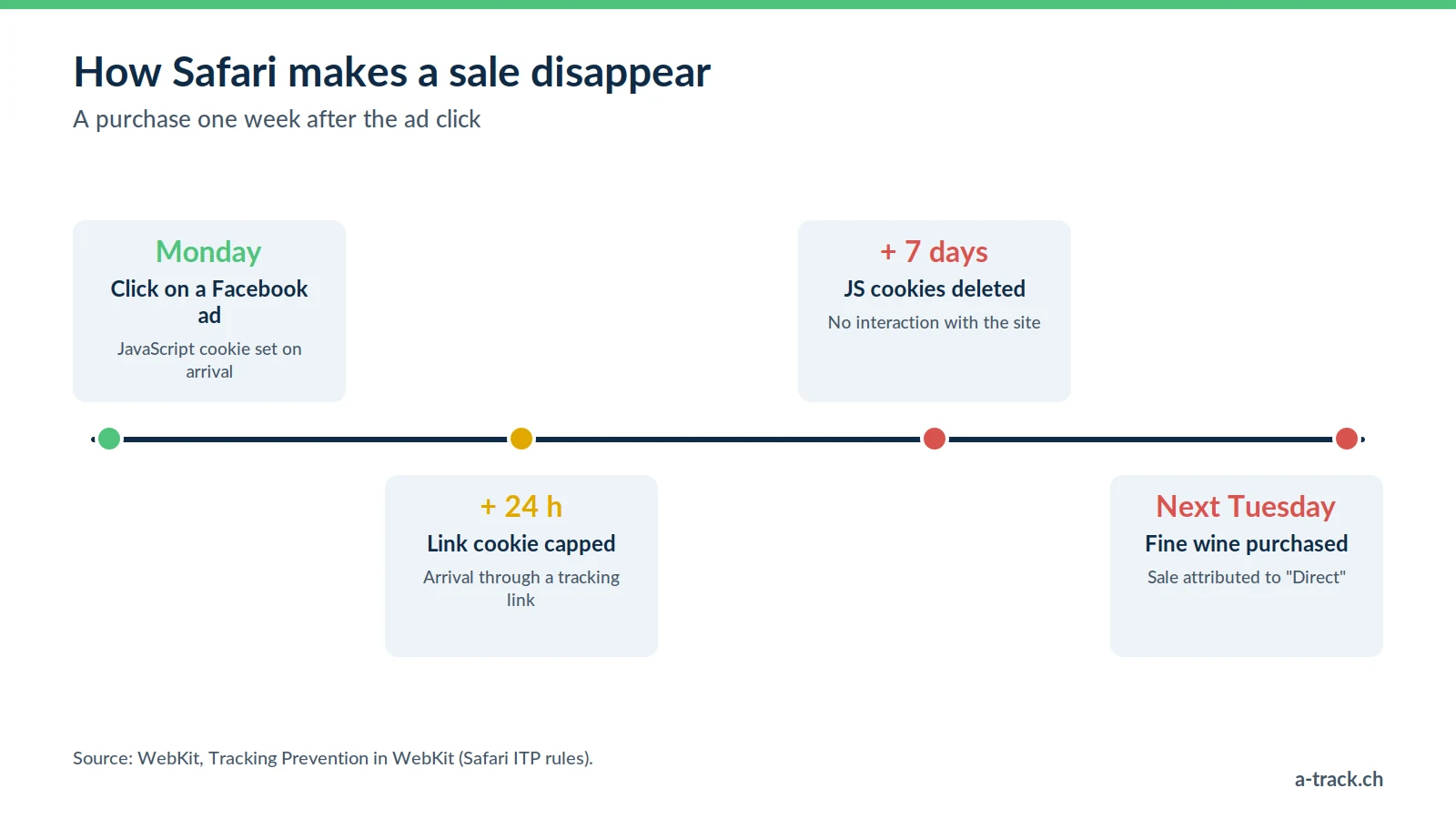
Safari applies ITP (Intelligent Tracking Prevention). According to WebKit, cookies set in JavaScript are deleted after 7 days without interaction, and capped at 24 hours when the visitor arrives through a tracking link, such as an ad click.
The typical scenario: a customer discovers a fine wine in a Facebook ad on Monday. They come back to buy it on Tuesday of the following week.
Without server-side: Safari has deleted the cookie. The sale is attributed to "Direct" traffic and the Facebook ROAS is wrong.
With an ad blocker: Google Analytics does not even see the sale.
Vaudvins.ch was therefore steering its campaigns on truncated data.
The A-Track intervention: first-party, server-side measurement
We deployed a server-side tracking infrastructure: data flows through a measurement server (proxy) controlled by Vaudvins, on a subdomain of the site, instead of going straight from the browser to each platform.
This setup does not get around ad blockers or consent. It makes measurement resilient to technical restrictions (blocked third-party scripts, shortened JavaScript cookies), and the visitor's choice still applies: a refusal stays a refusal.
The figures below compare the browser stream and the server stream over the 90 days after installation. They were measured at Vaudvins.ch over that period and are not a market average.
The results: 30.7% of purchases recovered
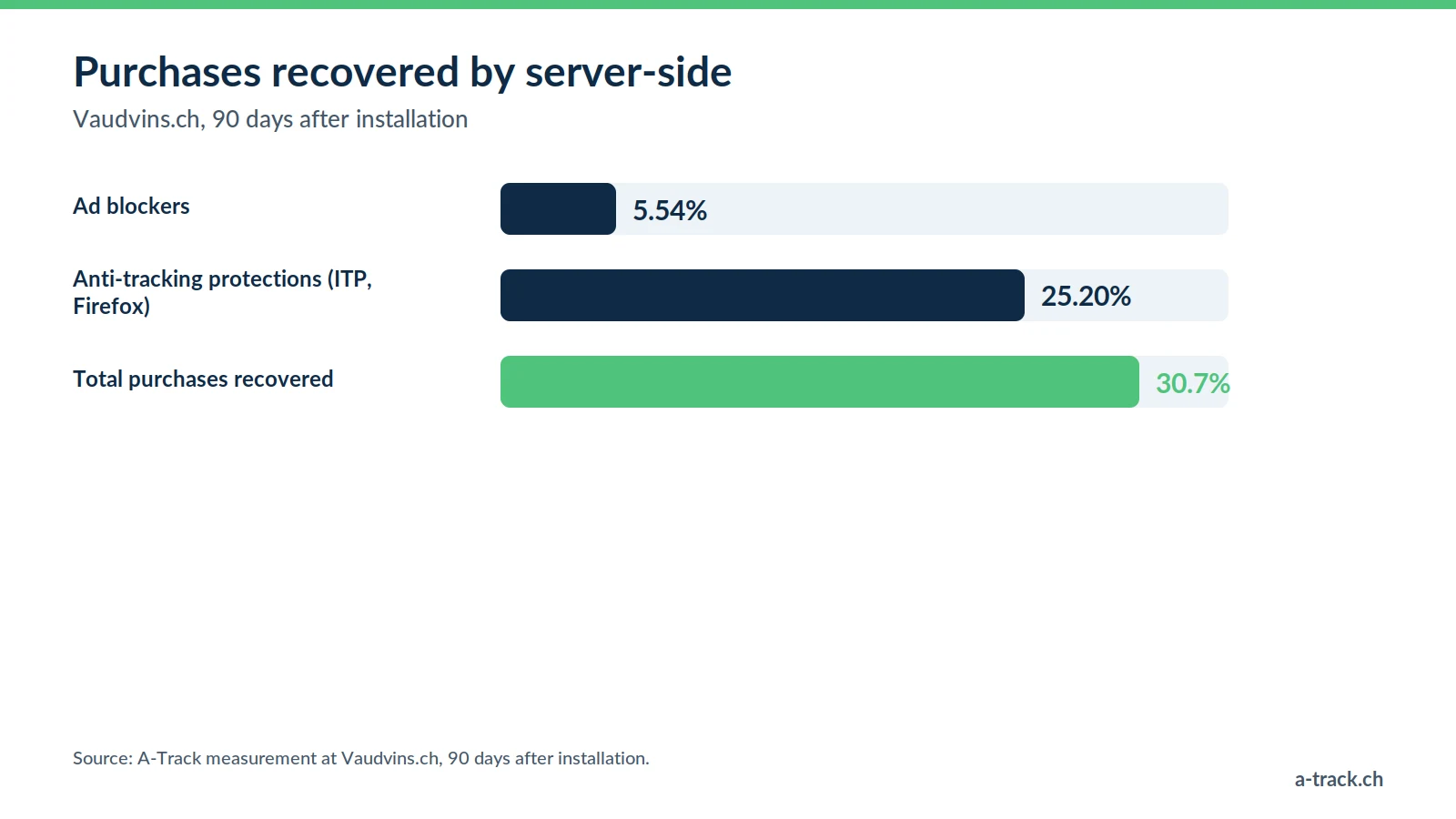
This is the figure that matters most for revenue. On the purchase event, the server stream recovered:
5.54% of sales, lost to ad blockers;
25.20% of sales, limited by browser anti-tracking protections (Safari ITP, Firefox Enhanced Tracking Protection).
What this changes: without this intervention, 30.7% of actual sales were invisible or misattributed in analytics tools. Nearly one sale in three was escaping marketing budget decisions.
Safari and the conversion funnel: what the requests reveal
Safari: tracking restored
Over the period, 185,546 requests were recovered from tracking prevention mechanisms, almost exactly the total volume of Safari traffic. In other words, nearly all Safari visitors had previously been tracked with short-lived cookies.
The server sets first-party cookies in the HTTP response. Beware: WebKit also caps these cookies at 7 days if the measurement server is detected as a third party (CNAME or an IP address different from the site's). Configured properly, they let you recognise a customer over several weeks and better estimate their customer lifetime value (LTV).
A "clogged" conversion funnel
The loss did not only affect the final purchase, but the whole journey:
view_cart: 31.79% of data recovered;
add_shipping_info: up to 100% of data recovered on some segments.
With these intermediate steps, Vaudvins.ch can build larger and more precise abandoned-cart audiences, for visitors who have consented.
Consent: the reality of "no"
FADP compliance means respecting the visitor's choice. On Vaudvins.ch, the measured refusal rates were clear:
Page views: 37.8% refusals.
Purchases: 15.4% refusals.
Buyers are therefore more willing to accept cookies than casual visitors.
With Google Consent Mode v2 in advanced mode, refusals are not lost for analysis: GA4 can model the behaviour of missing visitors. This modelling only kicks in above volume thresholds, including 1,000 events per day with consent denied for at least 7 days, according to Google Analytics Help. More in our Consent Mode v2 guide.
A-Track tip
Track your refusal rates at each funnel step, not just on page views. A clearly lower refusal rate at purchase, as here, shows your sales data remains usable, provided the technical measurement keeps up.
Conclusion: don't let the browser decide your ROI
The Vaudvins.ch case shows that a site with heavy Safari traffic can lose a significant share of its sales in its reports without losing a single customer. What you lose is the information that helps you win new ones.
Check your Safari traffic share in GA4 and compare your shop's sales with those in your reports.
Route key events through a first-party server, configured according to Safari's rules.
Switch on Consent Mode v2 in advanced mode and track refusals by step.
To go further, read our guide to marketing performance measurement.
Do you want to know how many sales your site is "missing" in its reports?
Let's conduct the same audit for your e-commerce.