

Table of content
Performance Max, Meta Advantage+, tCPA or tROAS bidding: a traffic manager's job is now to steer algorithms rather than fine-tune bids to the cent. The promise never changes: "let our AI find your best customers". It only holds if the AI is fed accurate data.
In short
Bidding algorithms learn only from the conversions you send them.
Three needs: volume (enough signals), value (the right measure of success), truth (clean data).
First-party server-side measurement helps on all three, without bypassing the visitor's choice.
Dirty data does not slow AI down: it sends it quickly in the wrong direction.
Why advertising AI depends on your data
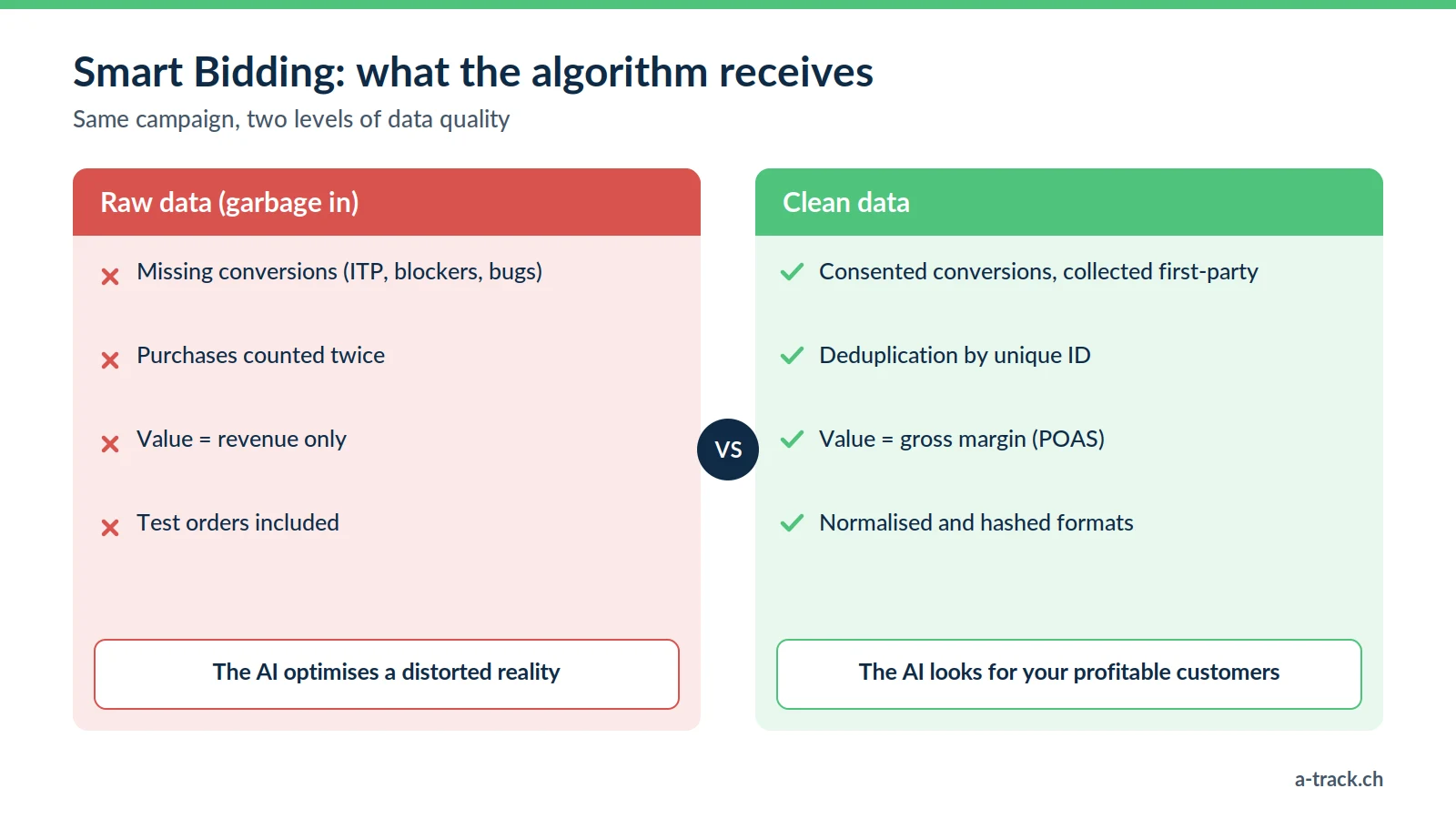
Data scientists sum it up in three words: "garbage in, garbage out". Feed the world's most powerful algorithm incomplete, duplicated or poorly valued conversions, and it will make bad decisions, fast and at scale.
Smart Bidding does not "see" your till or your CRM. It sees the signals your tags send. The quality of those signals therefore becomes a performance lever as important as creative or targeting. That is the whole point of first-party tracking: making the data that feeds your bids reliable, on your own domain.
Volume: enough conversions to learn
An algorithm learns by example. Meta, for instance, states that an ad set exits the learning phase after about 50 optimisation events within a week (Meta Business Help). Every conversion that goes unreported delays that learning.
Yet some conversions get lost along the way: cookies capped by Safari (ITP), ad blockers (used by 30.9% of Swiss internet users according to GWI, Q2 2025), badly tagged thank-you pages.
Consequence: the campaign stays in learning longer, or the algorithm wrongly concludes that an audience does not convert and scales delivery back.
Lever: server-side tracking on your own subdomain makes collection more resilient to technical restrictions. Consented conversions arrive more completely, and a refusal stays a refusal.
Value: optimise for margin, not just revenue
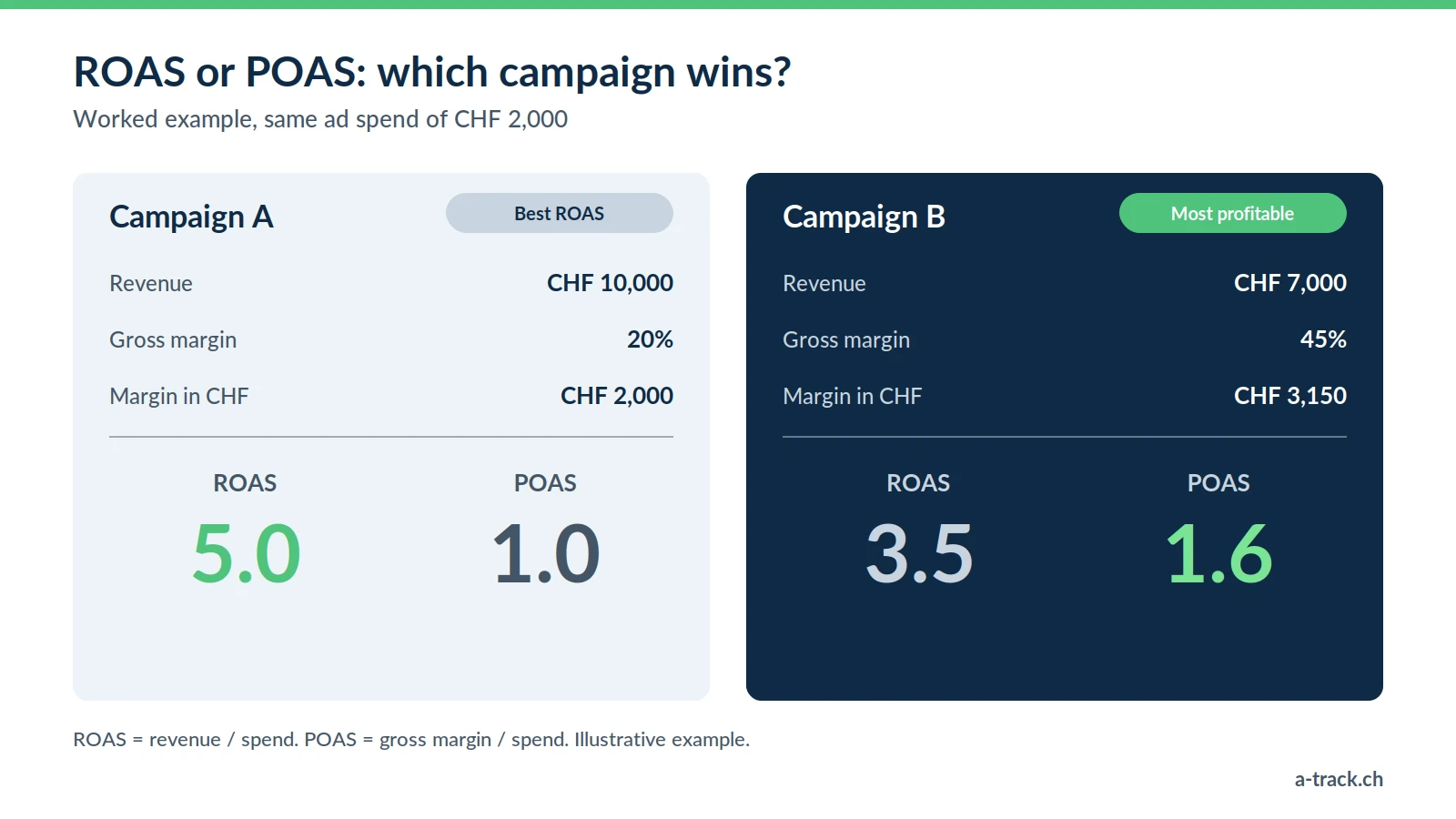
Not all conversions are equal. A CHF 50 order returned the next day costs you money. A CHF 500 order from a loyal customer is worth far more than its amount.
A standard pixel only sends the transaction value. With tROAS, the algorithm therefore maximises revenue, not profitability, and may favour high-value but low-margin products.
The fix: enrich the signal server-side with data the browser does not know, such as gross margin or customer status (new or returning), to steer by POAS (Profit On Ad Spend). Google itself offers gross profit reporting through conversions with cart data, combined with the cost of goods sold from your Merchant Center feed (Google Ads Help).
A-Track tip
This data (margin, customer status) is commercially sensitive: send it from your server, never in clear text in the page code, where any competitor can read it.
Truth: clean data for reliable modelling
When a visitor refuses cookies, Consent Mode v2 lets Google model part of the missing conversions. According to Google (2021), this modelling recovers on average more than 70% of ad-click-to-conversion journeys lost to cookie refusals.
But a model is only as good as its reference data: the conversions observed among visitors who accept. If those are duplicated or polluted, the model extrapolates the error. So clean the data before sending it:
Deduplication of events (one unique ID per order or lead).
Normalisation of emails and phone numbers before SHA-256 hashing, as Google's enhanced conversions require (Google Ads Help).
Exclusion of test orders and internal traffic.
For the setup, see our Consent Mode v2 guide.
Conclusion: don't be AI's weak link
Launching Performance Max without reliable tracking is like putting contaminated fuel in a race car. Three actions to start with:
Compare platform conversions with your real sales to measure the gap.
Check deduplication and test exclusion before touching your bids.
Consider sending a margin value rather than revenue alone.
Our marketing performance measurement guide covers the architecture. To go further on acquisition, our partner Simba Digital explains how to build a complete acquisition system in the age of algorithms, the natural next step once your tracking is clean.
Is your bidding algorithm learning from clean data?
A-Track checks what Google Ads and Meta actually receive: duplicates, test orders, conversion values and enhanced conversions.
Book a 30-minute call with an expert to find out whether your Smart Bidding learns from reliable signals.