

Table of content
Steering campaigns with wrong numbers, while knowing that a sloppy setup can put your own liability on the line: that is the "double penalty" many Swiss SME managers live with. On one side the FADP, on the other advertising algorithms learning from incomplete data. Here is why a Swiss tracking expert makes the difference, and how to choose one.
In short
The FADP provides for fines of up to CHF 250,000 against the responsible individuals, for certain intentional violations.
Google and Meta optimise your campaigns using the conversions you send them: incomplete data is expensive.
Server-side tracking makes measurement more reliable and easier to control, without ever overriding the visitor's choice.
Outsourcing turns unpredictable technical costs into a controlled annual fee.
FADP compliance: why DIY is costly for management
In one sentence: the FADP can target the responsible individuals, not just the company, so a rigorous, documented technical setup also protects management.
The personal risk for managers
Since 1 September 2023, the revised FADP has provided for fines of up to CHF 250,000 for certain intentional violations. They target the responsible individuals and are imposed by cantonal criminal authorities (Art. 60 to 66 FADP). They cover, among other things, the duty to inform, transfers of data abroad without safeguards, poorly framed use of processors and failure to meet minimum security requirements. The FDPIC investigates and orders measures, but does not impose fines. In the EU, the GDPR fines companies, up to EUR 20 million or 4% of worldwide turnover (Art. 83).
A tracking expert does not just install a tool. They configure a CMP (Consent Management Platform) that:
Actually blocks scripts until the visitor has chosen, wherever that is required.
Keeps proof of consent, useful in case of an inspection.
Ensures the privacy policy really describes what happens technically on the site.
The free plugin illusion
Many SMEs believe they are compliant after installing a free WordPress plugin. It is rarely enough:
These plugins do not always keep up with legal and technical changes.
They do not check that tags really wait for the visitor's choice.
They do not control what is sent to advertising platforms, often American ones.
The A-Track approach: a CMP configured with Consent Mode v2, tested tag by tag, and documentation that matches what the site really does. For the full framework, see our FADP and GDPR compliance guide.
Ad algorithms: why broken tracking costs money
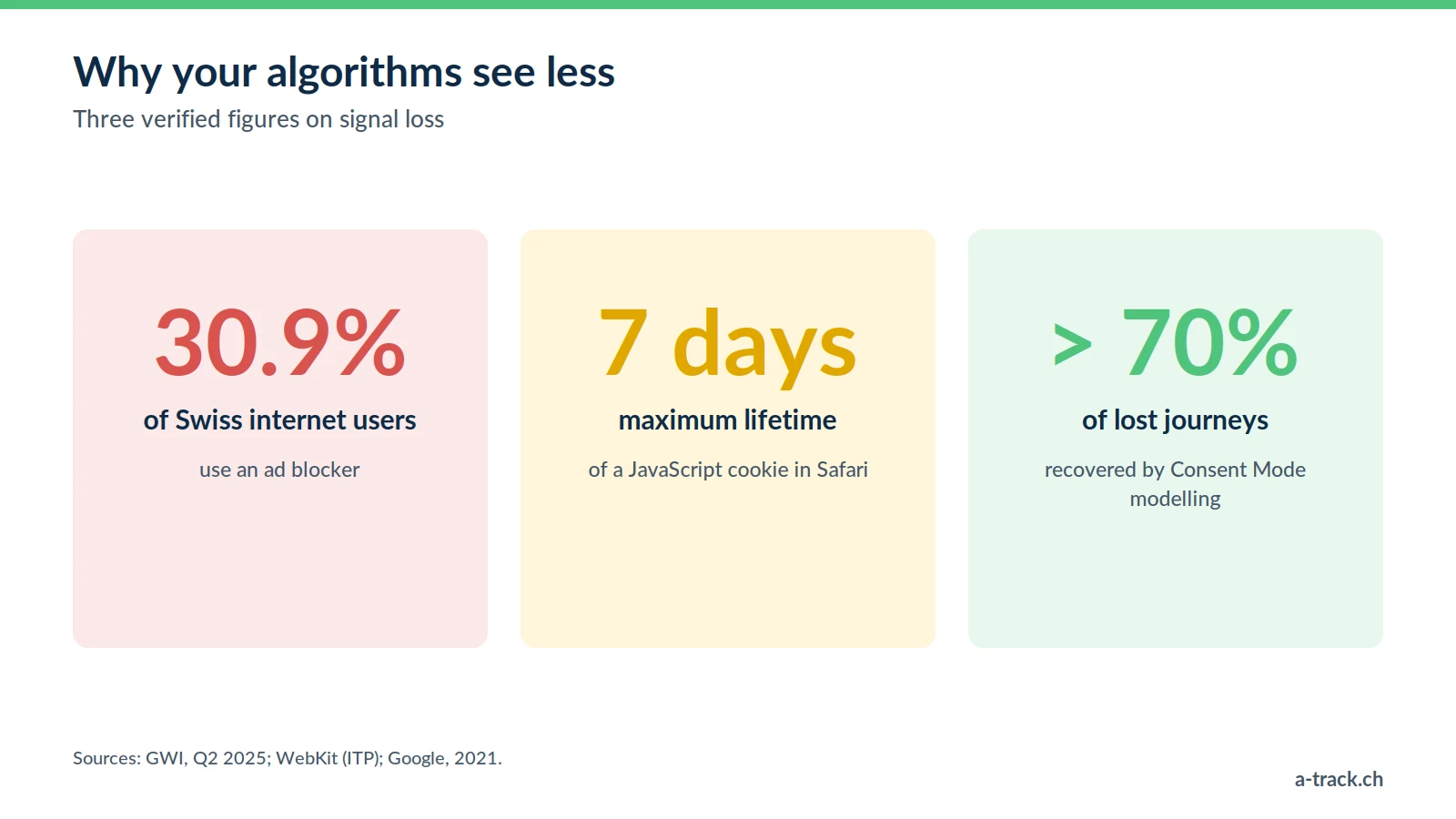
In one sentence: Google and Meta learn from the conversions you send them; if some are missing or wrong, they optimise poorly and your acquisition costs rise.
"Garbage in, garbage out"
Digital marketing is now largely automated. You give Google or Meta a budget, and their algorithms look for the best customers. To do so, they need to know exactly who clicked, who bought and who filled in a form.
Several factors degrade that signal:
Browsers: Safari caps JavaScript-set cookies at 7 days (ITP), and iOS 14.5 made cross-app tracking subject to user permission in 2021.
Blockers: according to GWI (Q2 2025), 30.9% of Swiss internet users use an ad blocker.
Consent refusals: legitimate, they also reduce the volume of observed data.
The consequences: the algorithm undervalues the campaigns that work, targets less qualified profiles and wastes part of the budget.
The competitive edge
If your competitor sends clean, complete conversions, their algorithm will learn faster than yours. They will pay less per lead while you conclude that "online ads no longer work".
A-Track's expertise: we make the conversions sent to platforms reliable (enhanced conversions, conversion APIs, Consent Mode). For visitors who refuse, Consent Mode's advanced mode lets Google model part of the conversions: according to Google (2021), this modelling recovers on average more than 70% of ad-click-to-conversion journeys lost to cookie refusals.
Server-side tracking made simple
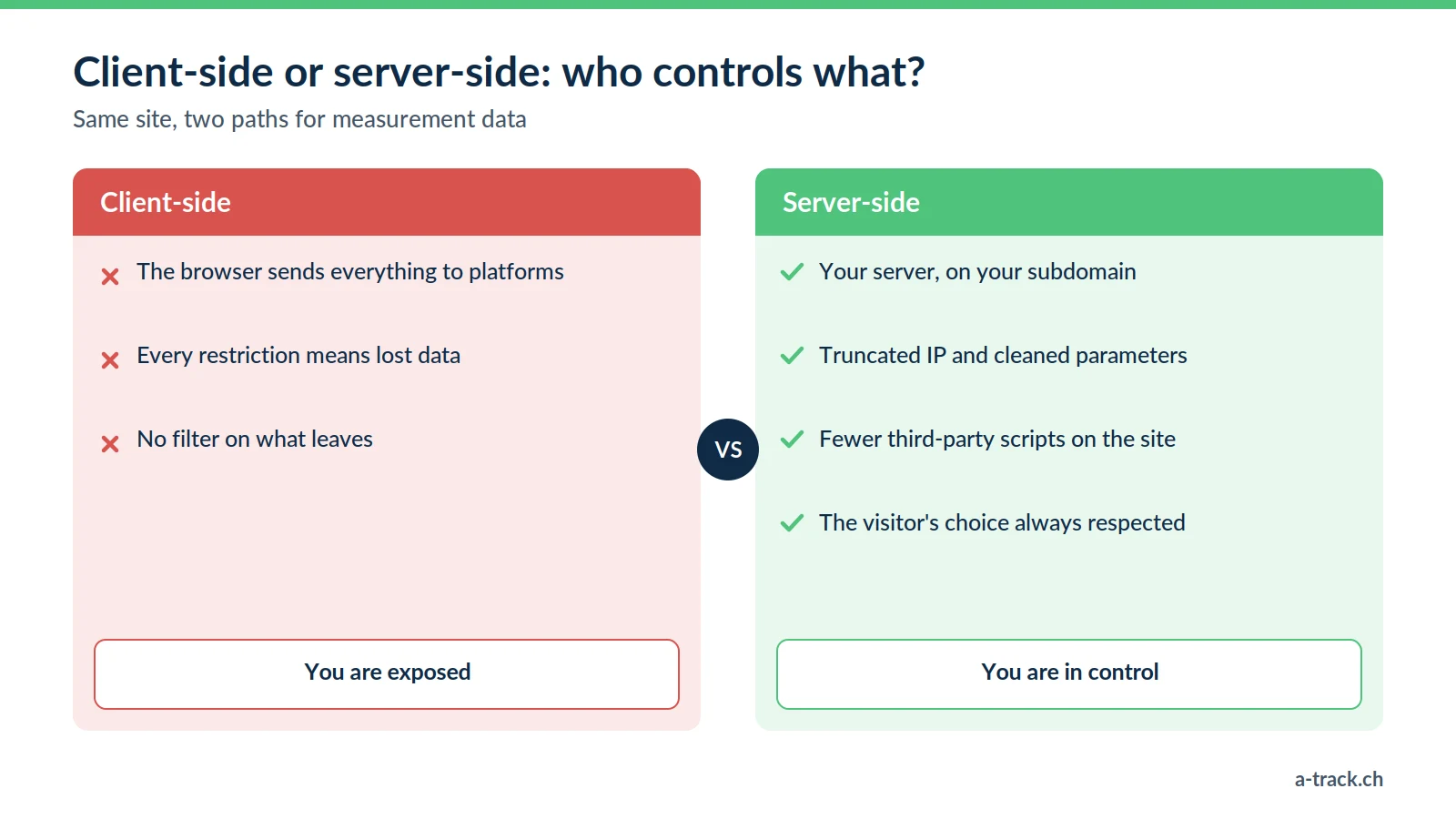
In one sentence: measurement data first goes through a server you control, on your own subdomain, before being forwarded, filtered, to Google or Meta.
Client-side or server-side
Client-side (the historical model): the visitor's browser sends data directly to Google, Meta or TikTok. Every browser restriction or blocker makes data disappear, and you do not control what leaves.
Server-side: the browser sends data to your tracking server (proxy), hosted in Switzerland or Europe. This server:
runs first-party, on your subdomain, and is more resilient to browser restrictions;
can clean data (truncated IP, sensitive parameters removed) before forwarding it;
can lighten the site by moving part of the third-party scripts to the server.
One thing never changes: the visitor's choice is respected. Server-side is not a way around a refusal or a blocker the user chose; a refusal stays a refusal.
Why it is a job in itself
Setting up server-side tracking with sGTM (server-side Google Tag Manager) requires skills in cloud infrastructure, DNS, JavaScript and consent. The A-Track offer: we manage the hosting of the sGTM container for you: no server to administer, and a cost announced upfront. To go further, read what server-side tracking is.
In-house, generalist agency or expert: the comparison
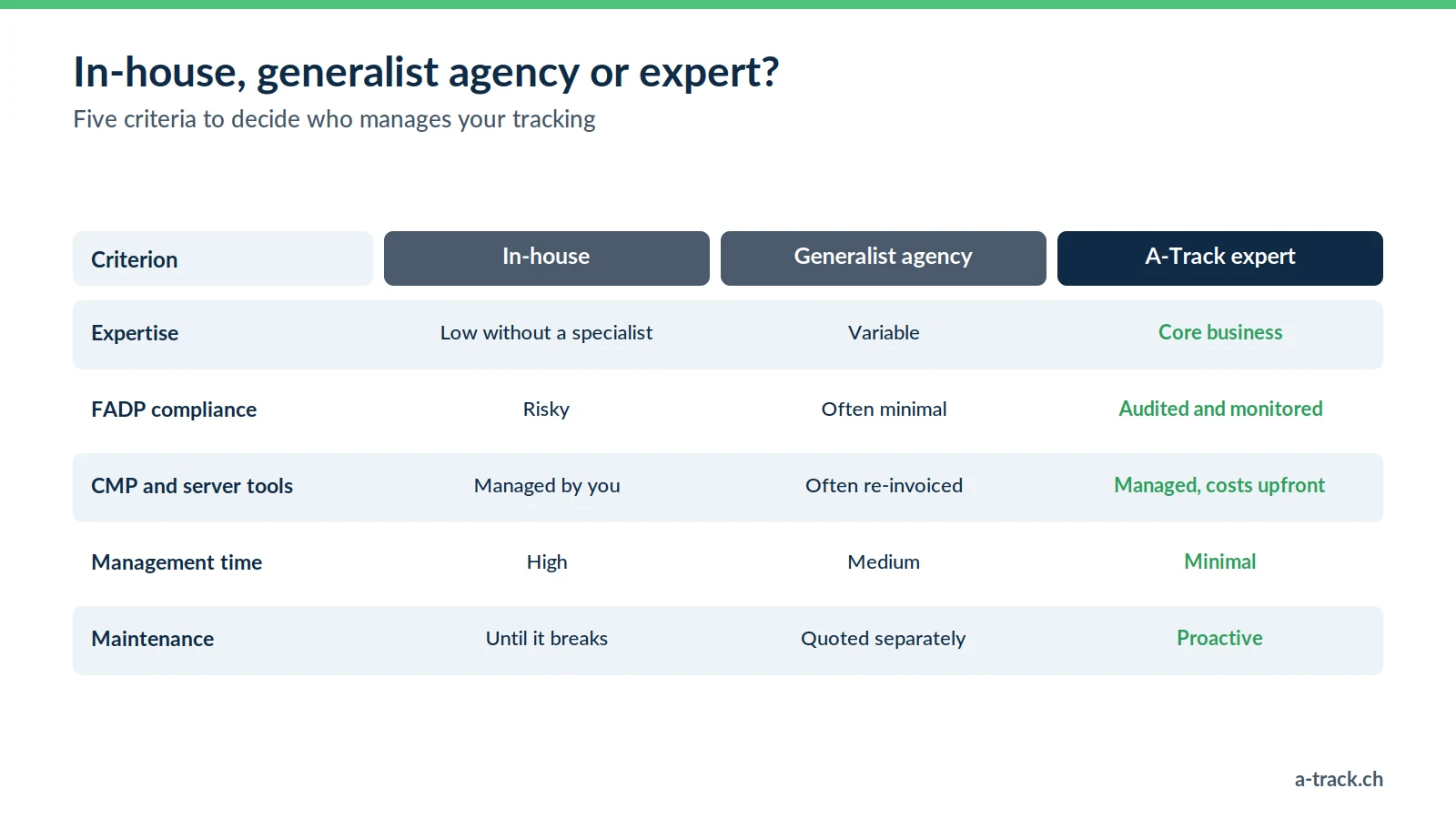
In one sentence: hiring a web analytics specialist in Switzerland is a high fixed cost and maintenance requires constant monitoring; an outsourced package makes spending predictable.
Technical expertise: low in-house without a specialist, variable at a generalist agency, core business for an expert.
FADP compliance: risky when improvised, often minimal at a generalist agency, audited and monitored by an expert.
Tools (CMP, server): managed by you in-house, often re-invoiced by agencies, managed by A-Track with costs announced upfront.
Management time: high in-house, medium with an agency, minimal with an expert.
Maintenance: often non-existent until something breaks, quoted separately by agencies, proactive with an expert.
A-Track's economic approach
Our offer is designed for Swiss SMEs:
Setup package: audit, migration to sGTM, CMP configuration, from CHF 1,200 excl. VAT depending on the size of the site.
Annual maintenance: a flat fee rather than hourly billing, from CHF 900 excl. VAT per year: tracker scans, review of GTM, the CMP and connectors, regulatory monitoring. We also manage the CMP licence (Cookiebot or another) and server hosting for you, billed separately and stated in the quote.
Variable technical costs become one fixed budget line.
Why choose A-Track
You are looking for a trusted partner, not one more supplier. Our three commitments:
Local, pragmatic expertise: based in Geneva, we know the reality of Swiss SMEs. No overengineering, just reliable dashboards that help you decide.
Security and peace of mind: every data flow is documented, so you can answer a client, an auditor or the FDPIC.
Business performance: tracking is not an end in itself. The goal is for your marketing to generate more revenue thanks to clean data.
A-Track tip
Before choosing a provider, ask them to reject all cookies on your site and show you, in the browser's Network tab, what still gets sent. An expert does it in five minutes, and the answer says a lot about the quality of your current setup.
Conclusion: take back control of your data
Tracking has become the backbone of digital marketing. Without it, ad budgets evaporate; badly installed, it creates legal risk. Three actions to start:
Protect your liability: check that nothing is sent before the visitor's choice.
Optimise your budgets: check that the conversions sent to Google and Meta match your real sales.
Plan ahead: schedule annual maintenance instead of waiting for a breakdown.
To measure the impact on your campaigns, also read our marketing performance measurement guide.
What would an expert see after refusing all your cookies?
We test your site tag by tag: what fires before the visitor chooses, how reliable the conversions sent to Google and Meta are, and how your CMP is set up.
Your free tracking and compliance audit is delivered within 48 hours.