

Table of content
At a Geneva private bank or a Zurich fintech, suggesting a Meta Pixel or a Google Analytics tag is often enough to get a flat no from Compliance. "Send our clients' browsing data to a US ad company? Out of the question." The result: marketing flies blind, running awareness campaigns that can never be tied to real meetings or real account openings.
In short
A standard pixel sends platforms the visitor's URL, IP address and device: on a banking site, the URL alone can already say too much.
A tracking server you control filters every event before it leaves: truncated IP, neutral URL, hashed identifiers.
Ground rule: no tracking inside e-banking or back-offices. Measurement stops at the public website.
On the server side, data is used only for statistical purposes and with consent: a refusal stays a refusal.
The problem: what a pixel sees on a banking site
Traditional (client-side) tracking loads a third-party script straight into the visitor's browser. As soon as it runs, for example on the "Open an account" page, Google, Meta or LinkedIn receive:
The page URL, e.g.
bank.ch/open-gold-account;The IP address, which can locate the household;
The user agent: device, operating system, browser;
And sometimes data left in the URL: email, client number, simulated amount.
For a bank, this goes beyond the FADP. Banking secrecy is protected under criminal law by Art. 47 of the Banking Act. And FINMA Circular 2023/1, in force since 1 January 2024, requires banks to manage their critical data, including the confidentiality of client identifying data. If an ad platform can link a profile to the "Wealth management from CHF 5 million" page, the risk of indirect profiling is very real.
The solution: a tracking server that filters before it forwards
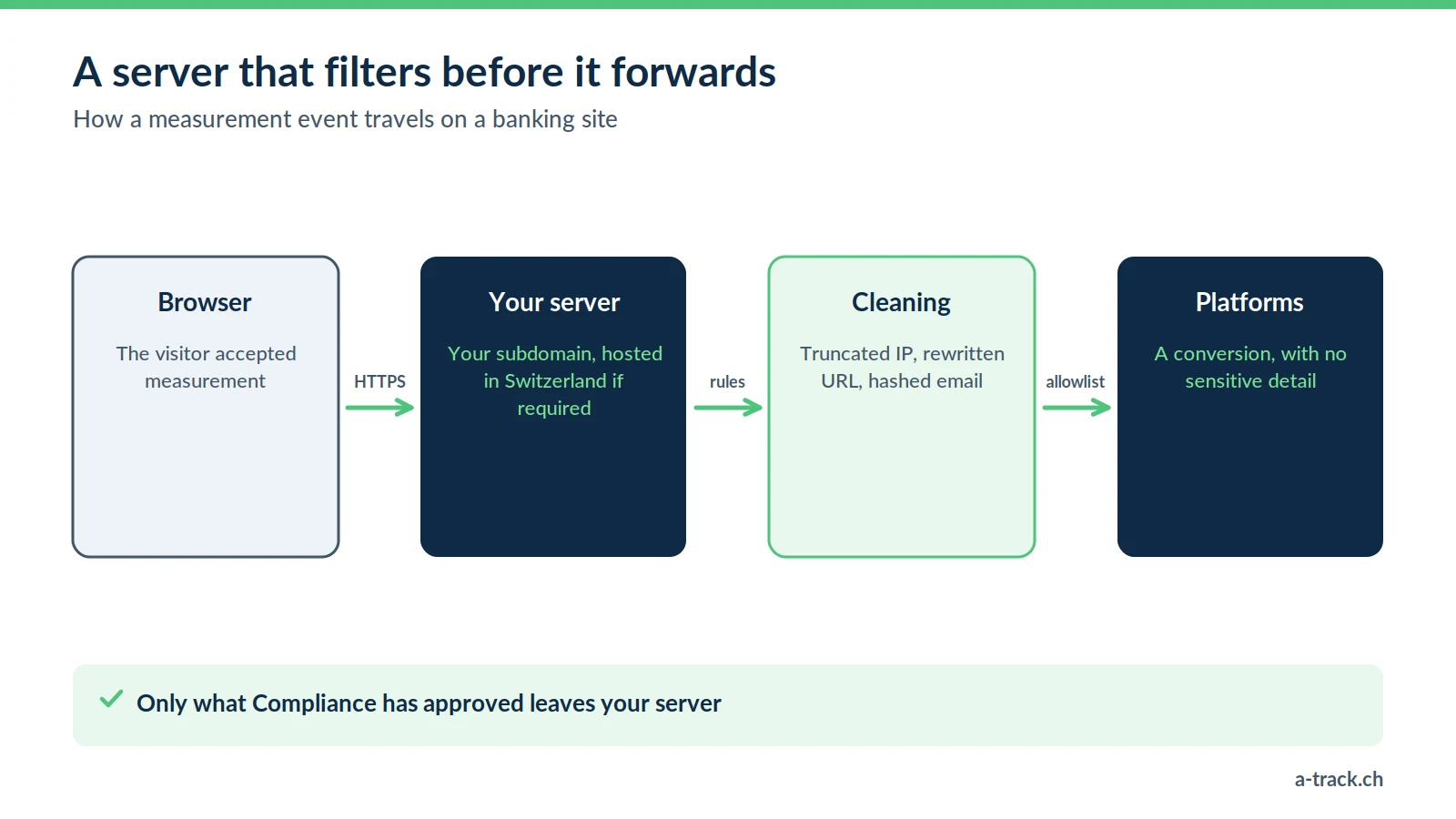
The only way to control this flow is to place a server that you control between the browser and the platforms: a server-side proxy container on your own subdomain.
How it works
Measurement events from the public website go to your server, hosted in Switzerland on dedicated infrastructure if your policy requires it, and only if the visitor has agreed.
The server applies your cleaning rules.
Only what you have allowed is forwarded to Google, Meta or LinkedIn.
What the server can clean
IP address: truncated or removed. The platform knows the visit came from Switzerland, not from which household.
URLs: rewritten to hide sensitive products.
bank.ch/premium-mortgagebecomesbank.ch/service-b. The algorithm knows a conversion happened, not which one.Identifiers: emails and client numbers never travel in clear text. They are hashed (SHA-256) before sending, or simply not sent at all.
Beware of a common shortcut: hashed data is not anonymous data. It is pseudonymised, since the platform can match it against its own accounts, so it remains subject to the FADP and the GDPR. To decide where to host this server, see our server-side hosting guide.
Typical scenario: a fintech that wants to measure LinkedIn without exposing clients
Picture a French-speaking Swiss investment platform that wants to scale its LinkedIn campaigns. Its Compliance Officer rejects the Insight Tag: he does not want LinkedIn to be able to rebuild a list of Swiss investors.
The solution relies on a server-side GTM container and one clear rule:
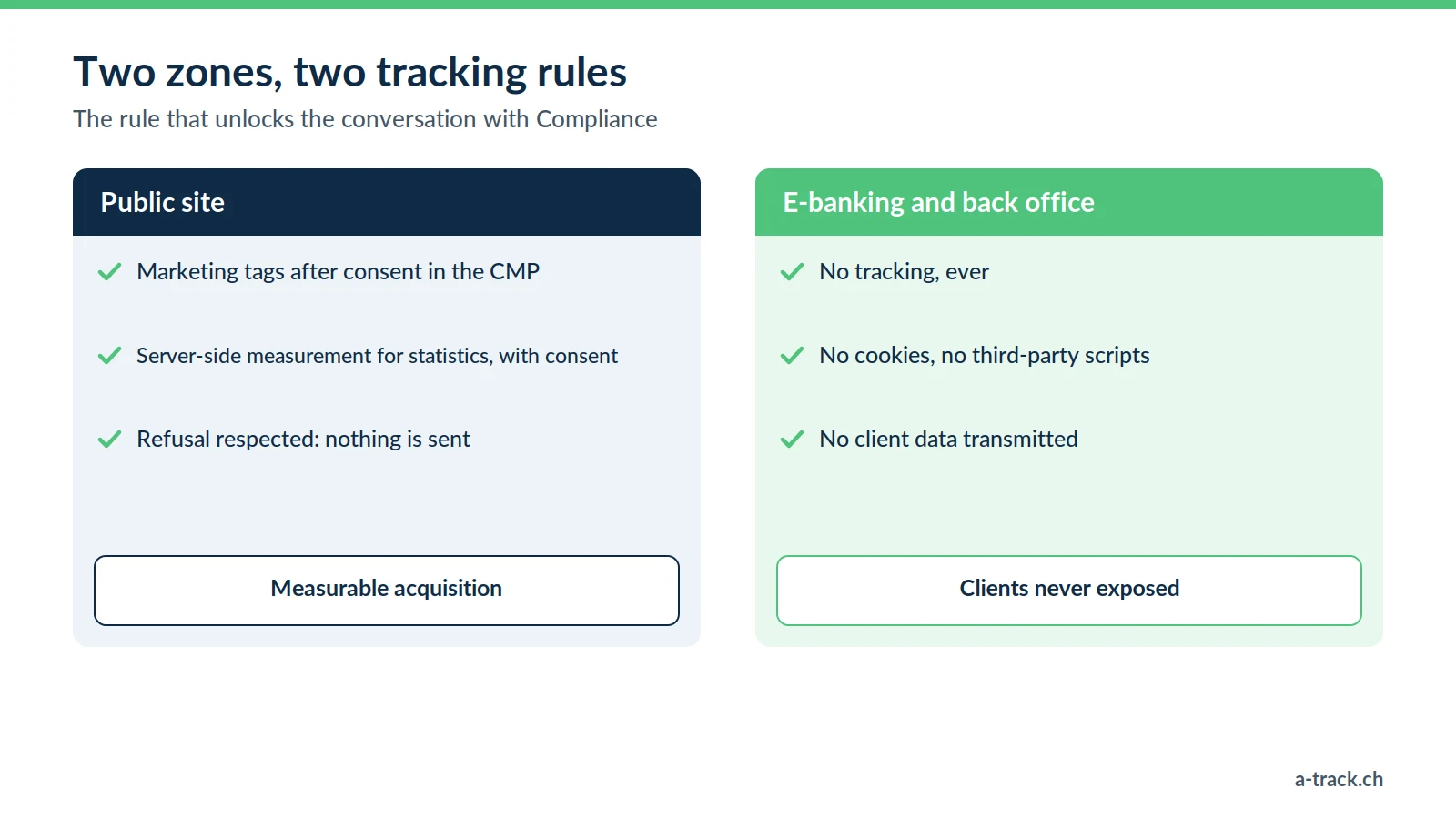
Public site: marketing tags only fire once the visitor has agreed in the banner (CMP). Remarketing remains possible for those who accept. On the server side, data is used only for statistical purposes, always with consent: a few generic conversions (for example "meeting request", with no product or amount) are sent via the Conversions API (CAPI), with no name, no clear-text email and no unnecessary personal data (PII).
E-banking and back-offices: no tracking at all, neither third-party scripts nor server events. A-Track never works inside these areas: measurement stops at the e-banking door.
The DPO documents exactly what leaves, to whom and why. Marketing finally sees which campaigns bring in real meeting or account-opening requests, not just clicks. See also our LinkedIn CAPI guide.
Three golden rules for a CMO in finance
If you run marketing at a financial institution, demand these guarantees from your agencies:
Zero tracking in e-banking and back-offices. No third-party script and no server event once the client is logged in: measurement is limited to the public website, with an allowlist of events.
A tracking server under your control. On your subdomain, with written cleaning rules, used only for statistical purposes and with the visitor's consent. Platforms still receive whatever you send: frame transfers to the United States, for example through the Swiss-U.S. Data Privacy Framework (in force since 15 September 2024) if the recipient is certified.
Up-to-date processing agreements. Check that your providers (agencies, tools, host) have signed data processing agreements that comply with the FADP.
A-Track tip
Before the workshop with Compliance, prepare a simple table: every event sent, its parameters, the receiving platform and the cleaning rule applied. That document, more than any diagram, gets a project through committee.
Conclusion: performance is not the enemy of security
Three actions to get started:
List the sensitive pages on your site and check what they send to platforms today.
Remove all tracking from e-banking and back-offices.
Have Compliance approve an allowlist of server-side events for the public website, with their cleaning rules.
For the full legal framework, see our FADP and GDPR compliance guide.
Is Compliance blocking your marketing tags?
A-Track designs an allowlist of server-side events with your DPO: truncated IPs, neutral URLs, hashed identifiers and no third-party script in the client area.
First step: a 30-minute call with an expert.