

Table of content
A fiduciary firm sells trust. Its prospects, entrepreneurs and business owners, often refuse to be tracked online, and that is their right. For G. Salerno & Associés, this meant Google Ads campaigns steered on half of reality, with a high cost per lead. Here is how measurement was rebuilt, without ever overriding a refusal.
In short
48.5% refusal of measurement cookies on the homepage, measured at G. Salerno & Associés.
Cost per lead down from CHF 68.81 to CHF 33.72 (-51%) between 2021-2023 and 2023-2026.
Qualified leads tripled, with the conversion rate rising from 2.77% to 8.66%.
The recipe: server-side tracking and Consent Mode v2 in advanced mode, respecting every visitor's choice.
The fiduciary paradox: prospects who do not want to be tracked
For a fiduciary like G. Salerno & Associés, discretion is part of the service. On the website, this shows up as very clear behaviour, recorded in the statistics of their tracking server (Stape):
48.52% of visitors refuse measurement cookies (opt-out) on the homepage.
19.72% of traffic comes through browsers that restrict tracking (Safari, Firefox).
The deadlock: with a standard Google Analytics setup, the firm could not see more than half of its traffic. Optimising Google Ads is impossible when one lead in two is not attributed. The cost per acquisition (CPA) was stuck at CHF 68.81, high even for B2B.
The solution: a filtering server and a well-configured Consent Mode
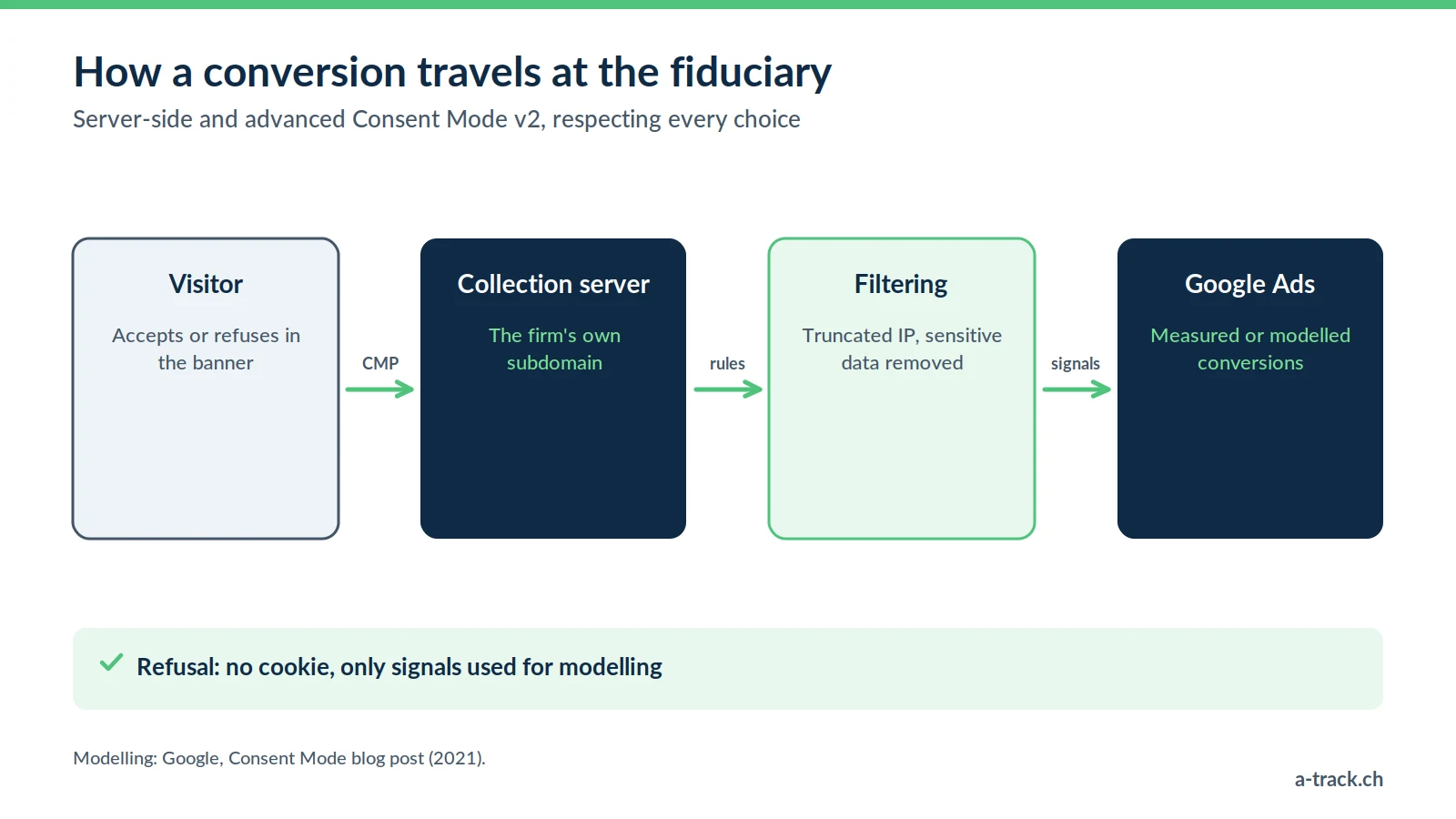
A-Track deployed a "privacy-first" architecture: server-side tracking combined with Google Consent Mode v2.
A filtering gateway between the site and Google
Data no longer goes straight from the browser to Google: it first passes through a collection server on one of the firm's subdomains.
Anonymisation: IP addresses are truncated before anything is sent.
Filtering: sensitive information is removed; Google only receives what attribution needs.
Where should this server be hosted? It depends on your internal policy: see our server-side hosting guide.
Consent Mode modelling in advanced mode
With almost one visitor in two refusing, Consent Mode's advanced mode makes the difference. When a visitor refuses, no tag sets a cookie; Google only receives cookieless signals and models the missing conversions. According to Google (2021), this modelling recovers more than 70% of ad-click-to-conversion journeys lost to cookie refusals.
A-Track tip: we recommend advanced mode to all our clients. It tracks no one against their will, but it gives algorithms the overall picture. Simply mention it in your privacy policy.
The results: cost per lead cut in half
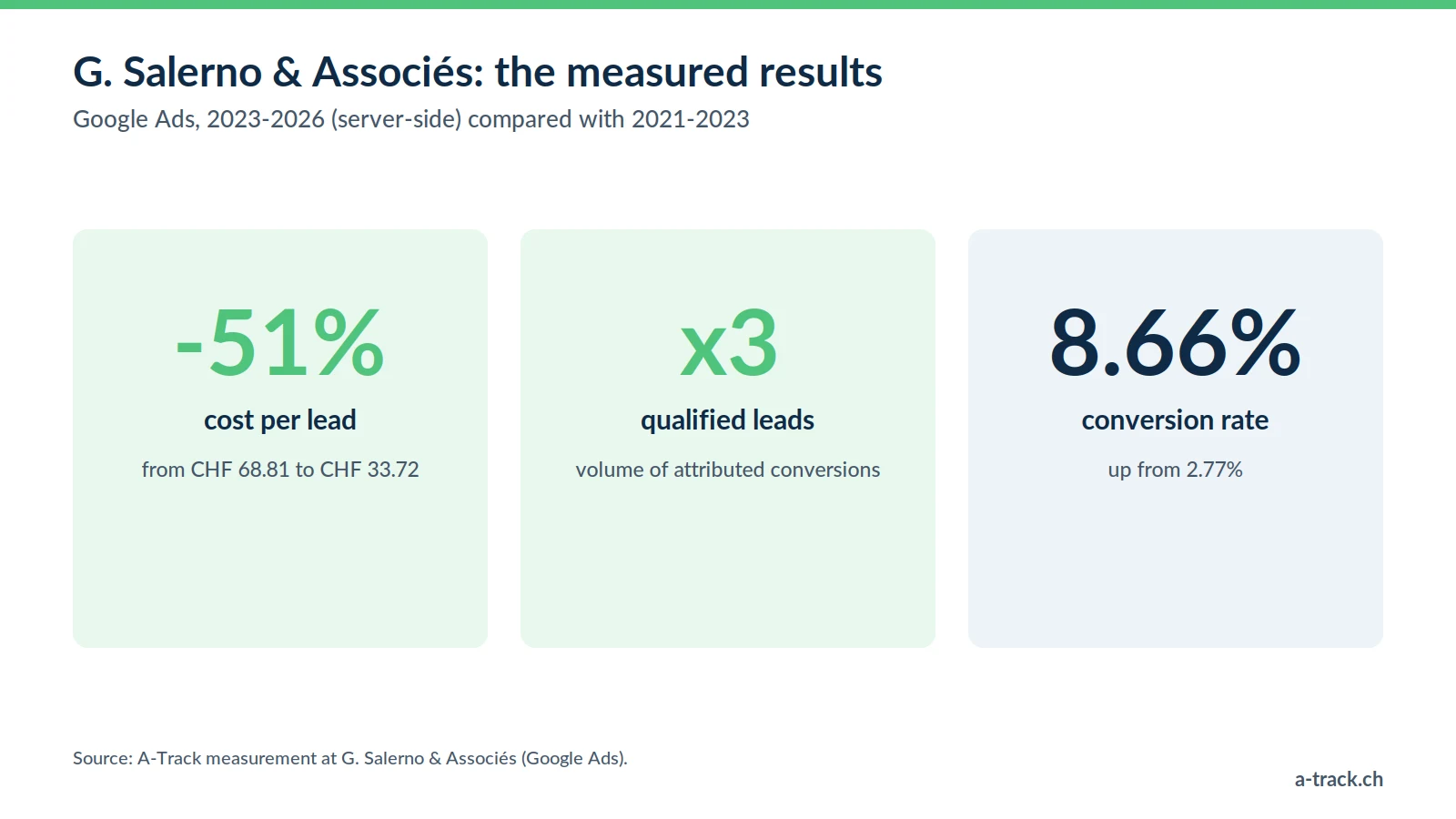
At G. Salerno & Associés, we compared 2023-2026 (server-side) with 2021-2023 (standard tracking) in Google Ads. These are results measured for this client over these periods, not a general promise.
Acquisition cost halved
Before: CHF 68.81 per lead.
After: CHF 33.72 per lead, or -51%.
Fed with more complete data, the algorithm targets better: each franc invested brings in roughly twice as many qualified contacts.
Qualified leads tripled
The measured conversion rate rose from 2.77% to 8.66%.
In our analysis, much of the gap comes from measurement capability: these conversions existed but were not attributed to campaigns. Now visible, they allow budget to go to the keywords that really perform.
Technical focus: Safari visitors (ITP)
Apple devices are very common among business owners and freelancers. Safari strongly limits cookie lifetime: according to WebKit, cookies created in JavaScript are deleted after 7 days without interaction, and after 24 hours in some cases of tracked links (ITP).
Over 90 days, 3,645 visits to G. Salerno & Associés were affected, i.e. 19.72% of traffic.
With first-party cookies set by the firm's own server, a quote request can be linked to a visit made three weeks earlier.
Note: WebKit also caps at 7 days cookies set by a server whose IP address is considered third-party. How the subdomain is configured matters as much as the tool.
Conclusion: confidentiality is not the enemy of marketing
The G. Salerno & Associés case shows that an infrastructure which strictly respects refusals can also make campaigns more profitable. Three actions for a confidential B2B business:
Measure your real refusal rate and compare CRM leads with Google Ads conversions.
Route measurement through your own server, with data filtering.
Enable Consent Mode v2 in advanced mode and document it.
For the full method, read our marketing performance measurement guide.
Is Your Cost per Lead Stagnating?
This may be because you are only seeing half of your results. Let's conduct an audit to uncover the reality of your numbers.