

Table of content
People who visit an addiction support website do not want to be followed. They are looking for information or a phone number, often at a difficult moment. For Carrefour addictionS, the challenge was twofold: respect that discretion without exception, and still be able to show what the website achieves.
In short
76.8% cookie refusal on page views, measured at Carrefour addictionS over 90 days.
First-party measurement on the site's own subdomain made more than 31% of visits visible that standard tools were not counting.
Every refusal is respected: no advertising tag fires without consent.
For a public-interest organisation, aggregated statistics are enough.
The context: anonymity as a condition for seeking help
Carrefour addictionS is the Geneva umbrella organisation for addiction prevention (alcohol, gambling, screens, tobacco and other substances). It receives financial support from the Republic and Canton of Geneva.
Its visitors are not buying anything: they want help, for themselves or for someone close. Simply viewing a page about alcohol can say a lot about a person. This kind of information relates to health, which the FADP classifies as sensitive personal data (Art. 5(c) FADP). Unsurprisingly, 76.8% of page views are linked to a tracking refusal (opt-out) in the cookie banner.
The challenge: reporting on a public mission without reliable data
An organisation funded by public authorities has to show what it delivers:
How many people view the guidance pages?
Which topics (alcohol, screens, gambling) are growing?
Do people come back, a sign that a support journey is taking shape?
With standard client-side tracking, nearly eight visitors in ten refused tracking, and some of those who accepted remained invisible for technical reasons. Activity reports were built on a fraction of reality.
The solution: first-party measurement that respects every refusal
A-Track's goal was not advertising but reliable, protected statistics. We deployed a server-side tracking architecture built on three principles:
First-party measurement: scripts and requests go through a subdomain of the site, which makes measurement resilient to browser and blocker restrictions.
The visitor's choice decides: the CMP controls what is sent. A refusal remains a refusal.
The server filters: no full IP address and no persistent identifier for visitors who refused.
The results measured over 90 days
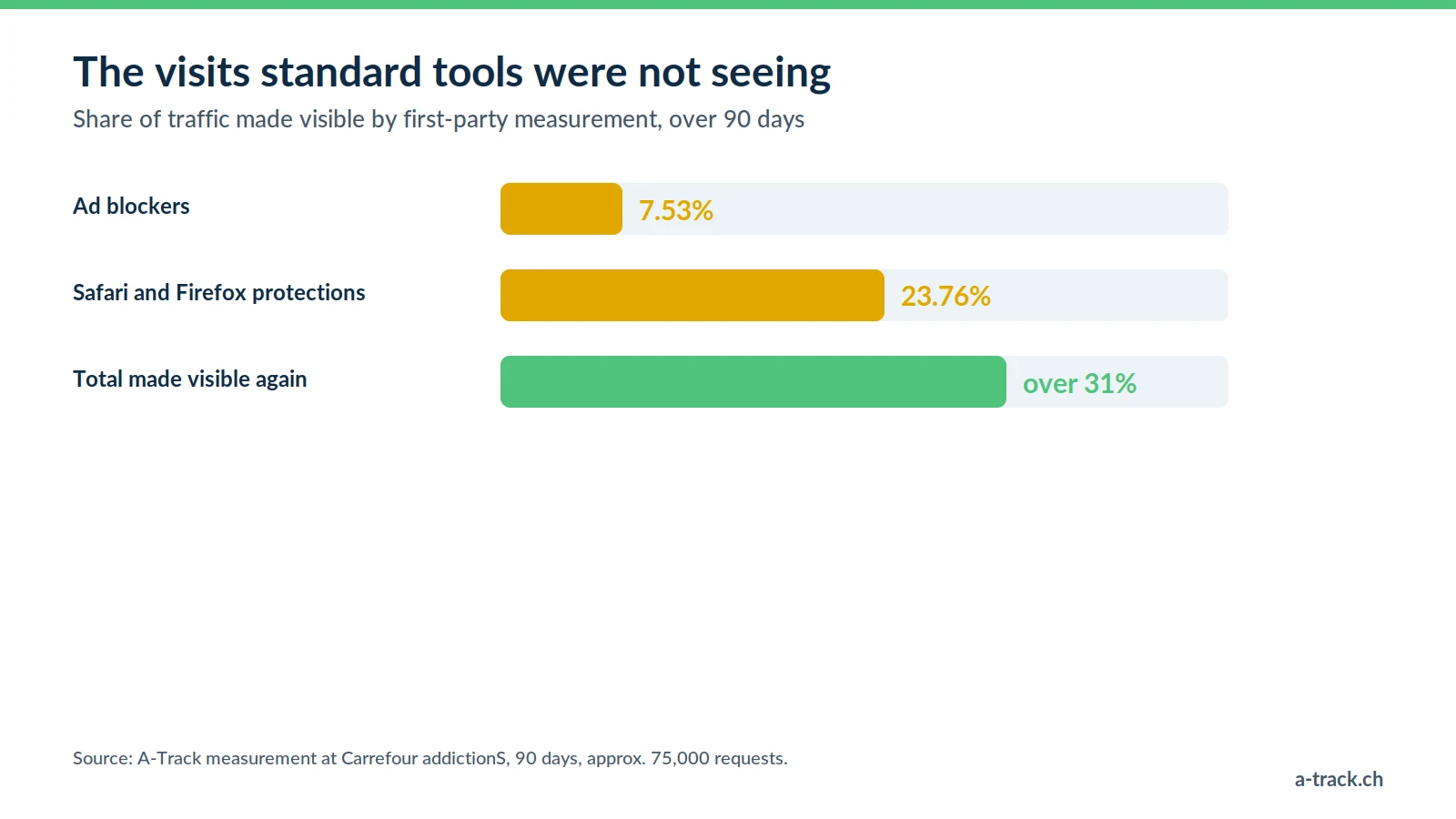
Over 90 days and around 75,000 requests, the infrastructure revealed the extent of signal loss. These are this client's figures for this period, not a promise for any other website.
Real visits that were not showing up
7.53% of traffic was blocked by ad blockers.
23.76% was restricted by browser protections (Safari ITP, Firefox ETP).
In total, more than 31% of visits became visible again.
On the script side, 20.15% of loads failed from third-party domains. Served from the site's own subdomain, they load normally, and the banner remains the only decision-maker.
Cookie Keeper: understanding return visits
A support journey takes time: people look for information, leave and come back a few weeks later. Yet Safari deletes cookies created in JavaScript after 7 days without interaction, so every return looks like a new visitor. For visitors who accepted measurement, the Cookie Keeper feature restored 99.96% of the identifiers affected by ITP. Return visits can be read again.
Consent: what happens when the visitor says no
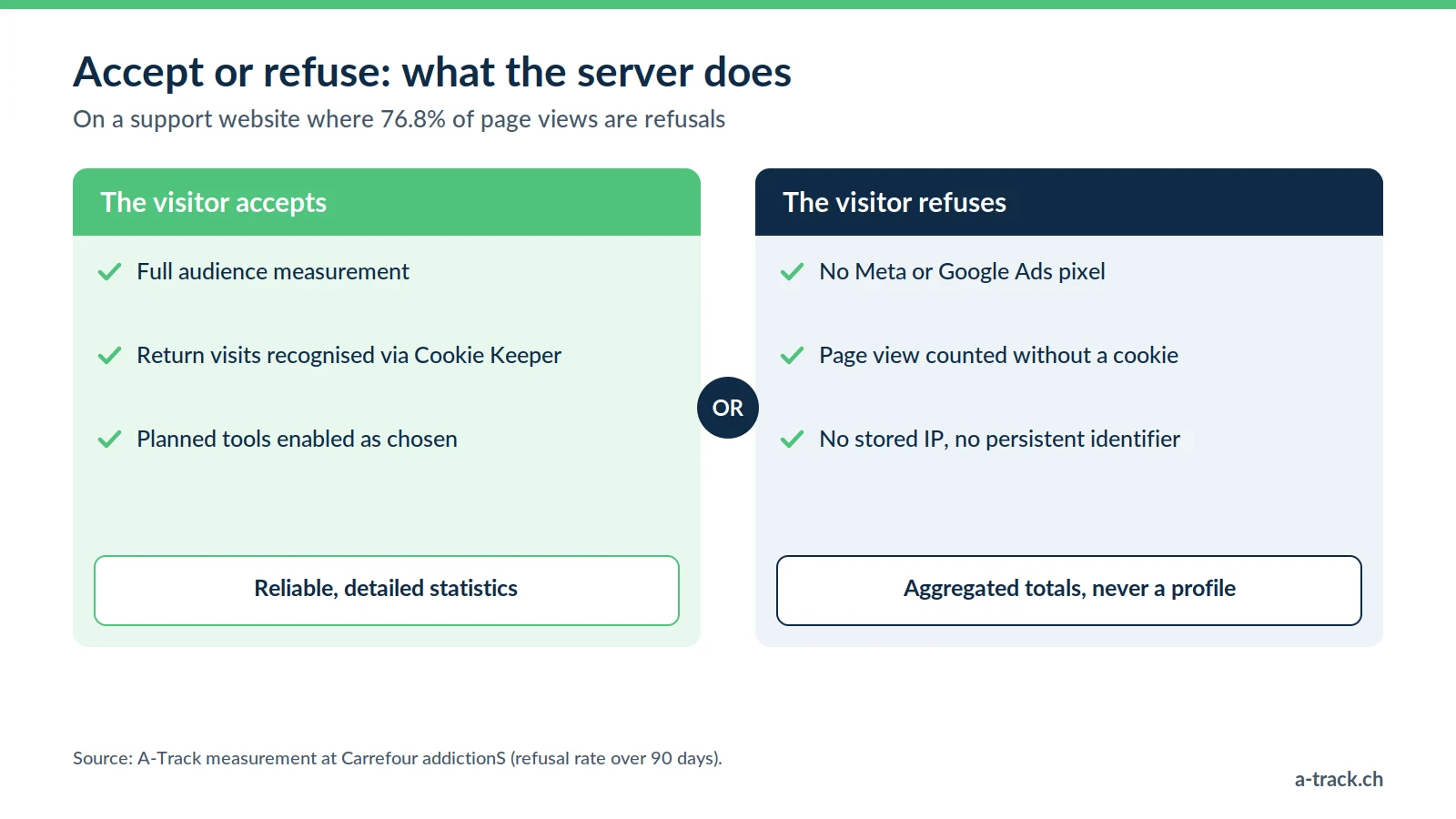
How do you steer when most people say no? Three rules.
No advertising tag without consent. When a visitor refuses, no Meta or Google Ads pixel fires. In Switzerland, the Telecommunications Act (Art. 45c) requires information and the right to refuse; for visitors in the EU, prior consent is required.
Aggregated statistics, without identification. The server can count a page view or a guidance click with no cookie, no stored IP address and no persistent identifier. The count feeds totals, never a profile.
The site works for everyone, whether measurement is accepted or not.
A-Track tip: on a health or social care website, agree a short list of aggregated indicators with management (topics viewed, clicks to a helpline, return visits) and measure nothing else. For EU visitors, have your legal counsel validate cookieless measurement.
On the consent signals sent to Google, read our Google Consent Mode v2 guide.
Conclusion: measuring impact without exposing the people you serve
Advanced tracking is not just for e-commerce. For NGOs, foundations, hospitals and public services, what matters is measuring real impact. Three actions to get started:
Measure your real refusal rate and the share of traffic your tools cannot see.
Move measurement to your own subdomain, and let the CMP decide.
Limit collection to aggregated statistics when the subject is sensitive.
Our FADP and GDPR compliance guide sets out the method.
Do you manage sensitive data or a public service?
Discover how to obtain reliable statistics without compromising the privacy of your users.