
Table of content
Guest column by Max Andersen, founder & CEO of Simba Digital
At Simba Digital, we hold one simple conviction: in the age of algorithms, a company only becomes "the king of its savanna" on one condition, by building a real acquisition system rather than stacking campaigns. At the event we co-hosted with A-Track in May 2026, we presented our vision of digital growth, Digital Growth in the Algorithm Era. Marketing has changed in nature: on Google Ads, Meta or LinkedIn, we no longer steer campaigns, we train algorithms. And those algorithms are worth exactly what the data you feed them is worth. That is precisely why we work hand in hand with A-Track. Here is our method, and how our two crafts fit together.
Yesterday we steered campaigns. Today we train algorithms
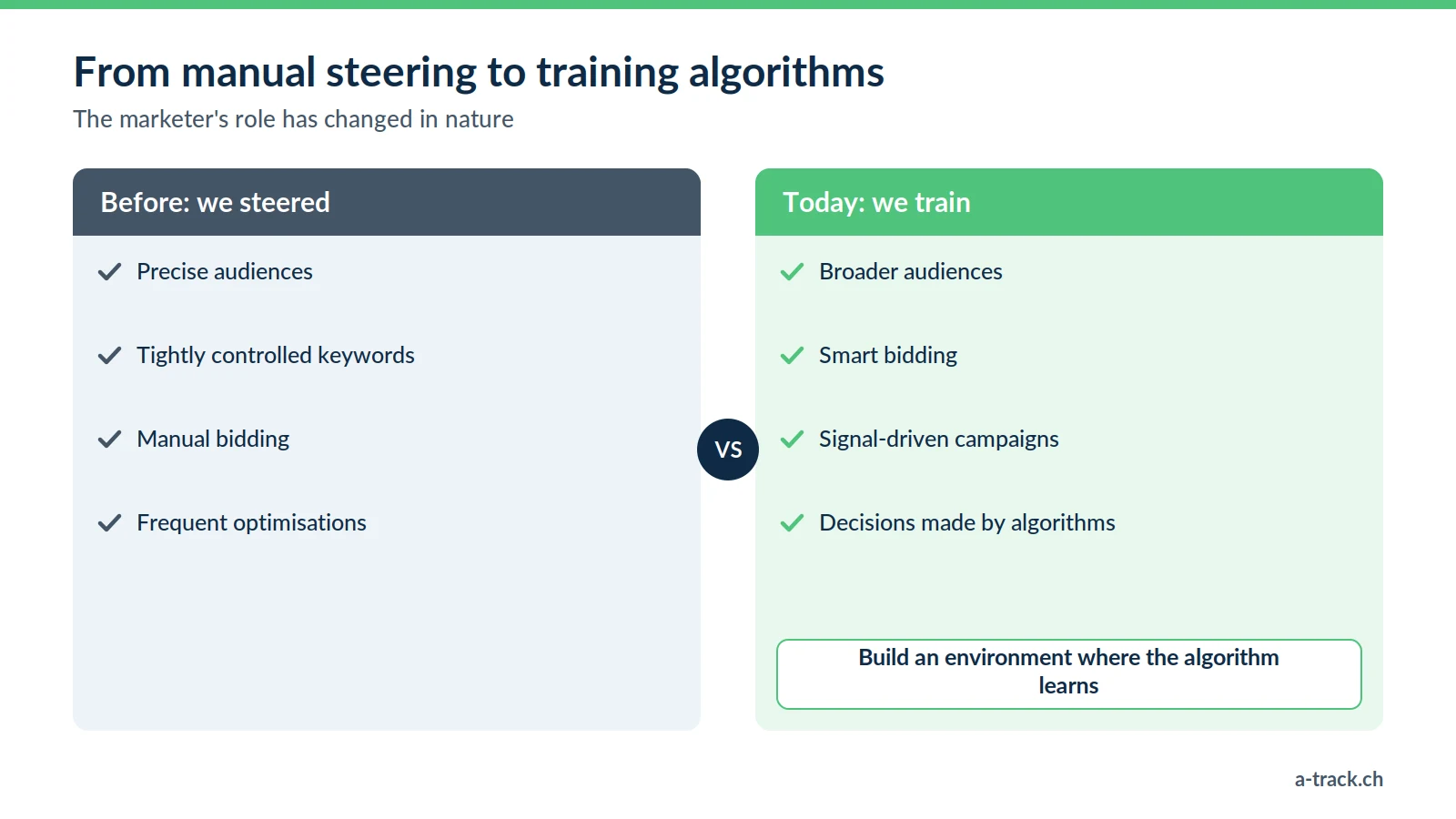
Marketing in the age of algorithms rests on a shift of role. Yesterday, the job was to set everything by hand: precise audiences, tightly controlled keywords, manual bids, detailed segmentation, frequent optimisations. Today, the platforms make those decisions for us: broader audiences, smart bidding, stronger automation, campaigns driven by signals, decisions taken by the algorithms.
Our role hasn't disappeared: it has changed in nature. It is no longer about controlling every lever, but about creating an environment where the algorithm can learn correctly. It's a different craft, and it's exactly where many companies go wrong, because they keep tweaking campaigns instead of building a system.
How an advertising algorithm actually learns
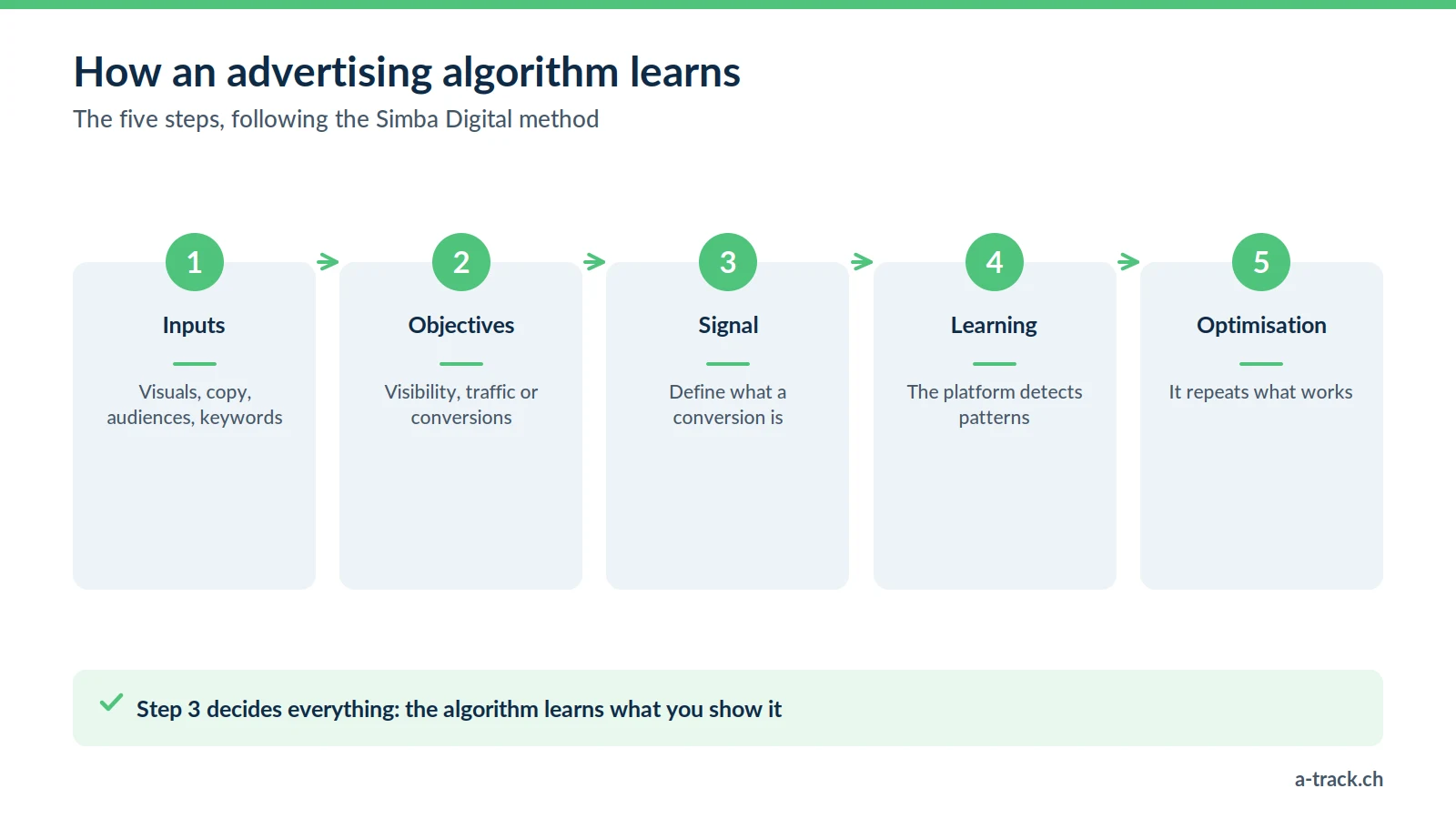
To train an algorithm well, you need to understand how it works. We sum it up in five steps:
Inputs: the campaign's starting conditions (visuals, copy, age, interests, keywords).
Objectives: what we ask the campaign to deliver (visibility, engagement, traffic or conversions).
Signal: we tell the algorithm what counts as a "conversion".
Learning: the campaign runs, the platform detects patterns.
Optimisation: the platform reproduces what works for the given objective.
Here is the most important point: an algorithm has no business common sense. It doesn't spontaneously know what a "good customer" is. It optimises the objective you've given it, not the outcome you're hoping for. Optimising on form submissions? You'll get more forms, spam included. Sending no sales value? The algorithm won't tell a small client from a big one. The machine learns fast, but it learns exactly what you show it.
The foundation: reliable data, and why we work with A-Track
Everything therefore hinges on step 3: signal quality. And a quality signal starts with reliable data. Without reliable tracking, the algorithm learns from an incomplete view of reality, and optimises in the dark.
The whole challenge is to separate signal from noise:
Signal, to amplify: real conversions, qualified leads, sales, customer value, CRM data.
Noise, to filter out: spam form fills, unqualified leads, low-intent clicks, misconfigured conversions, incomplete data.
This is exactly A-Track's craft. While we at Simba Digital run the advertising, A-Track builds and secures the foundation: reliable, first-party server-side tracking on the site's own subdomain, more complete conversion measurement despite browser restrictions, and an infrastructure compliant with the Swiss FADP and the GDPR. Between ad blockers, the limits browsers place on cookies (such as Safari's ITP) and tighter regulation, a significant share of conversions never reaches the algorithm. A-Track recovers signals lost for technical reasons and guarantees clean data, while always respecting each visitor's choice: a refusal of consent stays a refusal.
It's a clear division of labour: without that foundation, everything we build on top rests on sand. Data reliability isn't a technical detail, it's the most valuable asset of a modern advertising strategy.
The foundation isn't enough: content, media management and A/B testing
Let's be clear: reliable data is a necessary, but not sufficient, condition. A solid foundation doesn't build a house on its own. Once A-Track has laid the foundations, you have to build on top of them, and that is our craft at Simba Digital.
In practice, an algorithm constantly tests combinations of audiences and messages, then reinforces the ones that generate the best signals. But it can only test the material it's given. That material is three things:
Content and creative. Visuals, hooks, videos, landing pages: without quality content in sufficient quantity, the algorithm has nothing to optimise.
Campaign management and structure. Each campaign must have a clear role in the customer journey: awareness creates exposure, engagement identifies interest, traffic feeds the ecosystem, conversion captures demand, retargeting reactivates intent.
A rigorous A/B testing methodology. The algorithm reinforces what works, but it's up to us to test audiences, creatives and messages methodically, and to keep only what actually creates value. A/B testing isn't a gadget: it's the discipline that turns reliable data into profitable decisions.
Reliable data on one side, content and media management on the other: one doesn't work without the other.
Not all signals are created equal
A classic mistake is to treat every conversion the same. Yet:
A click is not a lead. A lead is not a qualified lead. A qualified lead is not a sale. A sale is not necessarily a profitable customer.
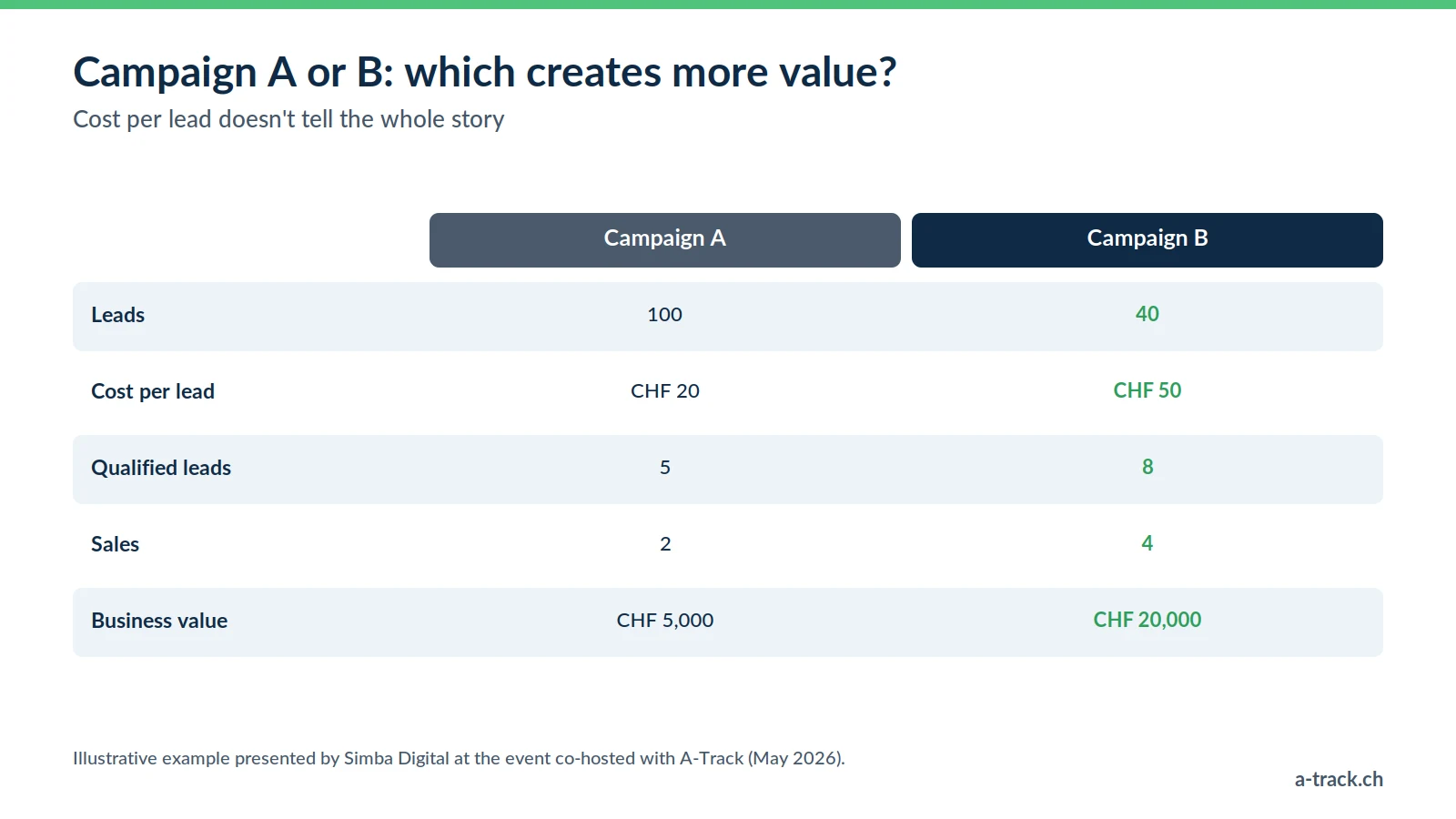
The real challenge is to bring the signals sent to algorithms closer to actual business results. A simple example shared at our event illustrates it perfectly:
Leads: 100 (campaign A), 40 (campaign B)
Cost per lead: CHF 20 (A), CHF 50 (B)
Qualified leads: 5 (A), 8 (B)
Sales: 2 (A), 4 (B)
Business value: CHF 5,000 (A), CHF 20,000 (B)
Which is better? Not the one with the most leads, nor the one with the lowest cost per lead, but the one that generates the most business value. As long as the algorithm only receives lead volume, it will favour campaign A. Feeding it lead quality and the real value of each sale, by connecting the CRM to the advertising platforms, changes everything.
Conversely, six mistakes quietly sabotage learning: optimising on the wrong event, judging a campaign on cost per lead alone, not feeding back lead quality, over-segmenting campaigns, changing them too often, and, the costliest of all, siloing tracking, media and business.
Two crafts, one acquisition system
That last mistake explains our collaboration. A-Track and Simba Digital don't do the same job, but we serve the same goal: your growth.
A-Track lays the data foundations: server-side tracking, reliable signals, FADP/GDPR compliance.
Simba Digital builds on top: content, creative, campaign structure and management, A/B testing methodology and optimisation.
Brought together, these two crafts form a complete acquisition system resting on four pillars: solid data foundations (A-Track), well-structured campaigns, quality learning and intelligent optimisation (Simba Digital). That is the conclusion of our presentation, and we sum it up in one sentence: stop thinking in "campaigns", start thinking in "acquisition systems".
Conclusion: train your algorithm, not just your campaigns
In the age of algorithms, performance is no longer won by manual tweaking, but by the quality of what you teach the machine. That requires two inseparable things: a foundation of reliable data, and a layer of content, media management and rigorous testing built on top. Neither works without the other.
That's the whole logic of the partnership between A-Track and Simba Digital, and ultimately what separates a company that endures its campaigns from one that becomes the king of its savanna.
Are your algorithms learning from reliable data? Start with an audit of your conversion signals with A-Track's Tracking & Compliance service, or contact the A-Track team. And to turn that foundation into growth, let's talk at Simba Digital; you can also find more of our thinking on our podcast La Savane.