

Table of content
Picture the scene. You invite friends to dinner. Everything is ready: a record playing, the tablecloth ironed, the lights dimmed, a meal that promises to be delicious. Your guests sit down, relaxed.
Suddenly, fifteen strangers walk in from the terrace with notebooks. A guy from Google times how long your guest takes to chew. Another from Meta photographs their shoes. Someone from TikTok notes every turn of the head. And a dozen data brokers jostle to listen in on the conversation.
Your guests, horrified, get up and leave. In digital marketing, our reflex has long been to shout after them: "Why are you leaving? You're ruining my ad budget!" We treated data like oil to be extracted. We acted as watchmen, when we should have acted as hosts.
In short
Too many third-party scripts in the browser pushed visitors towards ad blockers, and browsers towards stricter protections.
Server-side tracking acts as a butler: a single point of contact, your server, which decides what leaves.
Hospitality has one rule: you only talk about guests who agreed. A refusal stays a refusal.
Clean, consented data feeds your campaigns and your customer knowledge better.
From surveillance to courtesy: the end of digital stalking
For a decade, the industry confused optimisation with invasion. We let dozens of pixels and third-party scripts settle into our visitors' browsers, turning our websites into draughty railway stations.
The response was brutal, but healthy:
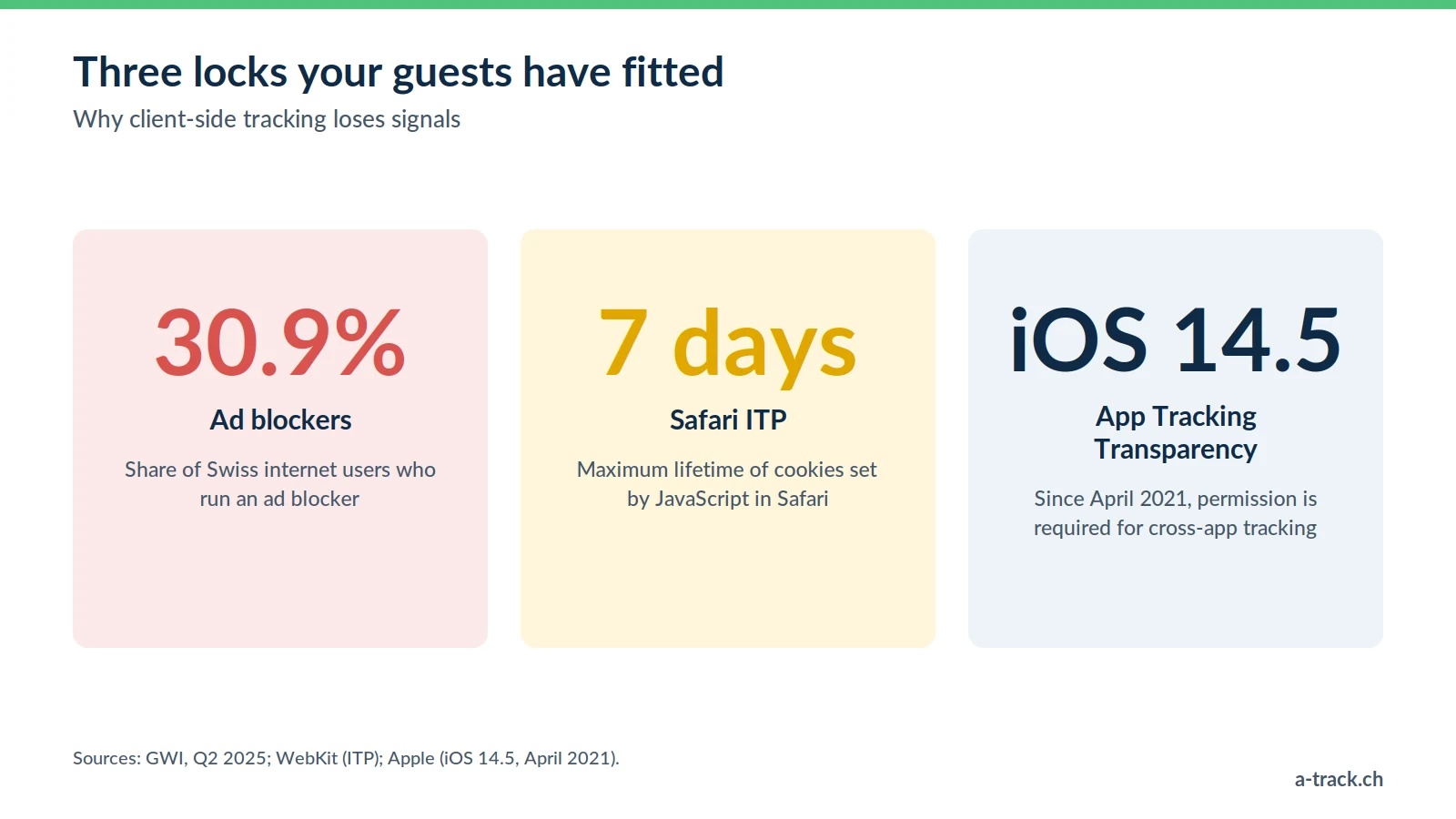
Visitors installed blockers: according to GWI (Q2 2025), 30.9% of Swiss internet users run an ad blocker.
Apple locked down Safari with ITP, which caps cookies set by JavaScript at 7 days, then iOS 14.5 (April 2021) introduced App Tracking Transparency.
Switzerland strengthened its protection with the revised FADP, in force since 1 September 2023.
If you still rely on classic (client-side) tracking, part of your conversions therefore never reaches Google Ads or Meta. Your dinner is spoiled because your guests have, quite logically, locked their windows. Without those signals, the algorithms bid on an incomplete picture, and your leads cost more than they should.
The secret of hospitality: a butler (server-side)
Digital hospitality is not about stopping measurement. It is about taking back control of your house and telling the ad platforms: "You no longer come into my home to pester my guests. If you want information, speak to my butler."
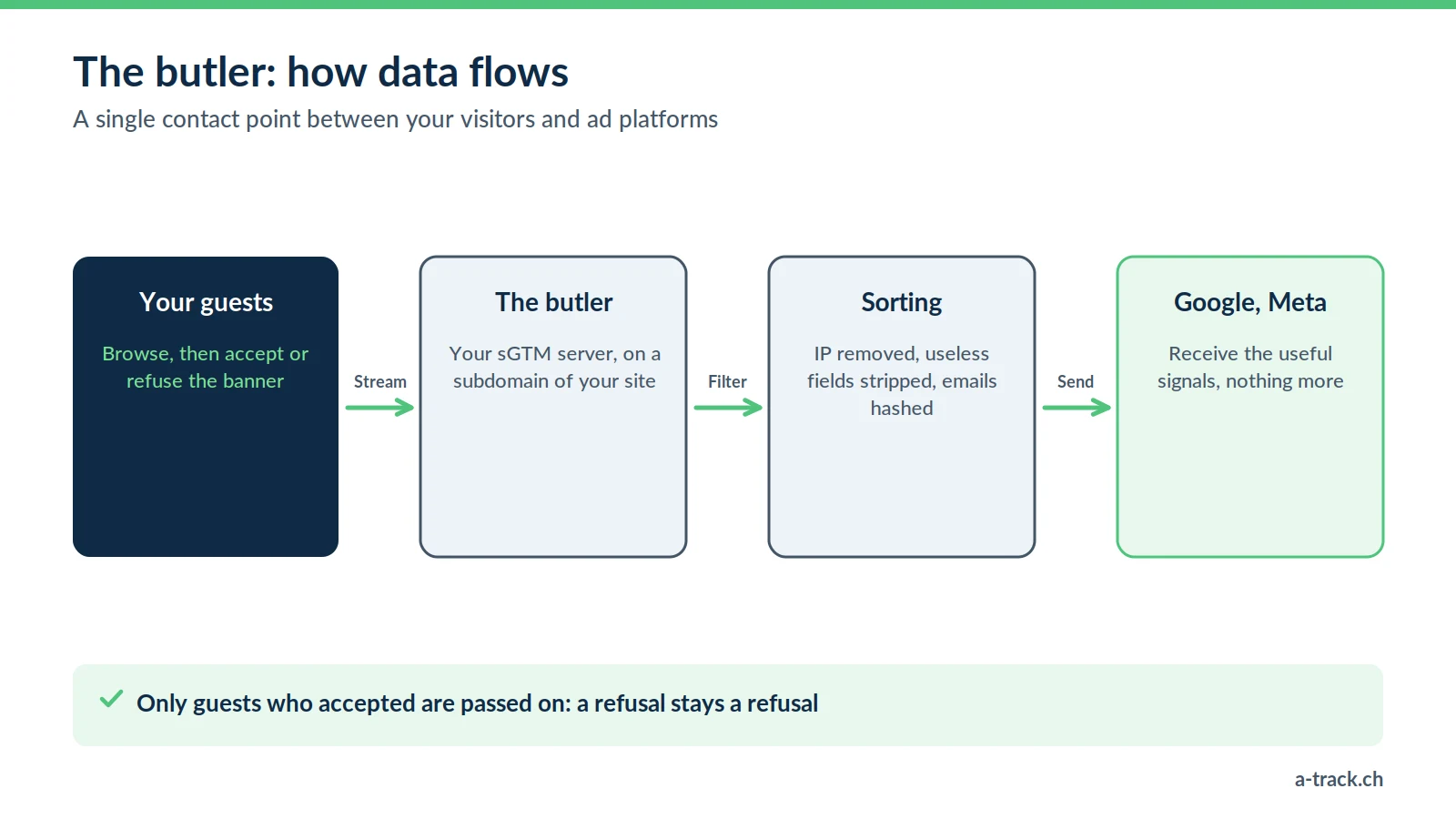
That is exactly what server-side tracking does. Instead of loading one script per platform, the browser sends a single stream to your own server, set up on a subdomain of your site. It sorts, cleans and decides what leaves, then steps out to meet Google or Meta on the pavement:
"Here is the summary of the evening. Three guests who accepted cookies bought this product. I will not give you their IP address or anything you do not need: only the signals your algorithms require."
Two rules of etiquette always apply:
The butler respects everyone's choice. Your cookie banner remains essential, and a guest who refuses is not tracked. Server-side makes measurement resilient to technical restrictions (browsers, blockers), never to refusals.
Discreet does not mean anonymous. A hashed email is still pseudonymised personal data: it must be covered in your privacy policy.
The result: consented conversions that reach their destination more reliably, deduplicated events, lighter pages. And a better fed algorithm works better. To see the effect on your own campaigns, compare reported conversions with real sales before and after the switch.
A-Track tip
Run the dinner test: open your site in a private window, refuse all cookies, and check in your browser's Network tab how many third-party domains are still contacted. Every unexpected domain is a stranger at your table.
Well-served data, and the AI challenge
Data is not the enemy of customer experience: used well, it is a mark of attention, like the bartender who prepares your favourite drink before you order it.
It also matters for a new challenge: visibility in AI answer engines (AEO). ChatGPT and Google's AI overviews do not read your pixels: they read your content, its structure and your reputation. But reliable measurement tells you which pages and questions actually bring in customers, and therefore which content to strengthen. We cover this link between consent, SEO and AEO in our article on IAB TCF 2.3.
You are no longer just building a database: you are building a relationship your customers accept, and your teams understand.
Conclusion: take back the keys to your house
FADP and GDPR compliance is not just a legal constraint: it is the etiquette of modern hospitality. The companies that do best will not be those with the biggest budgets, but those with the cleanest data and the healthiest relationship with their customers.
Count your uninvited guests: list the third-party scripts loaded on your site.
Check the front door: does your banner really block everything before the choice?
Hire a butler: centralise collection on your own server. To go further, read why you should take back ownership of your data.
Your marketing performance, and your guests, will be better for it.
How many strangers are still sitting at your table?
A-Track lists the third-party scripts loaded on your site, checks what still leaves after a refusal and shows how a first-party server filters what goes out.
Your free tracking and compliance audit is delivered within 48 hours.