

Table of content
You have invested in a great website, expensive campaigns and a solid content strategy. Every month, your agency shows you curves, clicks and impressions. Everything seems fine.
Yet a silent reality is eating into your budget and may expose you legally, and few agencies raise it on their own: your tracking may be outdated, poorly wired to consent, and costing you money.
In short
Ad blockers, browser restrictions and cookie refusals deprive your campaigns of part of their conversions.
Many setups do not truly respect the visitor's choice: that is an FADP and GDPR risk.
Server-side tracking makes measurement more reliable and more controllable, without ever overriding a refusal.
Agencies and brands both benefit from putting the topic on the table.
The lie of omission of client-side tracking
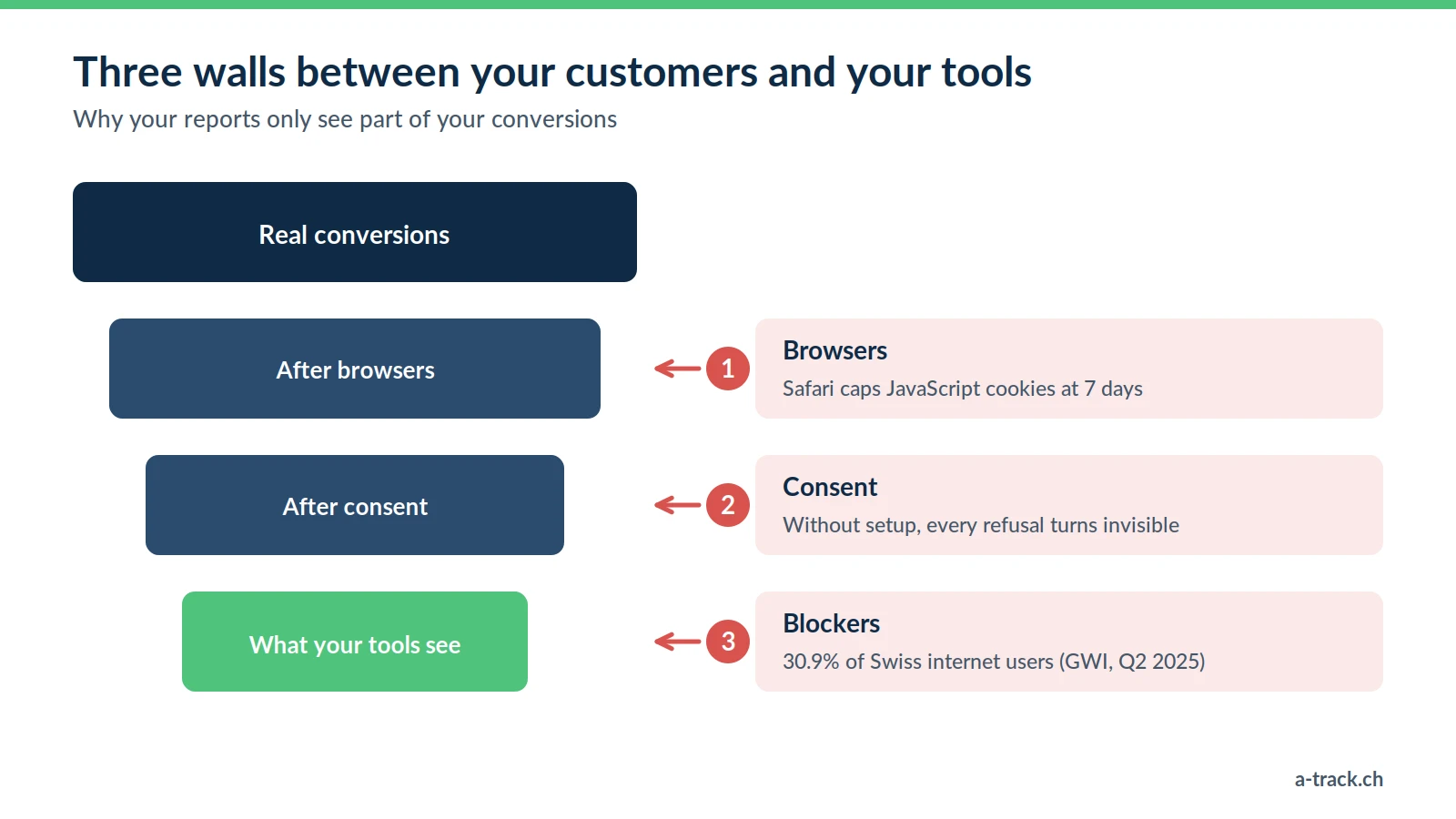
Most websites still rely on tracking that runs in the browser, such as the Meta pixel or the standard Google Analytics tag. Three problems follow:
Legal risk: many tags fire before the visitor's choice or ignore a refusal. In Switzerland, the FADP provides for fines of up to CHF 250,000 against the individuals responsible, for intentional violations; in the EU, the GDPR goes up to EUR 20 million or 4% of worldwide turnover.
Data loss: according to GWI (Q2 2025), 30.9% of Swiss internet users run an ad blocker; Safari caps cookies set by JavaScript at 7 days (ITP); and every cookie refusal legitimately reduces the observed volume.
Eroding performance: fewer conversions reported, and Google Ads and Meta algorithms optimise on an incomplete picture. ROAS drops, not because your ads are bad, but because measurement is failing.
Why your agency does not talk about it
This is the heart of the taboo. For a creative or media agency, raising the subject often means acknowledging a technical and legal complexity outside its core business:
Technical complexity: server-side tracking requires data engineering skills, not just marketing.
A cost that is hard to sell: without some education on data governance, the client does not see the point.
Result: the status quo is maintained, at the expense of the client's performance.
The solution: server-side tracking and compliance
With server-side tracking, the browser sends a single stream to a server you control, on a subdomain of your site, which then passes the data on to the platforms. The benefits:
Control: you decide which data goes to Google, Meta or LinkedIn, and you strip what is not needed (IP, sensitive parameters).
Reliability: first-party measurement, resilient to the technical restrictions of browsers and blockers.
Performance: consented conversions passed on more reliably, deduplicated, sometimes enriched (enhanced conversions), for better fed algorithms.
What server-side tracking does not do: replace the cookie banner or track a visitor who refused. A refusal stays a refusal. Details in our FADP and GDPR compliance guide.
A-Track: a technical partner for agencies and brands
We are not a media agency: we specialise in marketing measurement and data governance. Agencies excel at creation and strategy; we handle tracking and compliance, alongside them.
For brands: every franc invested is measured correctly, in line with the law.
For agencies: you stay focused on performance and creativity, without carrying the technical complexity.
Conclusion: the questions to ask your agency
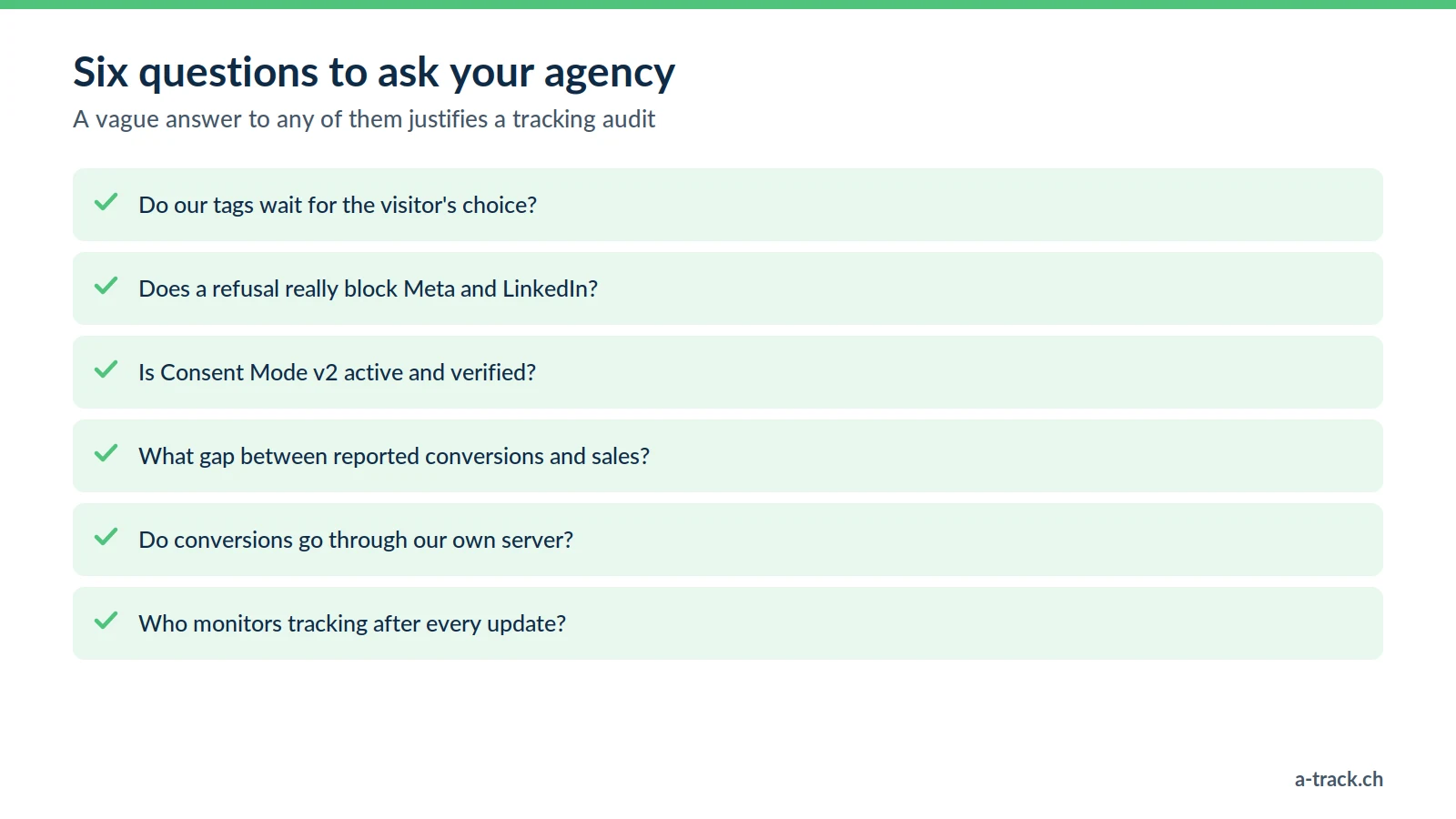
Before your next monthly report, ask:
Do our tags really wait for the visitor's choice?
Is Consent Mode v2 active and verified?
What is the gap between Google Ads, Meta conversions and our real sales?
Do our conversions go through a server we control?
If the answers are vague, an audit is needed. For the method, see our tracking audit checklist.
Finally ask your agency the tracking question
Agency or brand, A-Track checks how consent is wired, whether Consent Mode v2 works and how large your conversion gap is, then helps you discuss it openly.
Start with a 30-minute call with an expert.