

Table of content
You install a cookie banner to become compliant, and the next day your Google Ads campaigns only see part of your leads. That is what happened to SunStyle: a 35% gap between the real leads in the CRM and those visible in Google Ads.
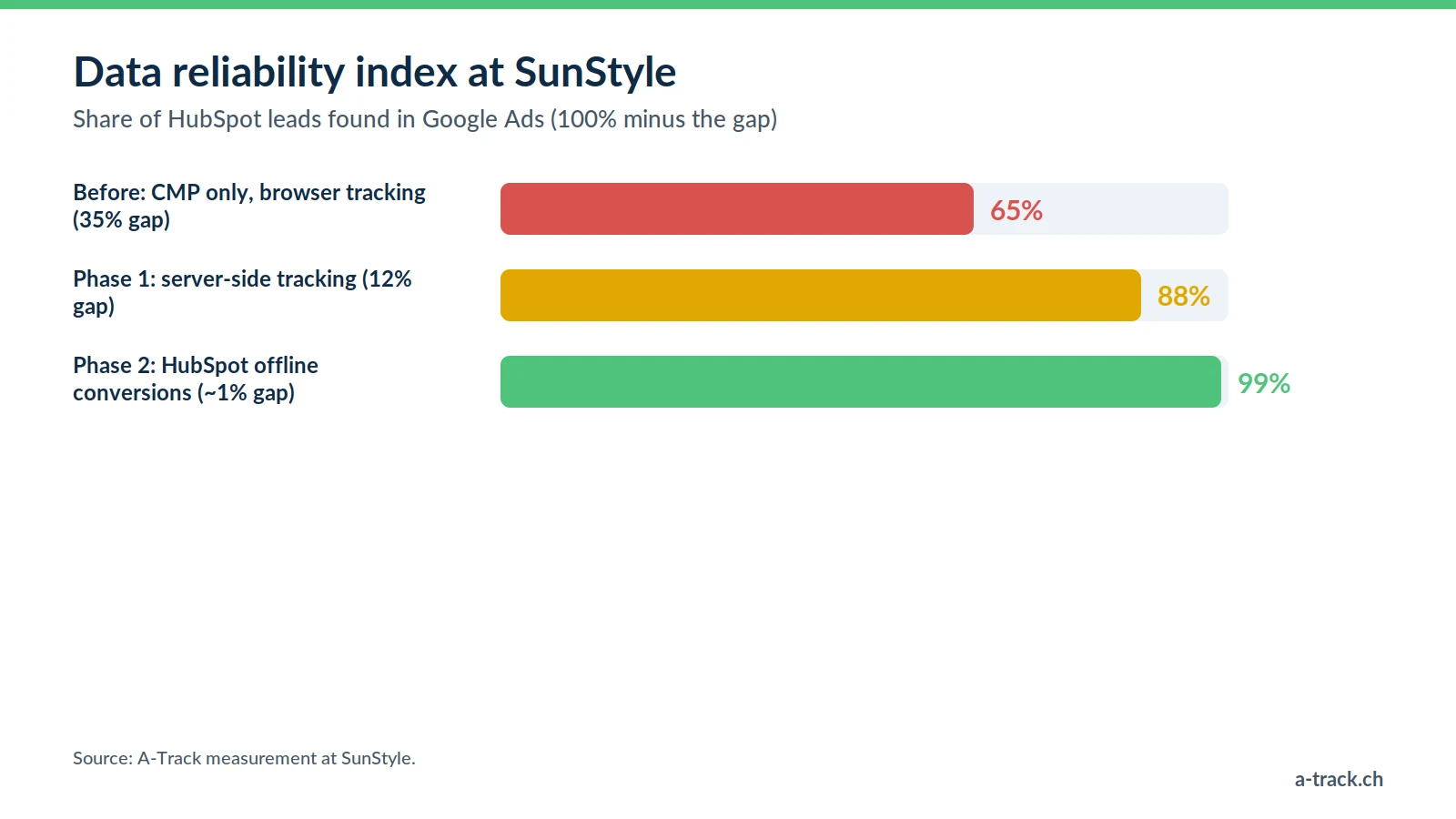
In two phases, server-side first, then a HubSpot integration, A-Track raised the data reliability index from 65% to 99%. Here is how.
In short
Client: SunStyle, a maker of aesthetic solar roofs, with a long sales cycle and high deal value.
Problem: after the Complianz CMP went live on WordPress, 35% of CRM leads were missing in Google Ads.
Solution: server-side tracking, then conversion imports from HubSpot into Google Ads.
Results measured over one year: a 99% data reliability index, a CPA down by CHF 33 and 312 more conversions.
The context: when compliance blinds your campaigns
SunStyle, which describes itself as a global leader in solar roofing, sells cutting-edge technology: photovoltaic tiles built into the roof. The sales cycle is long, the deal value high, and every lead counts.
The WordPress site had to comply with the FADP and the GDPR. The team therefore installed the Complianz cookie management solution. As soon as the banner went live, the dashboards dimmed:
Between cookie refusals, ad blockers and browser restrictions (Safari's ITP), the gap between CRM leads and leads reported in Google Ads reached 35%.
Deprived of roughly a third of its signals, Google Ads Smart Bidding optimised bids less effectively. Cost per lead went up.
Compliance was not the problem: measurement that still depended entirely on the browser was.
Phase 1: server-side tracking cuts the gap from 35% to 12%
Step one: stop relying solely on the visitor's browser, which is exposed to blockers and shortened cookies.
We deployed server-side GTM: events pass through a server controlled by SunStyle, on a subdomain of the site, before being sent to the platforms. The visitor's banner choice still applies: a refusal stays a refusal.
Intermediate result: the gap fell from 35% to 12%, which lifted the data reliability index (the share of CRM leads found in Google Ads) from 65% to 88%. Real progress, but still losing about one lead in ten was too much to steer a budget on high-value sales.
Phase 2: the truth lives in the CRM (HubSpot integration)
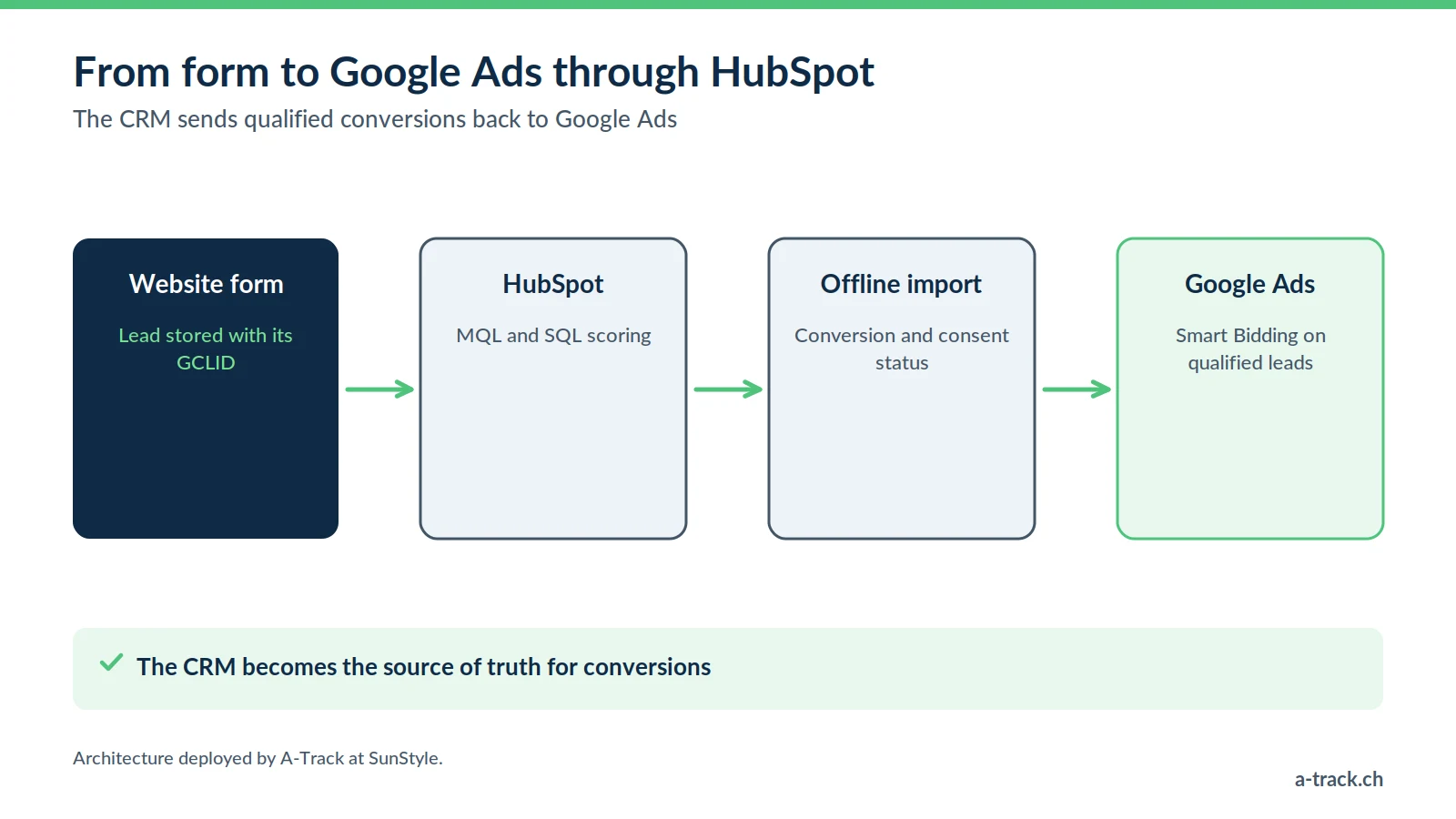
To go further, we changed the logic: instead of asking the website "who converted?", we query the source of truth directly, HubSpot.
A. Offline conversion import
The site form records the lead in HubSpot together with its Google Ads click ID (GCLID). HubSpot then sends the conversion back to Google Ads through the offline conversion import API.
Benefit: even if a tag is blocked in the browser, the lead exists in the CRM and Google Ads receives it. Measured data reliability index: 99% (a gap of about 1%).
Consent: Google recommends passing the visitor's consent status with every imported conversion (Google Ads API documentation).
B. Scoring and automation
Not all leads are equal. HubSpot workflows only send qualified leads (MQL and SQL) to Google. Smart Bidding thus learns to target solar roof buyers, not curious visitors downloading a brochure.
C. Dynamic audiences
HubSpot segments ("Quote sent", "Cold lead") are synced with the ad platforms, in line with the consents collected. They feed retargeting and above all exclusions: no point paying for an ad aimed at someone who has already signed.
A-Track tip
Before switching on offline imports, check that the GCLID is stored in a HubSpot property for every lead coming from Google Ads. Without it, the conversion cannot be tied to the click. Our offline conversions guide explains the method.
The results after one year
After twelve months of steering with this CRM-centric setup, here is what we measured at SunStyle, year on year. These results are specific to this client and period.
Financial performance
Ad spend: CHF 5,430 saved, with less budget wasted on unqualified audiences.
CPA: CHF 33 lower per lead.
Volume and quality
Conversions: 312 additional conversions measured and attributed.
Overall conversion rate: +0.56%, a gain that matters on a high-traffic B2B site.
Compliance is no longer a brake: it has become a quality filter.
Conclusion: key takeaways for your business
The SunStyle case shows that for a lead-generating business, GTM alone is no longer enough. Measurement has to be anchored in the CRM (HubSpot, Salesforce, Pipedrive).
Don't be at the mercy of the CMP: respect the visitor's choice and rely on your first-party data rather than on browser cookies alone.
Server-side is a prerequisite: it limits the loss, but the CRM delivers the final precision.
Align sales and marketing: with shared HubSpot dashboards, marketing sees the real impact of campaigns on revenue, not just on clicks.
For the legal side, see our FADP and GDPR compliance guide.
Are you using HubSpot or Salesforce and your Ads data doesn't match?
As with SunStyle, we can reconcile your tools and ensure reliable management.