

Table of content
For a Swiss watch Maison, digital is a geography puzzle. Headquarters sit in Geneva or the Jura Arc, but almost every client is somewhere else: according to the Fondation de la Haute Horlogerie, the Swiss watch industry exports 95% of its production. A client discovers a watch on Instagram in New York, asks questions on WeChat in Shanghai and buys it in a Geneva boutique, and no dashboard at headquarters connects those three moments.
In short
Safari caps JavaScript-set cookies at 7 days: over a purchase cycle of several months, attribution is lost.
A tracking server on your own subdomain sets longer-lived first-party cookies, provided it is configured correctly and respects consent.
A server-side "hub" routes data by region: Western tools on one side, Chinese tools on the other, a consolidated view at headquarters.
Boutique sales can be sent back to Google Ads up to 90 days after the click.
The "VIP" problem: Safari erases long-term memory
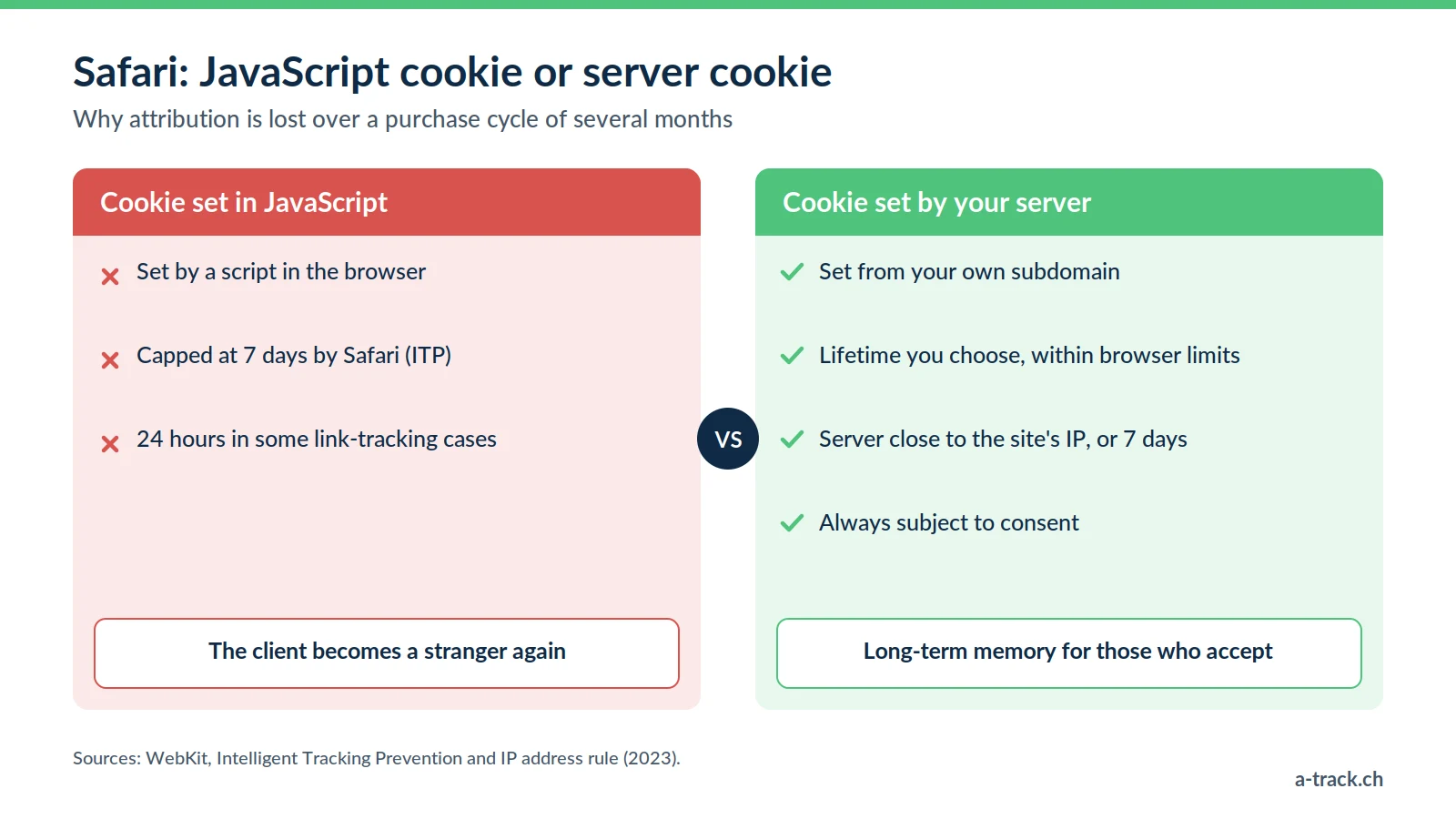
Affluent clients are heavy iPhone and Safari users. Yet with ITP (Intelligent Tracking Prevention), Safari caps JavaScript-set cookies at 7 days, and at 24 hours in some link-tracking cases.
The purchase cycle of a high-end watch is measured in months, sometimes years. If the cookie expires after a week, the client's story disappears:
You keep paying for ads aimed at someone who has already decided to buy.
The sale is credited to "direct" traffic or organic search, and your awareness campaigns look useless.
The answer: cookies set by your own server
A server-side custom domain (e.g. metrics.your-maison.com) lets you set measurement cookies from your server, as first-party cookies, with the lifetime you choose within each browser's limits. Two conditions:
Consistent infrastructure. Since 2023, WebKit also caps at 7 days the cookies set by a server whose IP address is too far from the website's. The tracking server must therefore be deployed carefully (same origin or same address range).
Consent. The cookie is only set with the visitor's agreement wherever that is required. This is not about getting around Safari: a refusal stays a refusal.
The "Great Firewall": reconciling WeChat and Google
In China, Western tools see very little: Google services are blocked or very slow there, and data from WeChat, Tmall or Xiaohongshu stays on those platforms. Running two separate stacks leaves headquarters with no global view.
The "hub" architecture
Server-side tracking lets you place a switch on a server you control:
Visitor in the US or Europe: the server forwards the permitted events to GA4, Meta CAPI and Google Ads.
Visitor in China: no Google script is loaded. Data goes to China-compatible tools (a local instance or a suitable proxy).
At headquarters: aggregated metrics are consolidated in a data warehouse (BigQuery, for example) for one global performance report.
The ROPO challenge: linking digital to the boutique
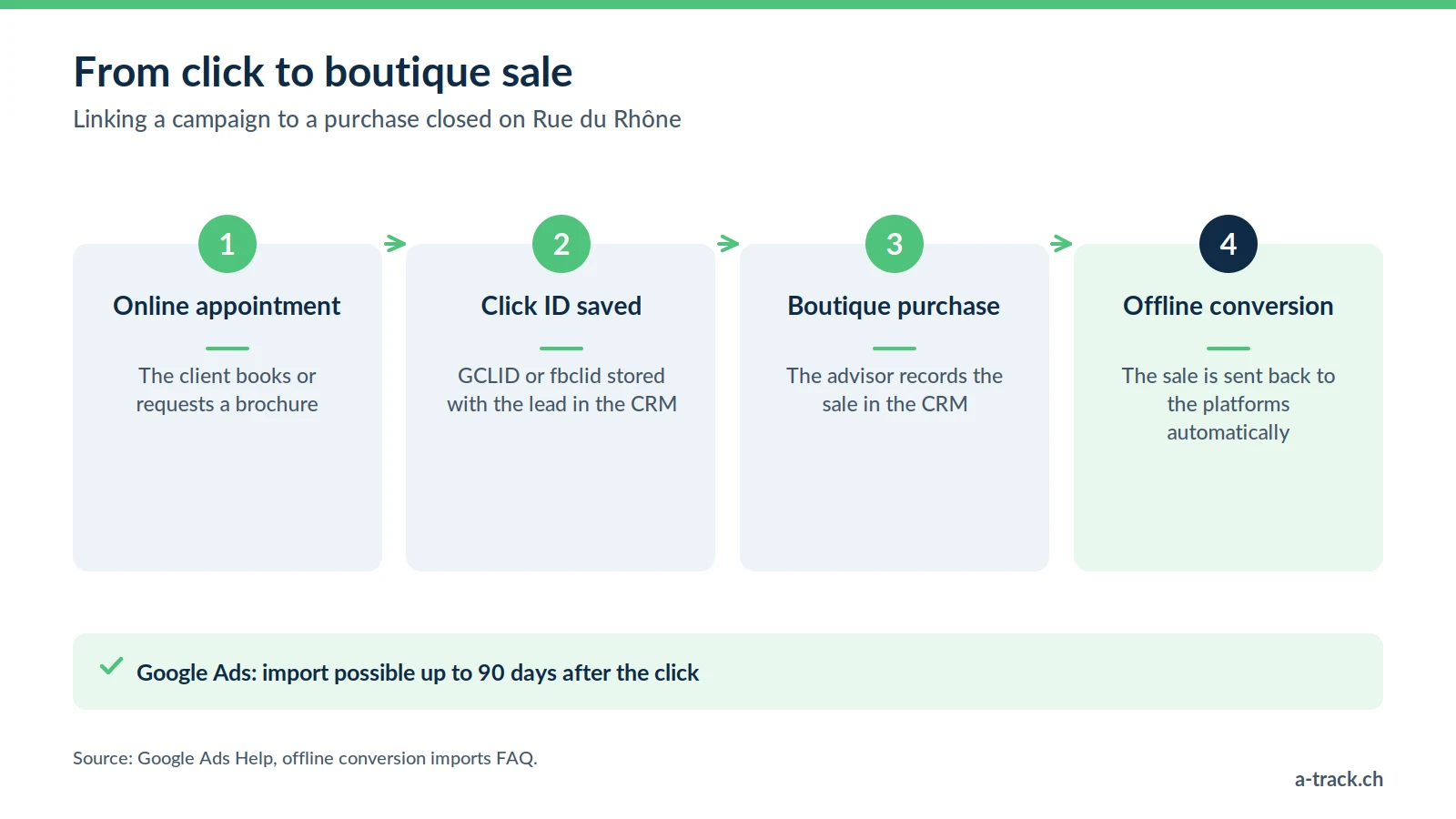
In luxury, the sale is often closed in a boutique: Rue du Rhône, Place Vendôme, Fifth Avenue. If your measurement stops at the website, you will never show management what your campaigns bring in.
The client books an appointment or requests a brochure on the site.
The advertising click ID (GCLID, fbclid) is saved with the lead in the CRM (Salesforce, Dynamics).
A few weeks later, they buy in the boutique and the advisor records the sale.
The sale is automatically sent back to the platforms as an offline conversion.
Mind the deadline: according to Google Ads Help, a conversion with a GCLID can be imported up to 90 days after the click (63 days with user-provided data for enhanced conversions). After that, the sale can no longer be linked to the campaign. The algorithms then learn who actually buys, not just who visits. Our offline conversions guide explains the setup.
Three legal frameworks at the same time
Centralising does not mean sending everything everywhere:
The FADP for the Swiss headquarters and Swiss clients;
The GDPR for European visitors, with prior consent for analytics and advertising cookies;
China's PIPL, in force since 1 November 2021, which strictly regulates sending personal information out of China: separate consent plus a transfer mechanism (security assessment, standard contract or certification), as summarised by Hong Kong's privacy commissioner.
A-Track tip
Send aggregated metrics (visits, leads, sales per campaign) to headquarters rather than raw client data. You keep the global view, and the legal file becomes much simpler, in China as in Europe.
Conclusion: centralised governance from Switzerland
A Maison's client data is a heritage asset, not a file scattered across local agencies. By centralising your tracking architecture, you take back control:
Of your image: you manage advertising pressure (capping) in every market.
Of your data: every flow is documented and compliant with local law.
Of your budget: you get a consolidated view of global ROAS.
First step: map the measurement tools used in each market and check which ones actually feed headquarters reporting. To go further, read our marketing performance measurement guide.
Do boutique sales flow back to your campaigns?
A-Track designs a server-side hub that routes data by region, links CRM and boutique sales to Google Ads, and respects the FADP, the GDPR and China's PIPL.
Let's talk about your markets in a 30-minute call with an expert.