

Table of content
On 15 April 2026, Meta announced automatic AI enrichment of Pixel events, switched on after thirty days unless advertisers turn it off. On 13 January, Shopify had moved its App Pixels to "optimised" data sharing by default, which can pause a pixel. And in September 2025, Safari 26 started scrambling what known fingerprinting scripts can read from the browser.
Three decisions. None of them yours. All of them changed what your company measures.
In short
Browsers, platforms and CMSs change settings that alter your data collection, without consulting you.
A collection server of your own becomes the checkpoint where you decide what leaves, and for whom.
Performance and compliance are not opposites: they are the same project.
Measurement hosted in Switzerland meets a strong public demand for digital sovereignty.
The common thread: your measurement is not yours
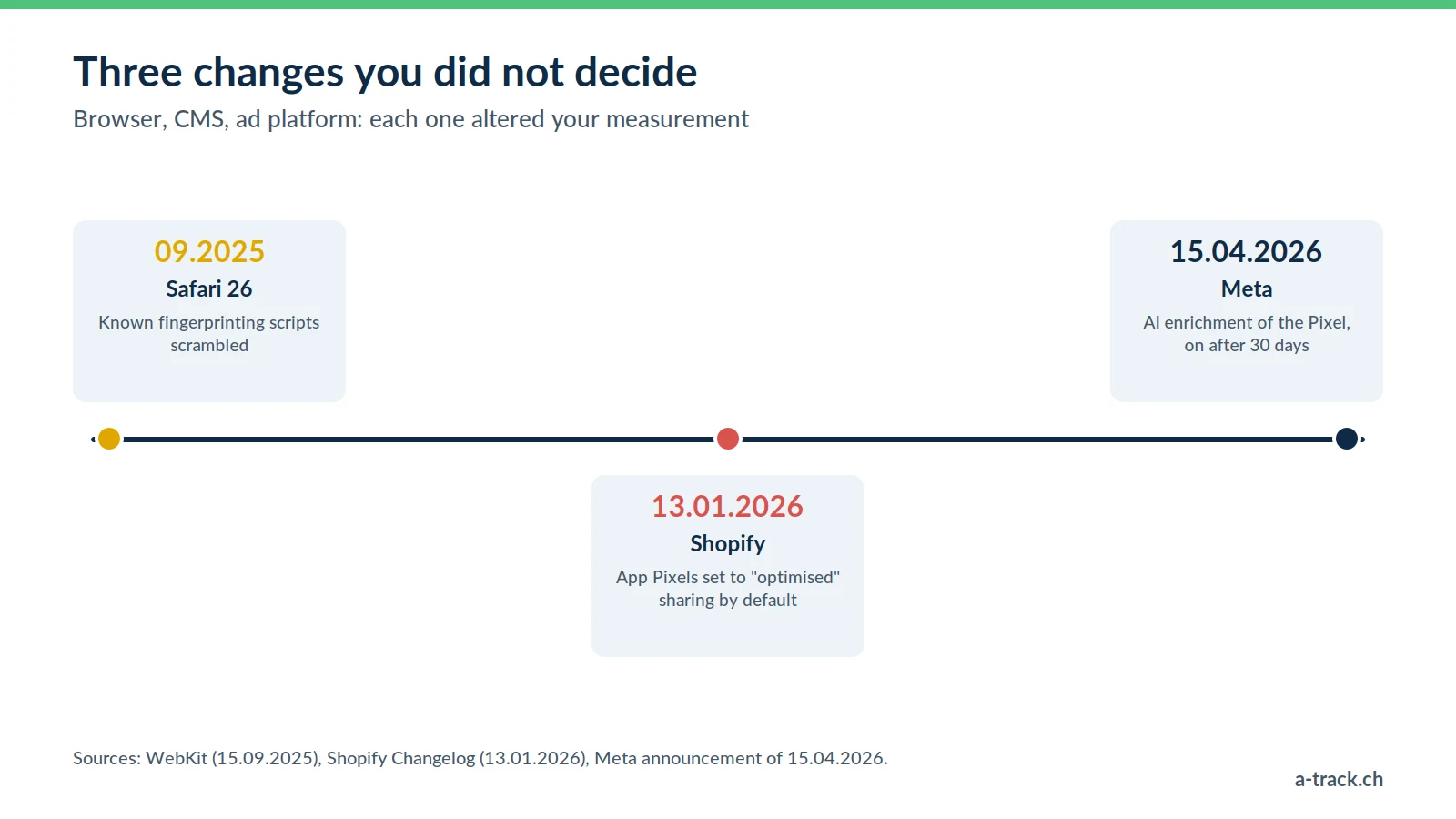
As long as your data collection lives in the visitor's browser, it depends on three parties you do not control: the browser vendor, the advertising platform and your CMS. Any of them can change a setting, one day, without asking you.
And you do not find out when the change happens. You find out weeks later, when a curve drops in a report and nobody can say why.
That is the real issue. Not only the GDPR or the FADP: the question is who decides what you measure.
What changes when the server is yours
Server-side tracking routes collection through your own server before it goes anywhere else: a container you host, on a subdomain of your own, which you can place in Switzerland. It moves three decisions from the browser to your side.
What leaves. You choose the fields sent to Meta, Google or LinkedIn, and you strip out what should not go out.
How it leaves. Pseudonymisation, IP truncation, deduplication: the rules are written once, on your side, for every channel.
Where it is processed. Your server can stay in Switzerland. What you then send to Meta or Google still goes to them: Swiss hosting does not remove those transfers, it lets you reduce and document them.
When Safari changes its rules or a platform switches an option on by default, your server remains the mandatory checkpoint. You see the change instead of absorbing it.
A-Track tip
Every month, compare reported conversions with real sales. A widening gap is often the first sign that a setting was changed somewhere else. The method is in our article on monitoring server-side tracking.
Competitive and compliant, not one against the other
The two are often set against each other: American companies supposedly move without constraints while European ones fill in registers. It is a false debate, and an expensive one.
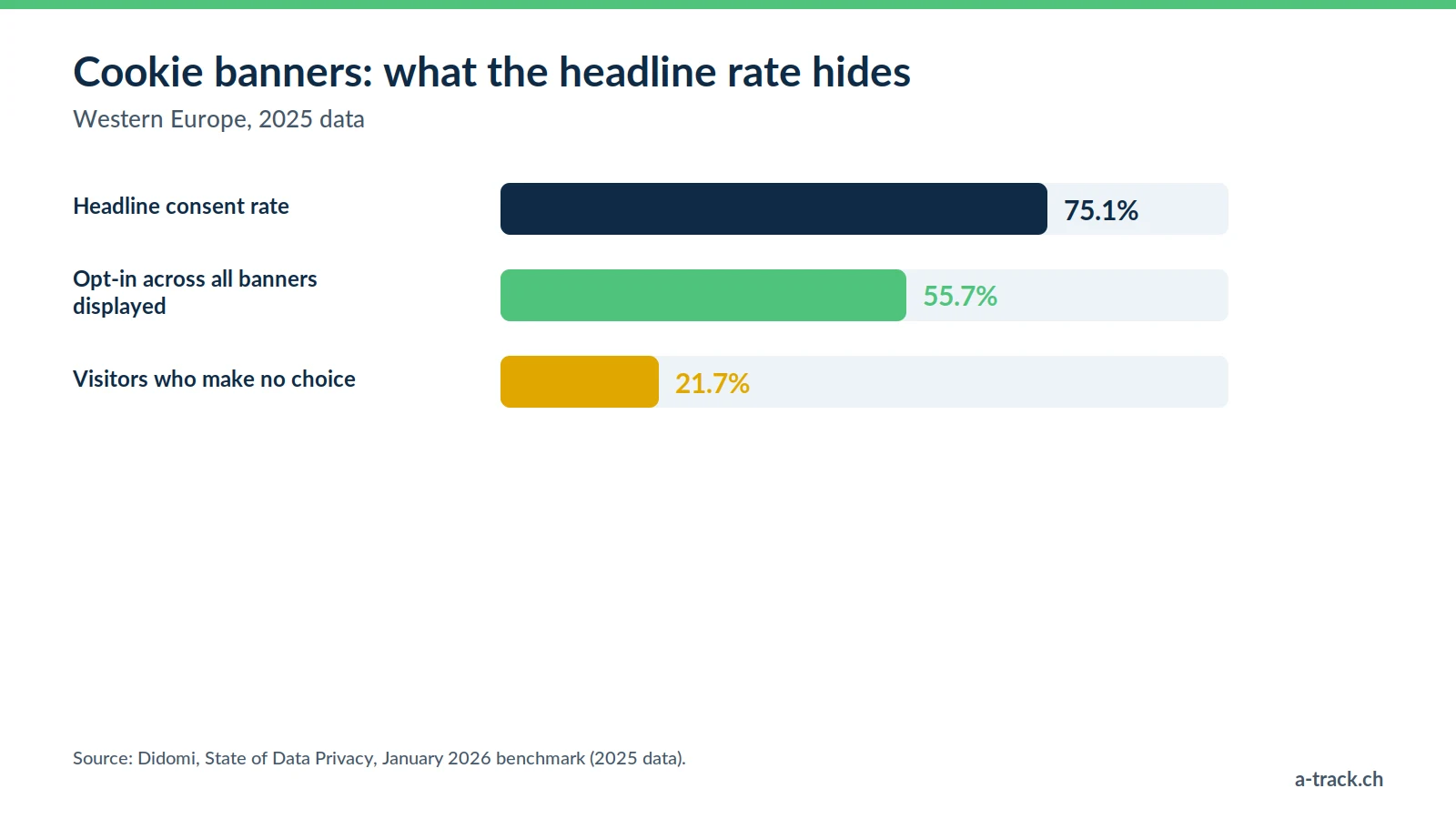
According to the Didomi 2026 benchmark (2025 data), in Western Europe the headline consent rate reaches 75.1%, but the opt-in rate measured against all banners displayed falls to 55.7%, and 21.7% of visitors make no choice at all. More than four visitors in ten therefore give no usable agreement.
No technique should "recover" these visitors against their choice: a refusal stays a refusal. A well-built server-side setup ensures you lose nothing of what was consented (fewer losses to browsers and ad blockers) and passes Consent Mode signals correctly, which Google uses to model part of the missing conversions.
The same piece of work therefore delivers better fed campaigns and compliance that holds. These are not two projects. They are one.
The Swiss argument, in numbers
According to the DigitalBarometer 2026 by the Risiko-Dialog Foundation, 46% of respondents rank the lack of digital independence among Switzerland's greatest weaknesses, and 83% say a "Made in Switzerland" label would strengthen their trust in a digital service.
Hosting your measurement in Switzerland is therefore not only a legal precaution. It is a trust argument your clients already understand, provided you describe it honestly in your privacy policy.
You cannot stop Meta, Google or Apple from changing their rules. You can decide that those rules apply after your server, not before it.
Conclusion: where to start
Three questions are enough to know where you stand.
Which domain does your data travel through? If it is a third-party domain, your measurement is not yours.
Who can change your collection without warning you? Make the list: browser, CMS, CMP, platforms. It is longer than you expect.
What happens to visitors who make no choice? Check that your banner and your Consent Mode handle them correctly.
Server-side is not one more technical optimisation. It is the moment you take back control of what your company knows about itself.
Who actually decides what you measure today?
A-Track identifies who can change your data collection (browser, CMS, CMP, platforms) and shows how a server of your own becomes the checkpoint for what leaves.
It all starts with a 30-minute call with an expert.