

Table of content
Three numbers for the same campaign: Meta claims 40 conversions, Google Analytics counts 26, and the CRM records 9 deals actually opened. The meeting that follows is not about deciding. It is about choosing which of the three to believe.
This scene plays out every month in well-equipped Swiss companies that pay good money for each of those tools. The mess is usually blamed on regulation: the GDPR, the FADP, everything that supposedly stops us measuring the way Americans do. That is wrong. The truth is closer to the opposite.
In short
Europe's lag behind the United States is real, but countries under the same GDPR show very different digital levels.
The real difference is architectural: tools connected to each other, sharing the same data.
An ad algorithm optimises for what you show it: without CRM sales fed back, it looks for forms, not customers.
A collection server (server-side) is the plumbing that connects the tools and applies compliance in one place.
The gap exists, but not where we look for it
There is no denying the lag. According to a study published by the St. Louis Federal Reserve (March 2026), 43% of American workers were using artificial intelligence at work in early 2026, against 25.6% in Italy. The authors estimate that the adoption gap with Europe amounts to about 3.2 percentage points of additional cumulative productivity growth in the US since 2022.
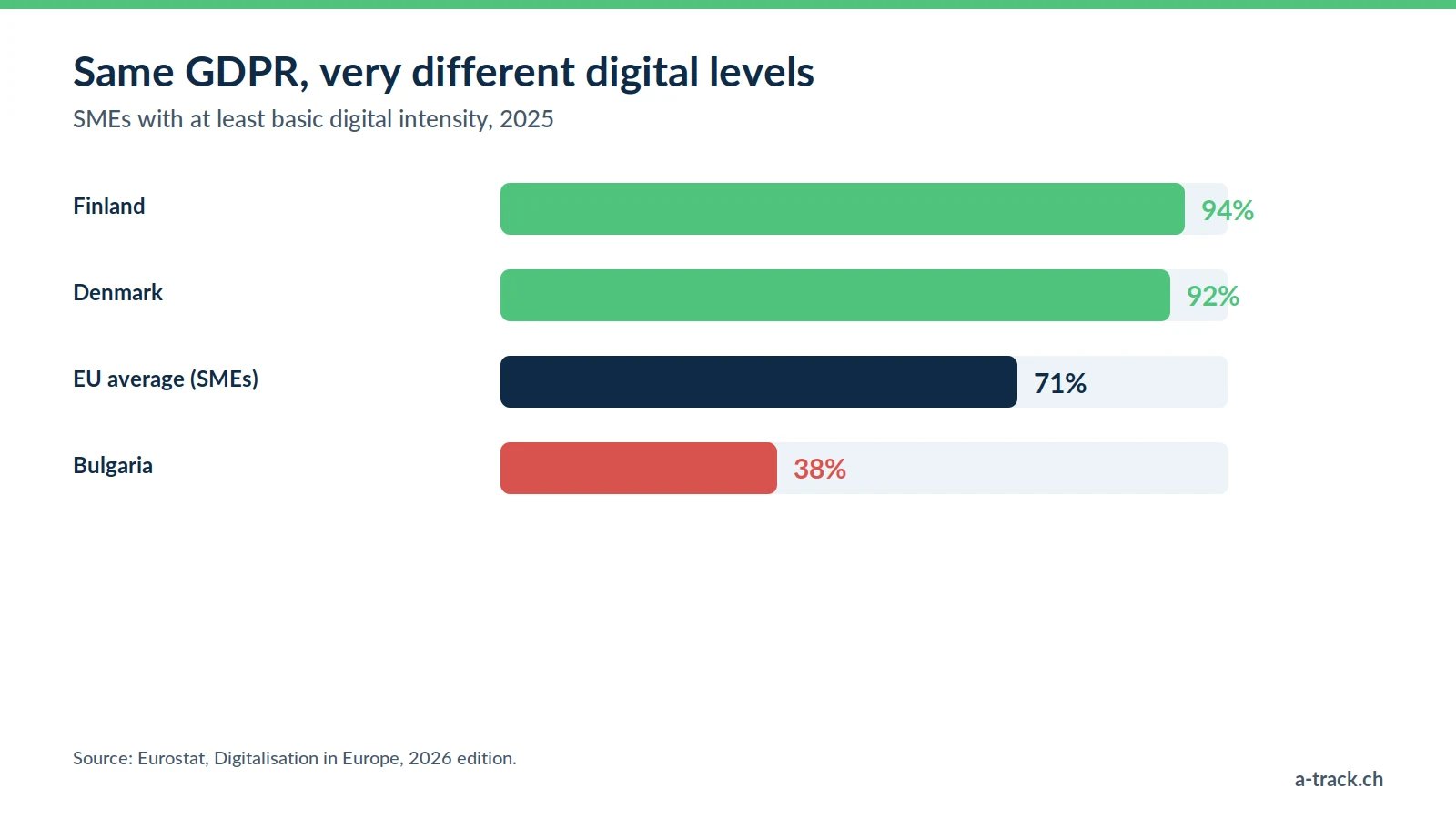
But that gap does not come from the law. According to Eurostat, 94% of Finnish SMEs and 92% of Danish SMEs reach at least a basic level of digital intensity, against 38% in Bulgaria. All of them apply exactly the same GDPR. Same text, a gap of more than fifty points.
What separates them is not legal. It is architectural.
What the most advanced companies actually built
They did not buy better tools. They connected the ones they had.
In a mature organisation, the ad platform, the CRM and the reporting layer share the same reference data. Meta knows that a lead generated six weeks ago became a client worth CHF 40,000. LinkedIn knows which of its conversions were qualified and which were rejected. The dashboard shows the same figures as the CRM, because it drinks from the same source.
Elsewhere, tools pile up. According to Gartner (2023), marketing teams use only 33% of their technology stack's capabilities, down from 58% in 2020. More tools, less use: three universal remotes on the same couch, none of which does everything.
Why it costs money
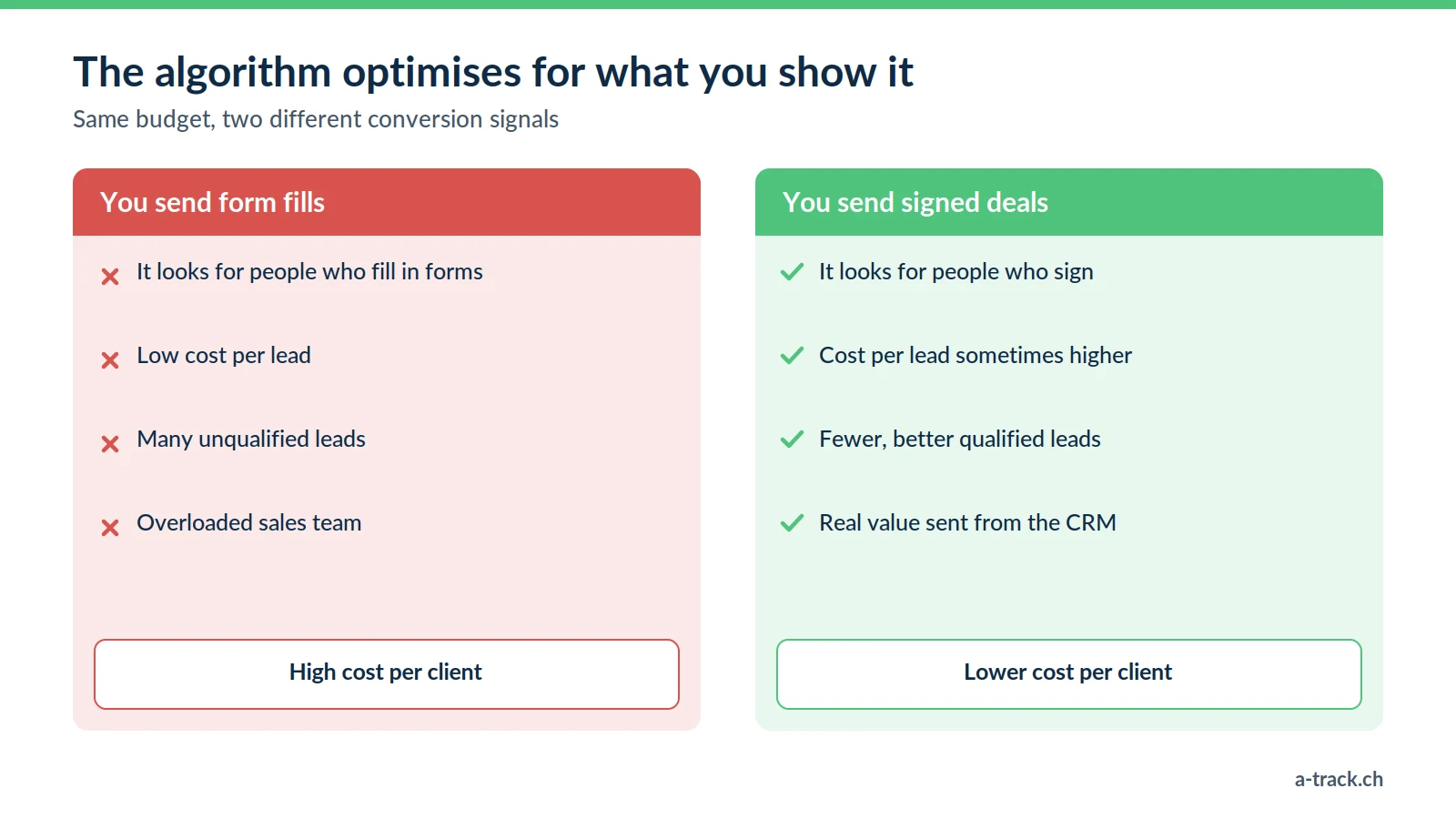
An advertising algorithm does not optimise for what you want. It optimises for what you show it.
Show it submitted forms, and it will bring you forms. Plenty of them, and cheap. Show it the deals actually signed, with their value, and it will go after the profiles that sign. Your cost per lead may rise while your cost per client falls. That is where the difference is made, not in creativity or budget size.
A company that does not send its CRM data back to its ad platforms therefore pays three times: to acquire a poor lead, to process it, and for the next campaign that goes looking for more of the same. The method to close that loop is in our CRM offline conversions guide.
Where Switzerland stands
We do not appear in Eurostat's statistics, which spares us a ranking but not the diagnosis. According to the DigitalBarometer 2026 by the Risiko-Dialog Foundation, 46% of respondents rank the lack of digital independence among the country's greatest weaknesses, and 38% of the population lack sufficient basic digital skills.
In the companies we audit, the symptom is always the same. The tools are there, often the best on the market, often well paid for. They do not talk to each other. The pixel sees one version of events, the CRM another, the dashboard a third.
This is not a cultural lag. It is missing plumbing.
Server-side is that plumbing
It is usually presented as a tracking technique. That definition is too narrow.
A collection server is the single point through which data passes before going anywhere else. There it is cleaned, normalised and deduplicated, then distributed to each tool in the language it expects: Meta's or LinkedIn's Conversions API, GA4, the CRM, the dashboard. A rule written once applies everywhere.
It is also where compliance is applied systematically rather than tool by tool: you decide what leaves, in what form and to which recipient. The server can be hosted in Switzerland, even though data then sent to Meta or Google goes to them.
The stakes are concrete. According to the Didomi 2026 benchmark, in Western Europe the opt-in rate measured against all banners displayed is only 55.7%. Every consented signal therefore counts double. A unified architecture loses none of them, and strictly respects the rest: a refusal stays a refusal.
A-Track tip
Before adding a tool, ask one question: from which single source will it receive its data? If the answer is "from its own pixel", you are creating a fourth version of reality.
Conclusion: the Swiss advantage exists, but it is not automatic
Switzerland has a lighter framework than people assume (information and a right to refuse cookies under Art. 45c of the Telecommunications Act, where the EU requires prior consent), the option of hosting data on its own soil, and a reputation that sells: according to the same Barometer, 83% of respondents say a "Made in Switzerland" label would strengthen their trust in a digital service.
None of these assets has any effect while data stays scattered across tools that do not talk to each other. Three first actions:
Reconcile the numbers: over one month, compare Meta conversions, GA4 and CRM deals, and explain every gap.
Send real sales back to your ad platforms, with their value.
Centralise collection on a server you own, applying the same consent rules to every tool.
The question for your executive committee is therefore not whether regulation penalises us. It is how many tools you are paying for today so that each can work with a different version of reality.
Do all your tools tell the same version of events?
A-Track reconciles Meta, GA4 and your CRM, explains every gap and sends signed deals back to your ad platforms from a single collection server, with the same consent rules.
First conversation: 30 minutes with an expert.