

Table of content
Conversions vanishing from reports, a CPA climbing for no obvious reason, social channels that seem to deliver nothing: that was daily life at Clinik.ch before it moved to server-side tracking. The culprit was browser-only tracking, exposed to ad blockers, Safari's limits and cookie refusals.
Here is how A-Track, working with Lausanne agency Emblematik, rebuilt Clinik.ch's measurement, and what the numbers showed in the very first month.
In short
Client: Clinik.ch, a Swiss network of laser hair removal and medical aesthetics clinics.
Solution: server GTM hosted on Stape under a first-party subdomain, Meta, TikTok, Pinterest and Snapchat conversion APIs, CMP and Consent Mode v2.
Measured result: +40.41% more usable data in November 2025 versus September and October.
Google Ads: +33% conversions and a 22% lower CPA on a near-stable budget.
The client: Clinik.ch, an aesthetics clinic that bets on technology
Clinik.ch lists 11 clinics in Switzerland and more than 450,000 treatments on its website. Its positioning is premium:
Advanced medical technology: latest-generation medical lasers and VISIA skin analysis.
Medical supervision for safe treatments (permanent hair removal, rejuvenation).
Personalised approach: free consultation and tailored treatment plans.
A business that invests in cutting-edge equipment cannot steer its acquisition on approximate data. The digital infrastructure had to keep up.
The challenge: client-side tracking that was losing conversions
Before A-Track stepped in, every channel ran through the browser: GA4, Google Ads, Meta, Microsoft Ads. Three things were draining the data:
Ad blockers and VPNs: they stop measurement scripts from loading. According to GWI (Q2 2025), 30.9% of Swiss internet users use an ad blocker.
Safari and ITP: according to WebKit, cookies set in JavaScript are deleted after 7 days without interaction, and after 24 hours in some link-tracking cases. Conversion attribution breaks.
Cookie refusals: the site's Cookie-Script CMP statistics showed around 21% of visitors refusing cookies. Those conversions vanished from reports.
The result: an artificially high CPA and campaigns steered blind, especially on social media.
The A-Track solution: a full server-side architecture
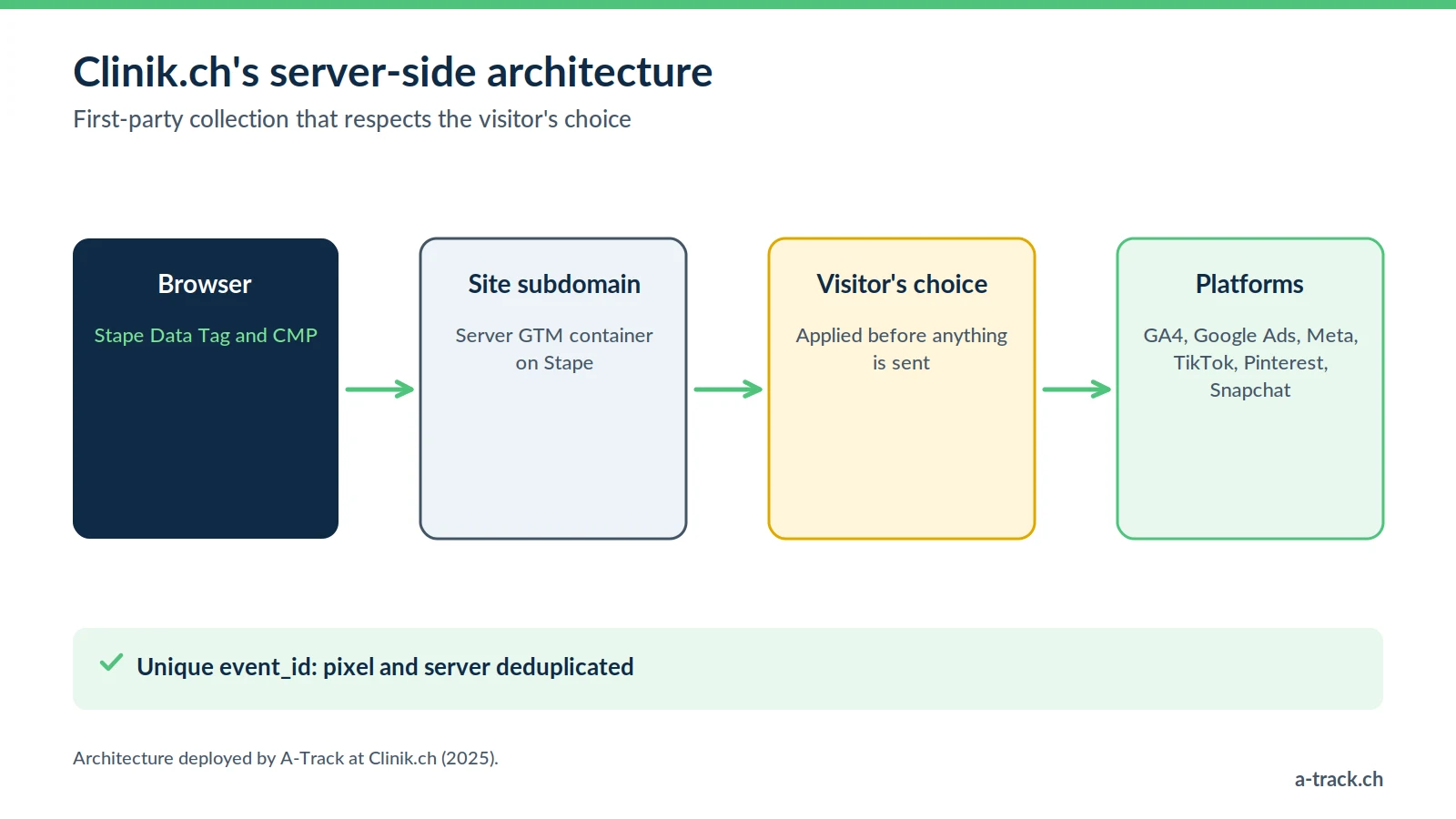
We wrote a custom tagging plan, then moved all measurement to a server.
1. A server GTM container on Stape
The Google Tag Manager server container is hosted on Stape, under a first-party subdomain of Clinik.ch.
Browser side: the Stape Data Tag sends events to the site's own subdomain.
Server side: the Stape Data Client receives the data, cleans it and forwards it to GA4 and the conversion APIs.
This setup does not get around ad blockers or consent. It makes measurement resilient to technical restrictions (blocked third-party scripts, shortened JavaScript cookies) while respecting the visitor's choice: a refusal stays a refusal.
2. Conversion APIs on every social channel
The browser pixel is no longer the only source. Events are also sent server to server to:
Meta Conversions API (Facebook and Instagram);
TikTok Events API;
Pinterest API for Conversions;
Snapchat Conversions API.
Each event carries a unique event_id: the platform deduplicates pixel and server, so a conversion is never counted twice. More in our guide to Meta CAPI on server-side.
3. Consent and Consent Mode v2
CMP: Cookie-Script, integrated with the IAB TCF 2.2 standard in force at the time (version 2.3 took over in February 2026, see our article on IAB TCF 2.3).
Google Consent Mode v2 in advanced mode: without consent, Google tags only send cookieless signals, which Google uses to model missing conversions. According to Google (2021), this modelling recovers on average more than 70% of ad-click-to-conversion journeys lost to refusals.
A-Track tip
In healthcare and medical aesthetics, never send the treatment type or any medical detail to ad platforms. A generic "appointment booked" event is enough for the algorithms, and the server lets you strip those fields before anything leaves.
The results: +40.41% more usable data
We compared November 2025, the first full month after go-live, with the September and October 2025 average. These figures were measured at Clinik.ch over that period: they are not a promise for every website.
+38.49% more data captured thanks to server-side tracking, according to the client's Stape dashboard.
+1.92% additional data from visitors using ad blockers, VPNs or private browsing.
In total: +40.41% more usable data.
For the first time, GA4 also reports reliable conversion values: CHF 134,000 of tracked value over the month. ROAS can finally be calculated on real amounts.
Google Ads and social media: what changed in one month
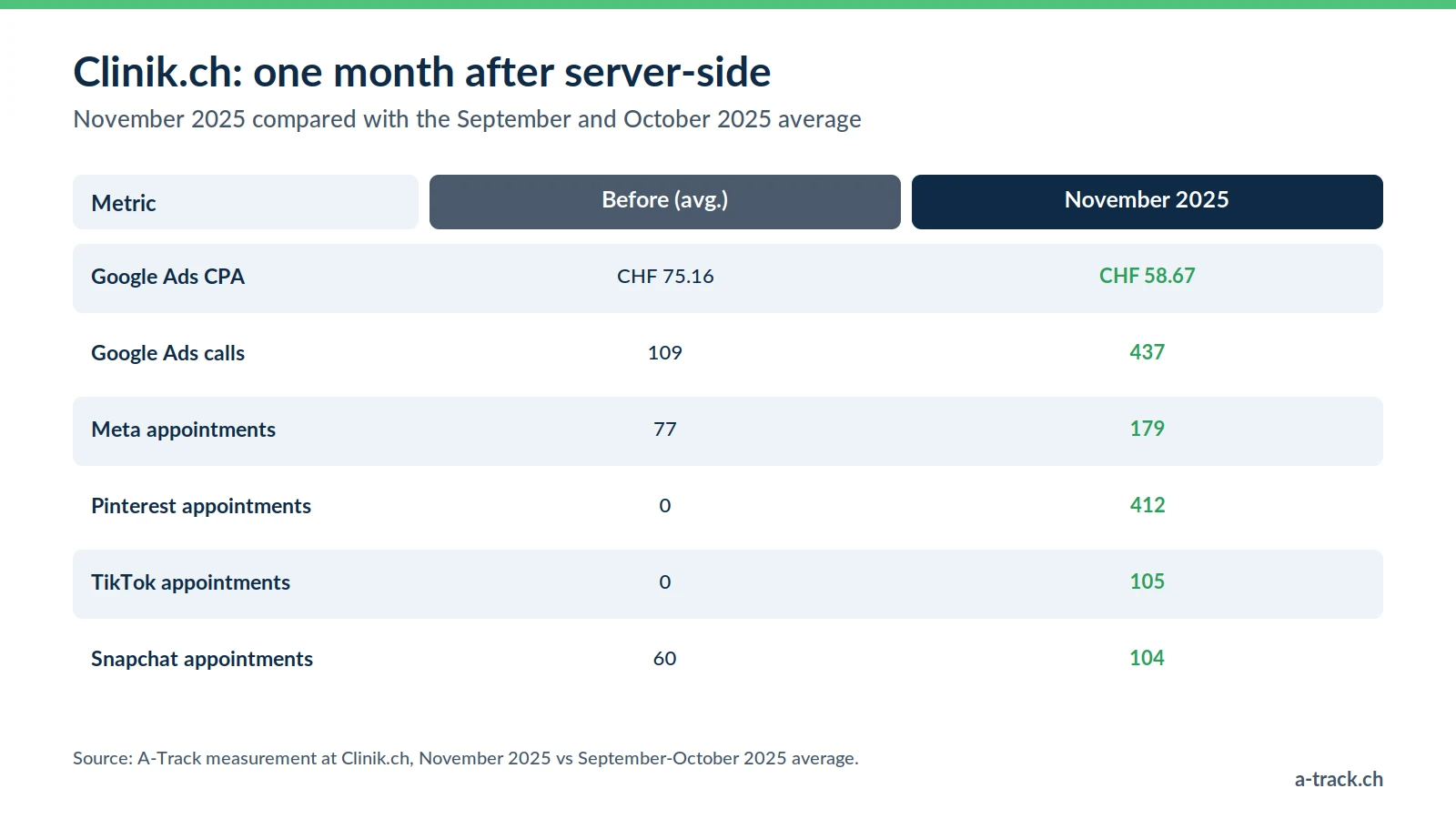
Google Ads: more conversions at a lower cost
On a near-stable budget (+3.65%):
Conversions: +33%, i.e. 1,630 conversions.
CPA: -22%, from CHF 75.16 to CHF 58.67.
Clicks: -28%. Fewer clicks for more conversions: with richer signals (Enhanced Conversions), Smart Bidding targets better.
Calls: from 109 to 437 phone calls measured.
Social media: channels that can finally be measured
Thanks to the conversion APIs, appointment bookings are now attributed to the right channels:
Meta: from 77 to 179 appointments (+132%).
Pinterest: from 0 to 412 appointments, on a channel that reported no conversions before.
TikTok: from 0 to 105 appointments.
Snapchat: from 60 to 104 appointments.
Part of this increase comes from better measurement of conversions that already existed. That is exactly the point: a channel that looked dead could finally be assessed and managed.
Conclusion: key takeaways for your website
The Clinik.ch case shows that performance no longer depends only on ads and budget, but on the quality of the technical data. Three actions to get started:
Measure the gap: compare the conversions in your ad platforms with those in your CRM or booking system.
Move key conversions to server-side, with event_id deduplication.
Check consent: an up-to-date CMP and Consent Mode v2 in advanced mode.
To go further, read our guide to marketing performance measurement.
Server-Side Tracking: The Strategy That Increased Data by +40% for Clinik.ch
Do you want to audit your current data loss?
Contact A-Track for an analysis of your setup and take it to the next level.