

Table of content
You have decided to move to server-side tracking; now you need to choose the platform that will host your server GTM container. In French-speaking Switzerland, two names keep coming up: Stape and Addingwell. Both do the job, but not for the same kind of company.
In short
Stape: simple, affordable sGTM hosting with plenty of ready-made features, ideal for SMEs and agencies.
Addingwell (part of Didomi since 2025): a platform focused on tag monitoring, for high-volume online shops and technical teams.
Neither offers servers in Switzerland: hosting runs in the EU or on global infrastructure.
The tool matters less than the setup: your own subdomain, Consent Mode v2, data cleaning.
Why the choice of infrastructure matters
A server-side platform is more than a host. It shapes the reliability of your data, your site's performance and your ability to prove compliance.
Site performance
Client-side tracking piles third-party scripts into the browser (Meta, Google, LinkedIn, TikTok). Google says Core Web Vitals (LCP, INP, CLS) align with what its ranking systems seek to reward. Moving some of those tags server-side reduces the code running on the page, which can improve responsiveness (INP). It does not guarantee rankings, but it is a real gain for user experience.
Data quality and control
The server receives data before the ad platforms do. There you can enforce consent, remove personal data and enrich conversions. Clean data also means better signals for Google Ads and Meta bidding algorithms.
Stape or Addingwell: two approaches
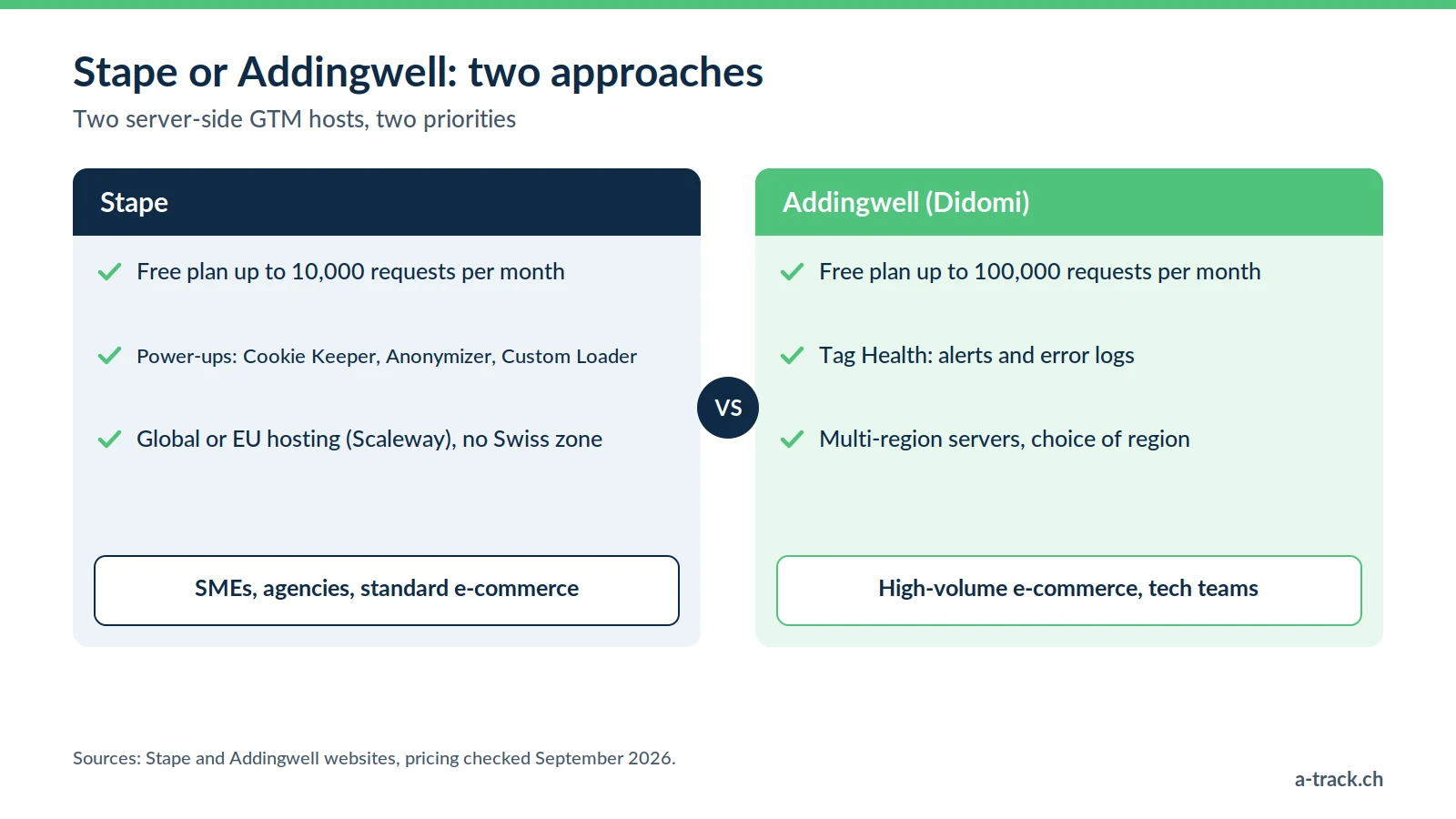
For a Swiss company that cares about the FADP and performance, here is what sets the two platforms apart.
Stape: the accessible, full-featured host
Price: a free plan up to 10,000 requests per month, then paid plans based on volume (Stape pricing, September 2026).
Simplicity: container and subdomain set up in a few steps.
Ready-made features: Anonymizer, Cookie Keeper (extends first-party cookie lifetime against Safari's ITP, with consent), Custom Loader, templates for Meta CAPI.
Location: global hosting on Google Cloud or EU hosting on Scaleway, GDPR-compliant. No zone in Switzerland.
Who is it for? Most Swiss SMEs, agencies managing many accounts and standard online shops.
Addingwell: the monitoring-first platform
Addingwell, a French company acquired in 2025 by the CMP provider Didomi, focuses on data monitoring.
Tag monitoring: a "Tag Health" dashboard shows in real time which tags fail and why, with alerts.
Infrastructure: multi-region servers, with a choice of hosting region.
Error logs: details of rejected requests help diagnose complex setups without digging through the container.
Price: a free plan up to 100,000 requests per month, then paid plans (Addingwell website, September 2026).
Who is it for? Large online shops and technical teams for whom every missed conversion shows up in revenue.
To compare these platforms with Google Cloud or Swiss hosting, read our guide Infomaniak, Google Cloud or Stape.
Which solution for your profile?
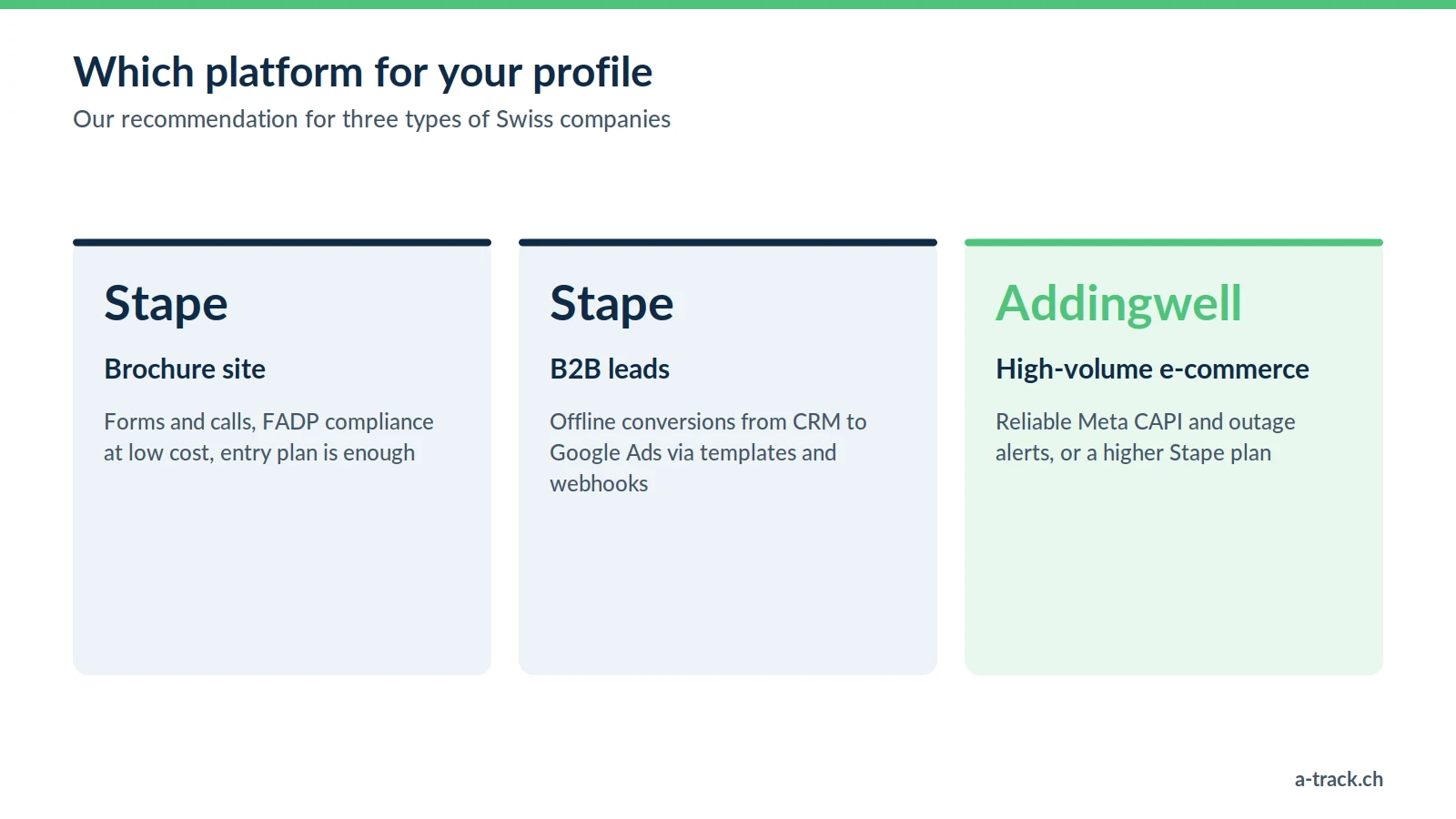
You would not recommend the same tool to a dental practice in Lausanne and to a watch brand selling worldwide.
Brochure site (SMEs, tradespeople, local services)
Goal: track forms and calls, stay FADP-compliant at low cost.
Choice: Stape. The entry plan is enough to run a custom domain (for example data.your-site.ch) and make your cookies more reliable.
B2B lead generation (SaaS, fiduciaries, construction)
Goal: qualify leads and send offline conversions from the CRM to Google Ads. See our offline conversions guide.
Choice: Stape. Its templates and webhooks make connecting HubSpot or Salesforce easier. Ease of setup comes first.
E-commerce (Shopify, WooCommerce, Magento)
Goal: maximise ROAS, make Meta CAPI reliable, handle large volumes.
Choice: Addingwell, or a higher Stape plan. The higher your online revenue, the more a tracking outage costs. Addingwell's alerts quickly flag an API that stops receiving data.
Note: Stape remains perfectly suited to standard e-commerce, provided you set up your own monitoring.
Best practices, whatever the tool
A subdomain of your own: do not use the host's default technical URL. A subdomain such as ss.your-domain.ch makes measurement first-party and more resilient to browser restrictions.
Google Consent Mode v2, in Switzerland too: Google has applied its EU consent policy to Swiss traffic since 31 July 2024. Set it up through your CMP (for example Cookie-Script). Details in our Consent Mode v2 guide.
Cleaning PII: configure the server to truncate IPs and remove emails before sending data to Google Analytics. This applies the privacy by design principle (Art. 7 FADP).
Server-side enrichment: add data you do not want exposed in the page code (product margin, customer type). Performance Max campaigns can then optimise on more accurate values.
A-Track tip
Whatever the platform, compare the conversions received by Meta and Google Ads with your actual orders every week. A gap that suddenly widens is often the first sign of a broken tag.
Conclusion: our recommendation
For most Swiss companies, Stape is the rational choice: complete, affordable, with EU hosting available.
For high-volume online shops that want built-in monitoring, Addingwell is a safety investment.
Either way, the value comes from the setup: consent respected, data cleaned, conversions enriched. A refusal stays a refusal, and that is what makes your measurement sustainable. To go further, see our marketing performance measurement guide.
Stape or Addingwell: which one fits your site?
A-Track picks the platform that fits your profile, then configures the server container: first-party subdomain, Consent Mode v2, data cleaning and monitoring.
Let's discuss it in a 30-minute call with an expert.