

Table of content
Since 1 March 2026, version 2.3 of IAB Europe's Transparency and Consent Framework (TCF) has been the only valid one. Does your site show ads through Google AdSense or Ad Manager, or does your cookie banner rely on the TCF? A malformed consent string can then cut off your personalised ad revenue. Here is what changed, who is affected in Switzerland and the real impact on your tracking, your SEO and your visibility in answer engines (AEO).
In short
TCF 2.3 was published on 19 June 2025; since 1 March 2026, a TC String without the disclosedVendors segment is invalid.
The first to be affected are publishers monetising with AdSense, Ad Manager or AdMob, Switzerland included since 31 July 2024.
For advertisers, Consent Mode v2 remains the key signal; the TCF is just one way of passing it on.
SEO and AEO: the impact is indirect (banner weight, content readable without JavaScript).
TCF 2.3: what changed technically
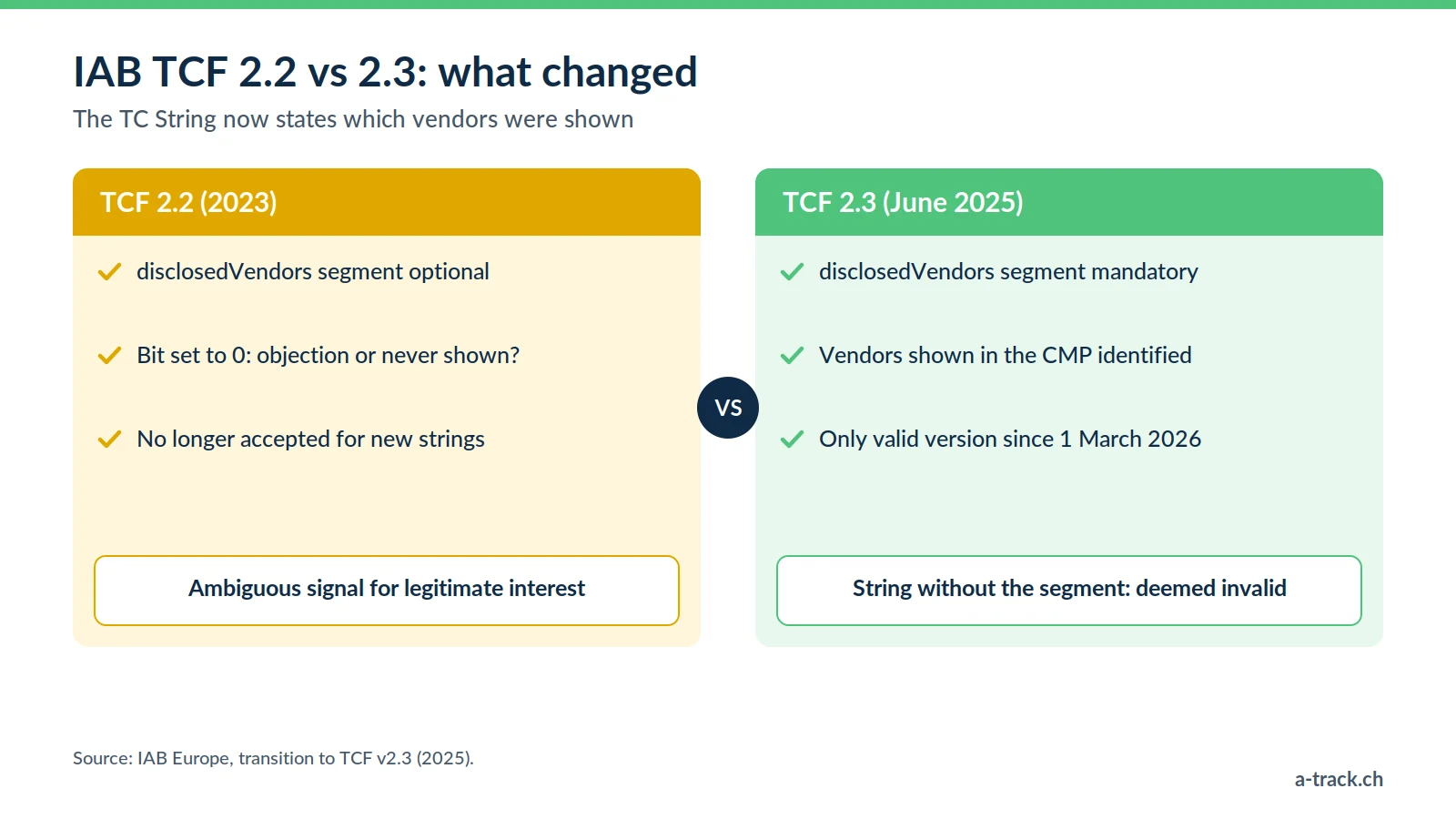
The TCF is a standard that encodes the visitor's choice in a string, the TC String, read by advertising partners ("vendors"). Version 2.2, launched in 2023, left an ambiguity: when a vendor relied on legitimate interest, a bit set to 0 could mean "the visitor objected" or "this vendor was never shown to them".
TCF 2.3 fixes this by making the disclosedVendors segment mandatory. It states which vendors were actually displayed in your CMP. According to IAB Europe, any TC String created since 1 March 2026 without this segment is deemed invalid; strings created earlier remain valid until consent is renewed.
If you use a commercial CMP, the vendor normally handles the update. An in-house CMP has to be adapted.
Who is really affected in Switzerland?
The FADP does not require the TCF, nor does the GDPR: it is an advertising industry standard. It becomes unavoidable in one specific case.
You monetise your site with Google (AdSense, Ad Manager, AdMob): Google requires a certified CMP integrated with the TCF to serve personalised ads in the EEA and UK since 16 January 2024, and in Switzerland since 31 July 2024 (Google Ad Manager Help). Otherwise, only non-personalised or limited ads are served.
You are an advertiser (SME, e-commerce, lead generation): the TCF is optional. What matters for Google Ads and GA4 are valid Google Consent Mode v2 signals.
For a business that only targets Switzerland and shows no third-party ads, switching to the TCF often just means a heavier banner.
TCF 2.3 and Consent Mode v2: how they fit together
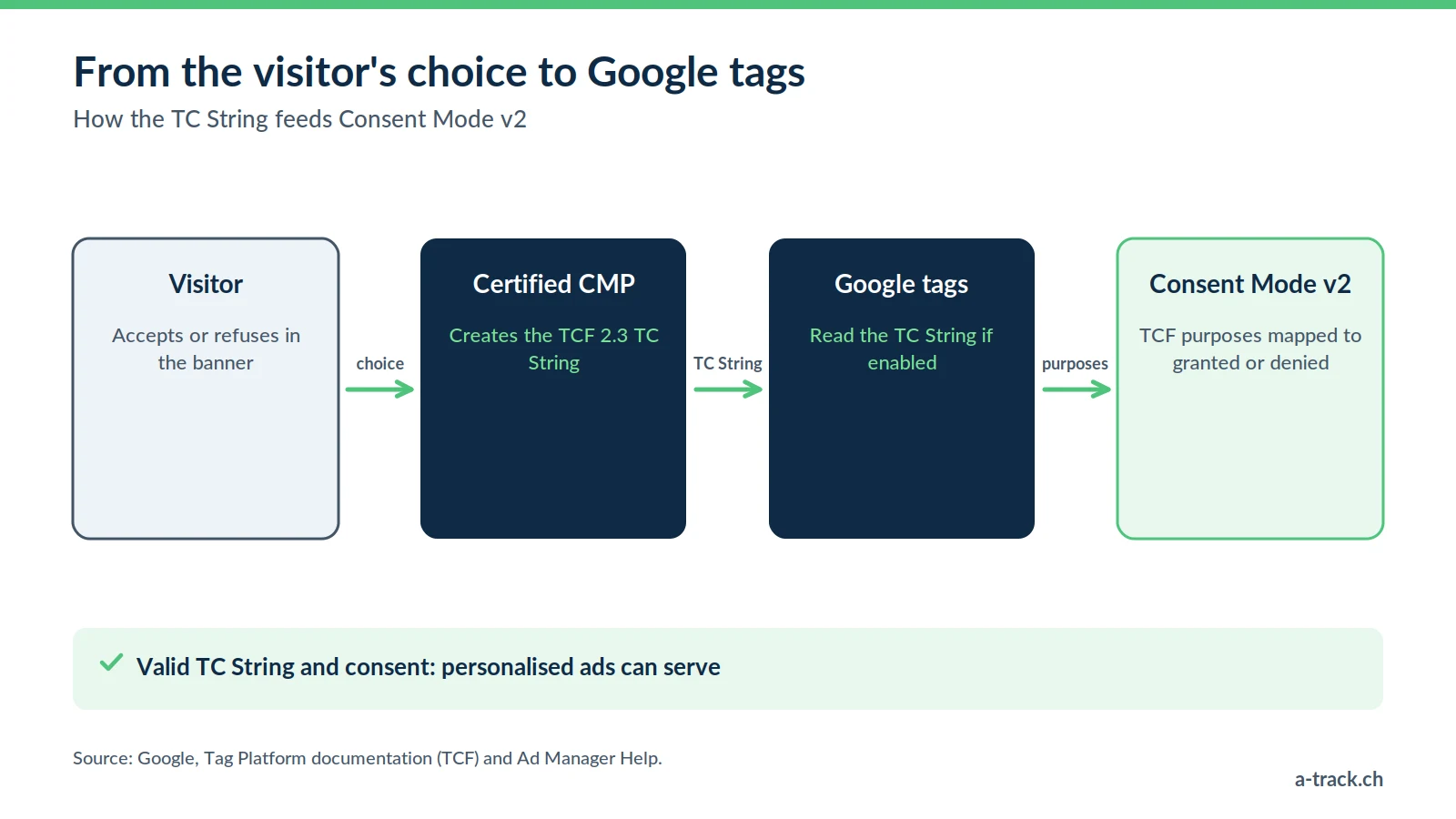
They do not duplicate each other. The TCF standardises the signal for the whole ad ecosystem; Consent Mode drives how Google tags behave. According to Google's documentation, Google tags can read the TC String and map TCF purposes to Consent Mode parameters (refusing Purpose 1, for example, sets ad_storage and ad_user_data to denied). This is not automatic: it must be enabled by the CMP or on the site.
For Google Analytics cookies, Google recommends using Consent Mode. On the publisher side, an invalid TC String only allows limited ads: that is where TCF 2.3 can be costly.
A-Track tip
In Google Tag Manager preview, check that the consent state changes after the visitor's choice, then look for the gcs and gcd parameters in the Network tab. More in our Consent Mode v2 guide.
The indirect effects on SEO and AEO
The TCF is not a ranking factor. But how you implement it affects the performance and accessibility of your content.
A sensible vendor list
IAB's Global Vendor List counts more than 1,000 active vendors (GVL, September 2026). Enabling them all weighs down the banner, its readability and the TC String. And Core Web Vitals are among the signals Google uses. Only declare the vendors you actually use: transparency towards visitors requires it too.
Content readable without JavaScript
According to a Vercel study (December 2024), the main AI crawlers (GPTBot, OAI-SearchBot, ClaudeBot) do not execute JavaScript. A banner injected with JavaScript does not get in their way, provided your content is in the HTML served by the server. The real risk: a server-side cookie wall or content that only loads after consent.
Trust, without shortcuts
A clear, up-to-date privacy policy builds trust with visitors and engines alike. However, FAQPage markup is no silver bullet: since August 2023, Google has limited FAQ rich results to authoritative government and health websites (Google Search Central).
Conclusion: four checks to run
Check your CMP (Cookiebot, Didomi, Usercentrics, Axeptio...): TCF 2.3 enabled and, if you monetise with Google, certified CMP status.
Clean up the vendor list to keep only your real partners.
Audit Google Tag Manager: no analytics or advertising tag should trigger before the visitor's choice.
Align your FADP and GDPR notices with the partners you keep. To choose or switch CMP, see our article FADP vs GDPR for web agencies.
Does your CMP generate valid TCF 2.3 TC Strings?
A-Track checks your CMP: the disclosedVendors segment, the vendor list, how Google tags read the string, and Consent Mode v2 signals before and after the choice.
Get a free tracking and compliance audit, delivered within 48 hours.