

Table of content
Picture a salesperson you give a travel budget to every month. At month's end, they tell you: "I sold things, but I'm not sure what or how much: I lost my notes from some of my meetings." Would you keep funding their trips without asking questions? Yet that is what many companies do with Google Ads and Meta Ads when their tracking leaks.
In short
Signal loss is the gap between your real sales and what your ad platforms see.
Three main causes: browser restrictions (Safari ITP), ad blockers, consent refusals.
The cost goes beyond reports: bidding algorithms learn from a truncated reality.
First-party server-side measurement makes collection more resilient while respecting the visitor's choice.
Signal loss: the gap you don't see
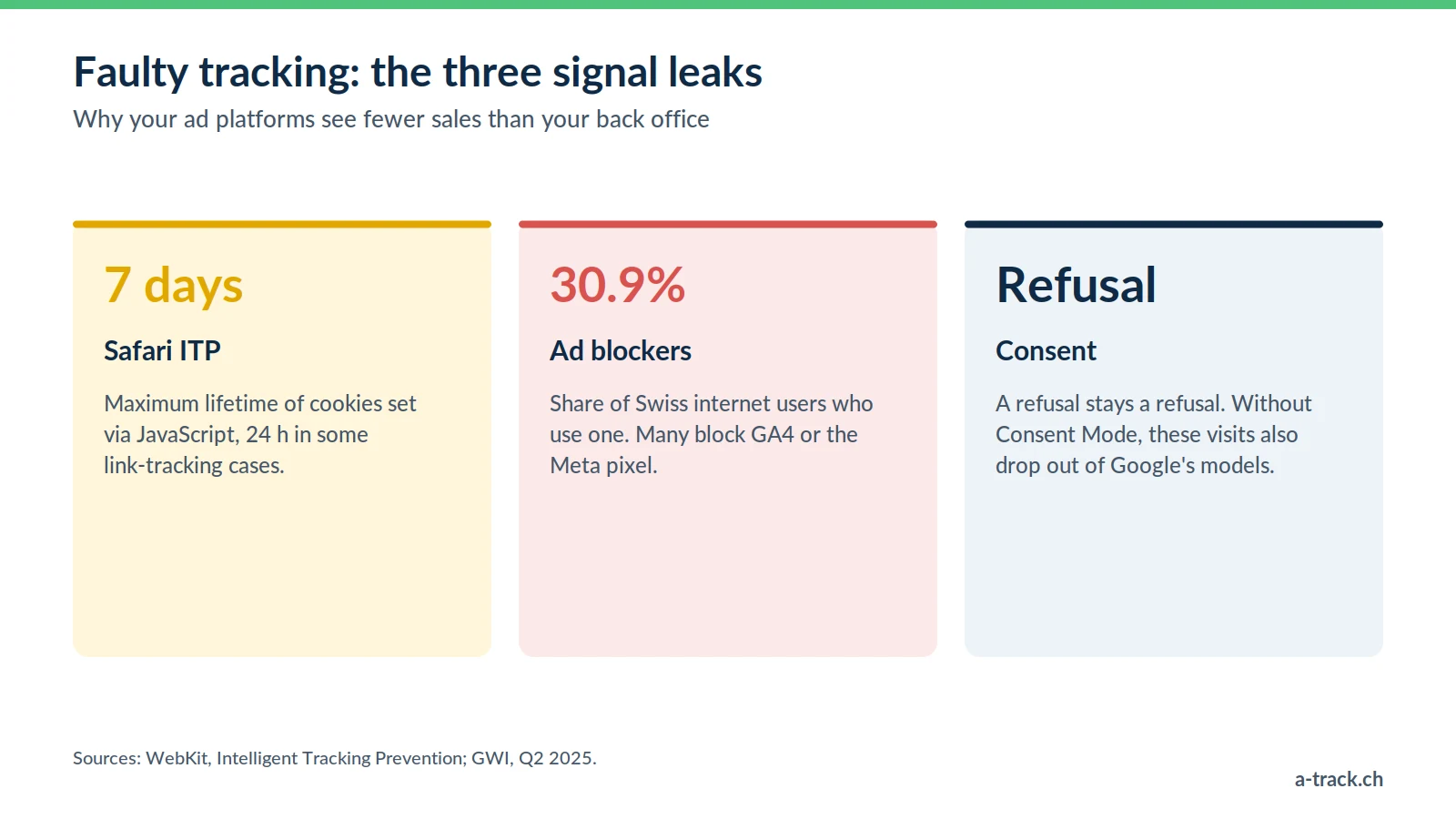
Signal loss is the gap between the reality of your sales, as recorded in your back office or CRM, and what your ad platforms record. Three mechanisms widen it:
Safari and iOS: with ITP (Intelligent Tracking Prevention), cookies set via JavaScript are capped at 7 days, or even 24 hours in some link-tracking cases. A customer who comes back to buy after a week of thinking may no longer be tied to the ad. Since iOS 14.5 (April 2021), App Tracking Transparency also limits tracking inside apps.
Ad blockers: according to GWI (Q2 2025), 30.9% of Swiss internet users use one. Many stop Google Analytics or the Meta pixel from loading.
Consent (FADP and GDPR): a visitor who refuses cookies must stay untracked. Without Consent Mode, these visits vanish entirely from Google's models.
Note that, contrary to what was announced for years, third-party cookies are not leaving Chrome: Google dropped the plan in April 2025. The problem does not come from there but from the three mechanisms above, which hit your tags directly.
The double penalty: underfed algorithms
Losing data in a report is annoying. Starving ad algorithms of data is far worse. Google Smart Bidding and Meta Advantage+ learn from the conversions you send them in order to find your best customers.
The vicious circle of faulty tracking:
Some conversions are never reported.
The algorithm "believes" your campaigns perform worse than they really do.
It shows your ads less to the profiles that convert, for lack of a positive signal.
Your reported cost per acquisition rises artificially.
You cut a budget out of caution, even though the campaign may well have been profitable.
Result: you lose more than visibility on the past, you lose future sales volume.
Estimate your own loss in five steps
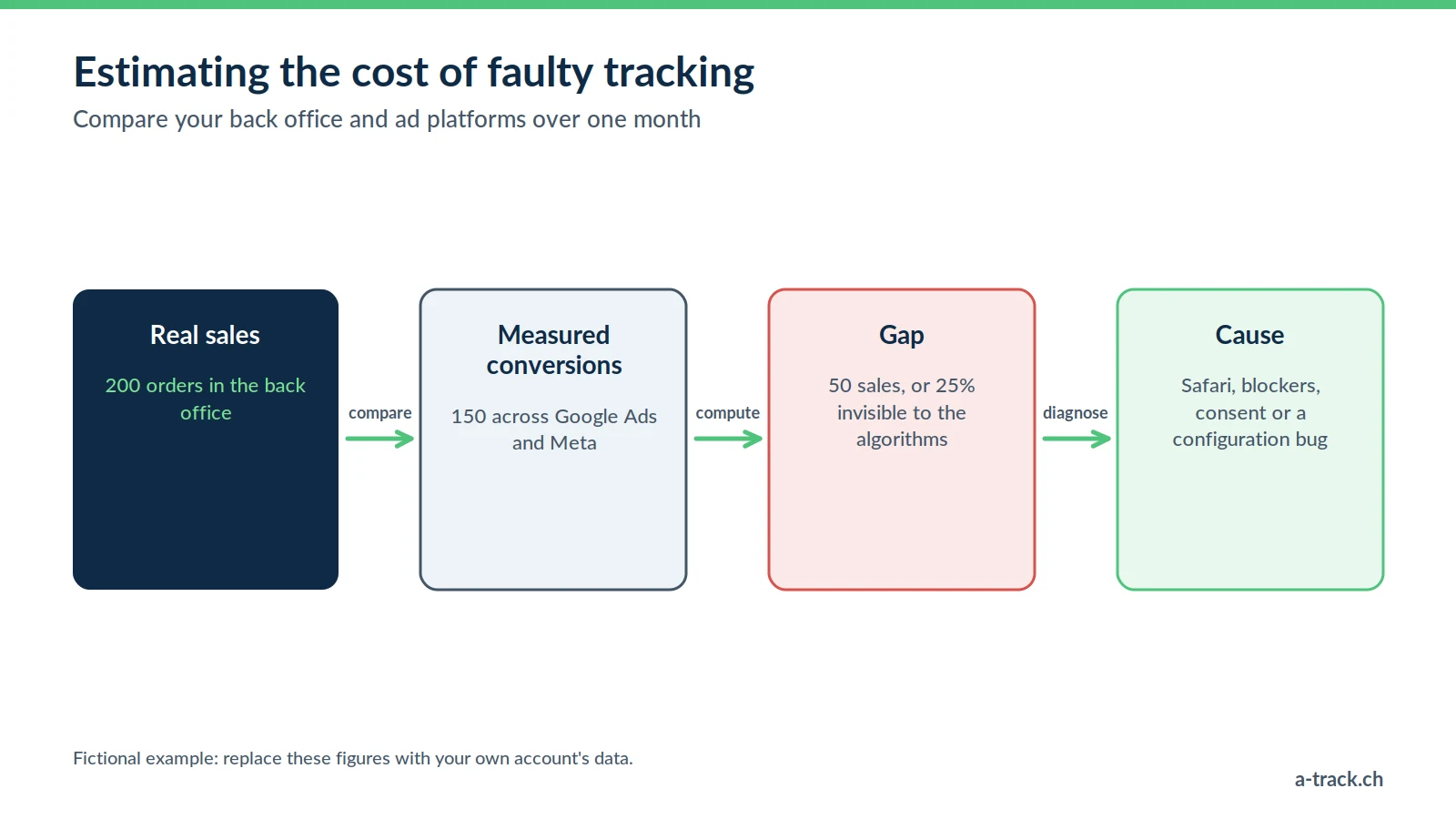
Be wary of "average" percentages: the extent of signal loss depends on your audience (share of iPhones, EU visitors, tech-savvy users), your banner and your setup. The only figure that matters is yours, and it is simple to calculate.
Export your real sales for one month from your back office (Shopify, Magento) or CRM.
Export the conversions recorded over the same period in GA4, Google Ads and Meta.
Calculate the gap: real sales minus measured conversions, divided by real sales.
Put a value on it: apply the gap to your digital revenue to see what share the algorithms miss.
Find the cause: browser, blockers, consent, or a plain configuration bug.
Fictional example: 200 orders in Shopify, 150 attributed across Google Ads and Meta. A quarter of sales escapes the algorithms. If that quarter comes mostly from Safari, the priority is not the same as if it comes from a broken thank-you page.
A-Track tip
Before investing in new infrastructure, run an audit checklist: many gaps come from simple configuration errors that cost nothing to fix. Our 15-point tracking audit checklist gives you the method.
Server-side: more resilient first-party measurement
If measurement relies entirely on JavaScript running in the browser, it suffers every restriction described above. Server-side tracking moves part of the work to a server you control.
Instead of the browser talking directly to Google or Meta, it sends events to your own subdomain (for example metrics.yoursite.ch), which then forwards them, notably through Meta's CAPI.
Resilient: first-party collection on your own domain is less exposed to technical restrictions, and cookies set by your server in principle avoid the 7-day cap on JavaScript cookies (Safari does cap some server cookies depending on hosting, so configuration matters).
Controlled: you filter and minimise data before forwarding it, which makes FADP compliance easier.
Respectful: a refusal stays a refusal. Server-side is not a way around consent or blockers; it makes authorised measurement more reliable.
For visitors who refuse, Consent Mode in advanced mode lets Google model part of the conversions: according to Google (2021), this modelling recovers on average more than 70% of ad-click-to-conversion journeys lost to cookie refusals. To go further, read our server-side vs client-side comparison.
Your questions, our answers
How do I know if my tracking is losing data?
Run the calculation above on the last full month. There is almost always a gap; what matters is its size, how it evolves over time and what causes it.
Is Consent Mode v2 mandatory?
To use Google Ads measurement, personalisation and remarketing, Google requires consent and its transmission through Consent Mode for the European Economic Area, and for Switzerland since 31 July 2024 (Google Ads documentation). This is a contractual requirement from Google, separate from the law. Details in our Consent Mode v2 guide.
Is server-side worth the investment for an SME?
With a regular ad budget, often yes: hosting a measurement server stays modest compared with the amounts invested in campaigns. For a small brochure site without paid advertising, a clean, well-tuned client-side setup may be enough.
Conclusion: measure before you cut
Before cutting a budget or changing agencies, check that your tools really see your sales.
Calculate the gap between your back office and your ad platforms for the last month.
Fix configuration errors first, then tackle the structural causes (browsers, consent).
Consider first-party server-side measurement if your campaigns represent a significant budget. Our marketing performance measurement guide explains the approach.
How many sales are your algorithms missing?
A-Track compares your real sales with measured conversions, finds the cause of the gap (configuration, browsers, consent) and proposes a fix plan.
Request your free tracking and compliance audit, delivered within 48 hours.